
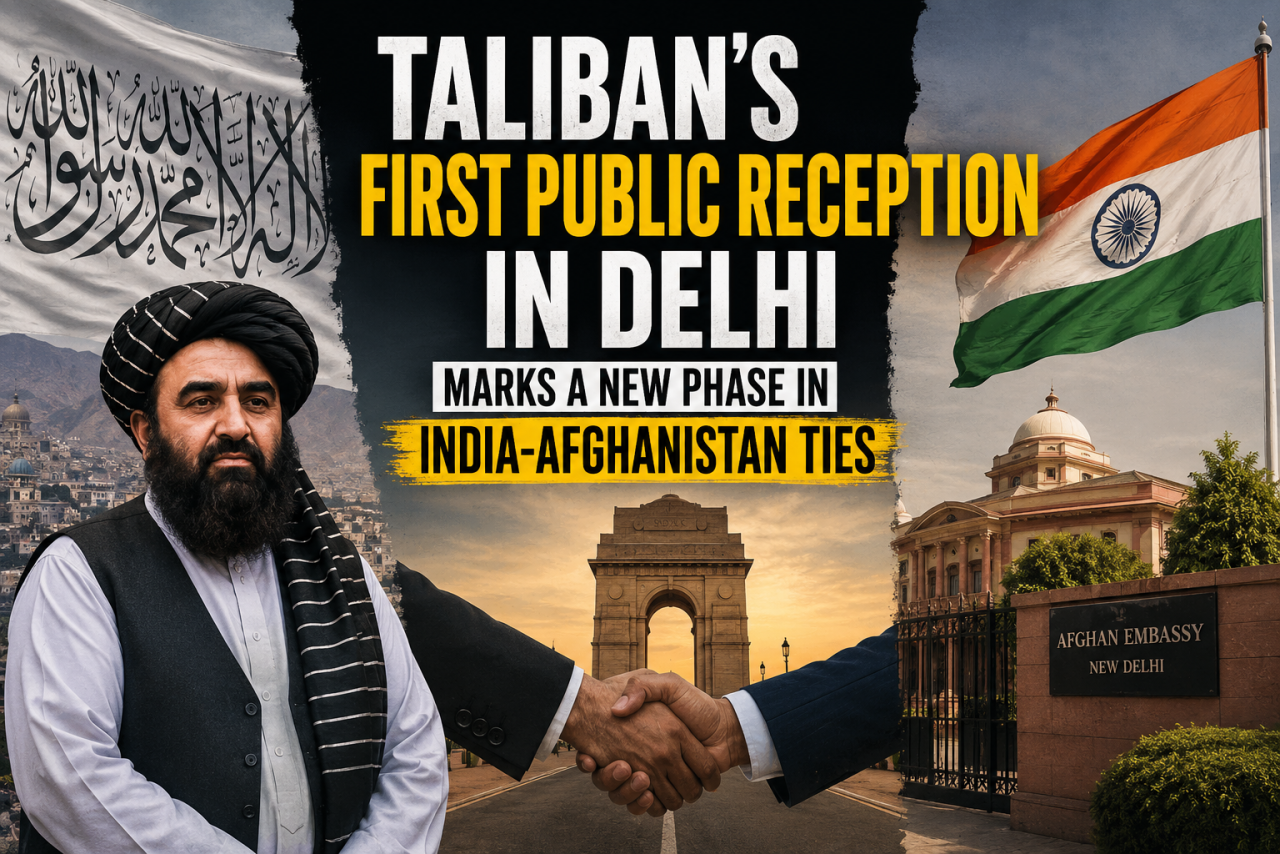
The Taliban is holding its first public reception in Delhi. For India, the event signals something bigger than diplomacy: a cautious embrace of strategic reality without recognising the regime.
The Taliban regime is set to host its first-ever public reception on Indian soil on August 17, marking five years since the group seized control of Kabul. The event, described as a “celebration and reception” for the Taliban’s so-called Victory Day, is being organised by Noor Ahmed Noor, the group’s charge d’affaires at the Afghan embassy in New Delhi.
Diplomats, members of the Afghan diaspora, prominent citizens and journalists are expected to attend. The Indian government is also likely to send a representative, although the exact level of participation remains unclear.
For a country that has never formally recognised the Taliban government, India’s quiet accommodation of the event says much about the current state of bilateral relations. New Delhi appears to be moving from cautious distance towards pragmatic engagement, without crossing the line into formal recognition.
From Estrangement to Engagement
India shut its embassy in Kabul within days of the Taliban takeover in August 2021. The decision reflected New Delhi’s concerns about the Taliban’s historical links with Pakistan, its record on human rights and its treatment of women and minorities.
That cautious approach gradually began to change.
In 2022, India reopened a technical mission in Kabul to facilitate humanitarian assistance. The relationship then entered a more significant phase after Taliban Foreign Minister Amir Khan Muttaqi made a landmark visit to India last October, the first visit by a senior Taliban official since the group returned to power.
The visit changed the tone of India’s engagement with Kabul.
India subsequently allowed the Taliban to post its own diplomats in New Delhi and upgraded its Kabul mission to a full embassy. Since then, three more Taliban ministers responsible for industry, health and agriculture have travelled to India. Two Taliban-appointed officials also now head Afghan consulates in Mumbai and Hyderabad.
The pattern suggests that India is no longer treating the Taliban simply as an unwanted political reality. Instead, New Delhi appears increasingly willing to engage with the authority that controls Afghanistan, while maintaining its reservations about the regime itself.
Why India Is Recalibrating Its Afghanistan Policy
India’s changing approach does not represent sudden approval of Taliban governance. Rather, it reflects a calculation based on strategic interests.
China and Pakistan Factor
China, Russia, Iran and Pakistan have maintained functioning diplomatic missions in Kabul for years. Remaining largely absent from Afghanistan indefinitely could have allowed rival powers to expand their influence without meaningful Indian engagement.
China, in particular, has been developing closer ties with the Taliban while exploring opportunities linked to Afghanistan’s mineral resources, regional connectivity and wider economic potential.
For New Delhi, prolonged diplomatic distance therefore carries its own strategic risks.
Taliban-Pakistan Tensions
Another important factor is the deterioration in Taliban-Pakistan relations.
Border clashes, mutual accusations and disagreements over militant activity have increasingly strained a relationship that was once widely viewed through the lens of Pakistan’s influence over the Taliban.
The growing friction between Kabul and Islamabad has created greater diplomatic space for India.
New Delhi can now pursue a working relationship with the Taliban without necessarily assuming that Kabul will automatically follow Islamabad’s strategic preferences.
Security Concerns
Security remains at the heart of India’s calculations.
During Muttaqi’s visit, Kabul expressed its position on the Pahalgam terror attack and provided assurances that Afghan territory would not be used against Indian interests.
Such assurances carry particular significance for Indian policymakers amid continuing concerns over cross-border militancy and regional security.
For India, engagement with Kabul is therefore not simply about diplomacy. It is also about maintaining channels through which security concerns can be communicated directly.
Preserving India’s Afghan Legacy
India also has substantial long-term interests in Afghanistan.
Over two decades, New Delhi invested significantly in Afghan infrastructure and development projects, including the Afghan Parliament building and hydroelectric projects.
India has also continued humanitarian assistance, scholarships for Afghan students and disaster relief following earthquakes and other crises.
The allocation of ₹150 crore for Afghanistan in India’s 2026-27 budget further reflects New Delhi’s intention to maintain its engagement.
These efforts serve another purpose. They allow India to maintain goodwill among ordinary Afghans independently of its relationship with the Taliban leadership.
That distinction is important.
India can engage with the government that controls Kabul while continuing to maintain a broader relationship with the Afghan people.
A Calculated and Cautious Opening
What makes India’s evolving policy particularly significant is the care with which New Delhi has managed its diplomatic optics.
India has not formally recognised the Taliban government. The Afghan embassy in Delhi continues to display the tricolour of the former Afghan Republic rather than the Taliban’s flag.
That symbolism indicates that engagement should not automatically be interpreted as endorsement of the manner in which the Taliban returned to power.
The language surrounding the August 17 reception also highlights the diplomatic sensitivity involved.
The invitation identifies Noor Ahmed Noor as charge d’affaires of the “Embassy of the Islamic Emirate of Afghanistan”, the terminology used by the Taliban to describe the country’s current political order. India, however, has not officially adopted that formulation in its own diplomatic communications.
How Indian representatives respond to that symbolism at the reception will therefore be closely watched.
The event will be observed not only in Kabul but also in Islamabad, Beijing and other capitals following India’s evolving Afghanistan policy.
Engagement Without Endorsement
The Taliban’s first public reception in Delhi represents more than a diplomatic gathering. It is another indication of how dramatically India’s Afghanistan policy has evolved since August 2021.
Five years after the Taliban returned to power, New Delhi appears to have accepted a basic strategic reality. The Taliban controls Afghanistan, and completely disengaging from Kabul could undermine India’s security, economic and regional interests.
But engagement does not necessarily mean endorsement.
India’s emerging approach appears to rest on a carefully balanced formula: maintain diplomatic channels, protect strategic interests, support the Afghan people and seek security assurances, while stopping short of formally recognising the Taliban regime.
The August 17 reception may therefore be best understood not as a celebration of India-Taliban relations, but as another step in a cautious diplomatic recalibration.
The Taliban regime is set to host its first-ever public reception on Indian soil on August 17, marking five years since the group seized control of Kabul. The event, described as a “celebration and reception” for the Taliban’s so-called Victory Day, is being organised by Noor Ahmed Noor, the group’s charge d’affaires at the Afghan embassy in New Delhi.
Diplomats, members of the Afghan diaspora, prominent citizens and journalists are expected to attend. The Indian government is also likely to send a representative, although the exact level of participation remains unclear.
For a country that has never formally recognised the Taliban government, India’s quiet accommodation of the event says much about the current state of bilateral relations. New Delhi appears to be moving from cautious distance towards pragmatic engagement, without crossing the line into formal recognition.
From Estrangement to Engagement
India shut its embassy in Kabul within days of the Taliban takeover in August 2021. The decision reflected New Delhi’s concerns about the Taliban’s historical links with Pakistan, its record on human rights and its treatment of women and minorities.
That cautious approach gradually began to change.
In 2022, India reopened a technical mission in Kabul to facilitate humanitarian assistance. The relationship then entered a more significant phase after Taliban Foreign Minister Amir Khan Muttaqi made a landmark visit to India last October, the first visit by a senior Taliban official since the group returned to power.
The visit changed the tone of India’s engagement with Kabul.
India subsequently allowed the Taliban to post its own diplomats in New Delhi and upgraded its Kabul mission to a full embassy. Since then, three more Taliban ministers responsible for industry, health and agriculture have travelled to India. Two Taliban-appointed officials also now head Afghan consulates in Mumbai and Hyderabad.
The pattern suggests that India is no longer treating the Taliban simply as an unwanted political reality. Instead, New Delhi appears increasingly willing to engage with the authority that controls Afghanistan, while maintaining its reservations about the regime itself.
Why India Is Recalibrating Its Afghanistan Policy
India’s changing approach does not represent sudden approval of Taliban governance. Rather, it reflects a calculation based on strategic interests.
China and Pakistan Factor
China, Russia, Iran and Pakistan have maintained functioning diplomatic missions in Kabul for years. Remaining largely absent from Afghanistan indefinitely could have allowed rival powers to expand their influence without meaningful Indian engagement.
China, in particular, has been developing closer ties with the Taliban while exploring opportunities linked to Afghanistan’s mineral resources, regional connectivity and wider economic potential.
For New Delhi, prolonged diplomatic distance therefore carries its own strategic risks.
Taliban-Pakistan Tensions
Another important factor is the deterioration in Taliban-Pakistan relations.
Border clashes, mutual accusations and disagreements over militant activity have increasingly strained a relationship that was once widely viewed through the lens of Pakistan’s influence over the Taliban.
The growing friction between Kabul and Islamabad has created greater diplomatic space for India.
New Delhi can now pursue a working relationship with the Taliban without necessarily assuming that Kabul will automatically follow Islamabad’s strategic preferences.
Security Concerns
Security remains at the heart of India’s calculations.
During Muttaqi’s visit, Kabul expressed its position on the Pahalgam terror attack and provided assurances that Afghan territory would not be used against Indian interests.
Such assurances carry particular significance for Indian policymakers amid continuing concerns over cross-border militancy and regional security.
For India, engagement with Kabul is therefore not simply about diplomacy. It is also about maintaining channels through which security concerns can be communicated directly.
Preserving India’s Afghan Legacy
India also has substantial long-term interests in Afghanistan.
Over two decades, New Delhi invested significantly in Afghan infrastructure and development projects, including the Afghan Parliament building and hydroelectric projects.
India has also continued humanitarian assistance, scholarships for Afghan students and disaster relief following earthquakes and other crises.
The allocation of ₹150 crore for Afghanistan in India’s 2026-27 budget further reflects New Delhi’s intention to maintain its engagement.
These efforts serve another purpose. They allow India to maintain goodwill among ordinary Afghans independently of its relationship with the Taliban leadership.
That distinction is important.
India can engage with the government that controls Kabul while continuing to maintain a broader relationship with the Afghan people.
A Calculated and Cautious Opening
What makes India’s evolving policy particularly significant is the care with which New Delhi has managed its diplomatic optics.
India has not formally recognised the Taliban government. The Afghan embassy in Delhi continues to display the tricolour of the former Afghan Republic rather than the Taliban’s flag.
That symbolism indicates that engagement should not automatically be interpreted as endorsement of the manner in which the Taliban returned to power.
The language surrounding the August 17 reception also highlights the diplomatic sensitivity involved.
The invitation identifies Noor Ahmed Noor as charge d’affaires of the “Embassy of the Islamic Emirate of Afghanistan”, the terminology used by the Taliban to describe the country’s current political order. India, however, has not officially adopted that formulation in its own diplomatic communications.
How Indian representatives respond to that symbolism at the reception will therefore be closely watched.
The event will be observed not only in Kabul but also in Islamabad, Beijing and other capitals following India’s evolving Afghanistan policy.
Engagement Without Endorsement
The Taliban’s first public reception in Delhi represents more than a diplomatic gathering. It is another indication of how dramatically India’s Afghanistan policy has evolved since August 2021.
Five years after the Taliban returned to power, New Delhi appears to have accepted a basic strategic reality. The Taliban controls Afghanistan, and completely disengaging from Kabul could undermine India’s security, economic and regional interests.
But engagement does not necessarily mean endorsement.
India’s emerging approach appears to rest on a carefully balanced formula: maintain diplomatic channels, protect strategic interests, support the Afghan people and seek security assurances, while stopping short of formally recognising the Taliban regime.
The August 17 reception may therefore be best understood not as a celebration of India-Taliban relations, but as another step in a cautious diplomatic recalibration.



















Leave a Comment