
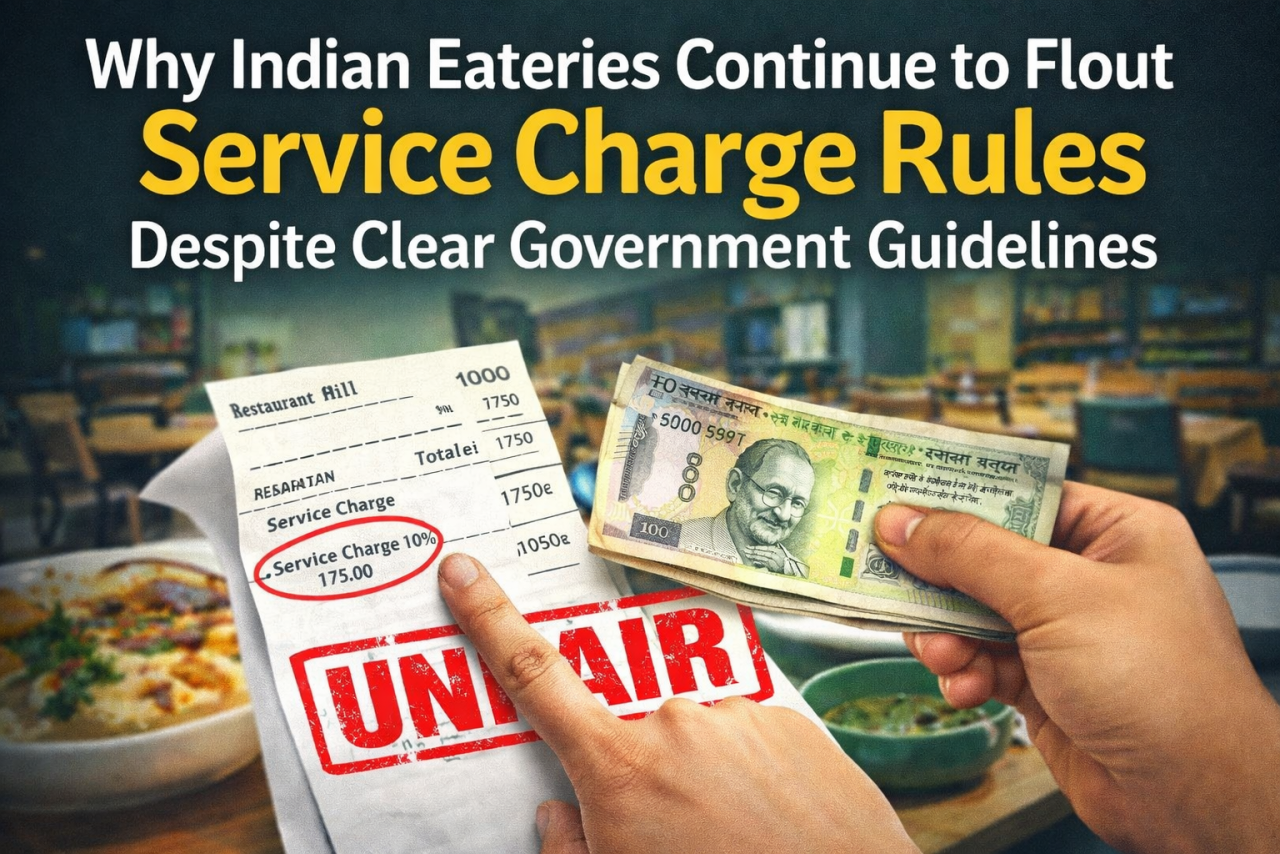
Despite clear government rules and repeated warnings, many eateries in India continue to flout regulations by charging customers a mandatory service charge. This practice has become widespread across restaurants, cafés, bars, and even fine-dining establishments, leaving consumers confused and often pressured into paying extra money they are not legally required to pay. The issue is serious because it directly affects consumer rights and highlights how weak enforcement allows unfair practices to continue.
In India, the government has clearly stated that a service charge is not mandatory. According to guidelines issued by the Department of Consumer Affairs, restaurants cannot force customers to pay a service charge or add it automatically to the bill. A service charge is meant to be voluntary, based on the customer’s satisfaction with the service provided. It cannot replace tips, nor can it be presented as a government tax like GST. Despite this clarity, many eateries continue to add service charges by default, often ranging from 5% to 10% of the bill.
One of the most common ways eateries flout the rules is by printing the service charge directly on the bill without asking for customer consent. In many cases, customers notice the charge only after receiving the bill. When they question it, they are often told that it is the restaurant’s policy or that it is used to pay staff salaries. Some restaurants even display notices saying “service charge applicable” at the entrance or on menus, creating the impression that it is compulsory. This is misleading and against government guidelines.
Another tactic used by eateries is pressuring customers when they object. Many consumers report being embarrassed, argued with, or made to feel guilty for asking the service charge to be removed. Staff sometimes claim that removing the charge will affect their income or that management does not allow it. In social situations or family outings, many customers give in to avoid conflict, even though they know the charge is unfair. This emotional pressure plays a big role in why the practice continues.
The problem is more severe in urban areas and popular food hubs, where customers are often tourists, office-goers, or young people who may not want to argue. High-end restaurants and bars are particularly known for adding service charges, sometimes as high as 10%, while still expecting tips on top of it. This turns dining out into an expensive experience and makes customers feel cheated.
Government bodies like the Central Consumer Protection Authority (CCPA) have taken action in some cases. Several restaurants across cities like Delhi, Mumbai, and Patna have been fined for levying mandatory service charges. In some instances, eateries were asked to refund the collected amount to customers and change their billing systems. These actions show that the government recognizes the seriousness of the issue. However, such cases are still limited compared to the large number of restaurants violating the rules daily.
One major reason eateries continue to flout rules is weak enforcement at the ground level. Inspections are rare, and most action happens only after a consumer files a complaint. Many consumers are unaware of their rights or do not know where and how to complain. Even when they know, the process is seen as time-consuming for a small amount of money. This lack of accountability allows restaurants to continue the practice with little fear of consequences.
Another reason is the lack of strict penalties. While some fines have been imposed, they are often not high enough to act as a strong deterrent. For large restaurant chains or popular establishments, paying a fine is easier than changing their billing practices. Until penalties become stricter and more consistent, violations are likely to continue.
This issue goes beyond money. It reflects a larger problem of ignoring consumer rights and normalizing unfair practices. When customers accept such charges quietly, it encourages more violations. On the other hand, when consumers question, refuse, and complain, it creates pressure for change.
To address this problem, stronger enforcement is needed along with regular inspections. Awareness campaigns should inform consumers that service charges are optional, not compulsory. Restaurants must be clearly told that adding such charges by default is illegal. At the same time, consumers should be encouraged to speak up without fear or embarrassment.
Finally, dining out should be a pleasant experience, not one where customers feel forced to pay extra. Respecting consumer rights is not optional, and eateries must be held accountable if they continue to flout the rules.

























Leave a Comment