
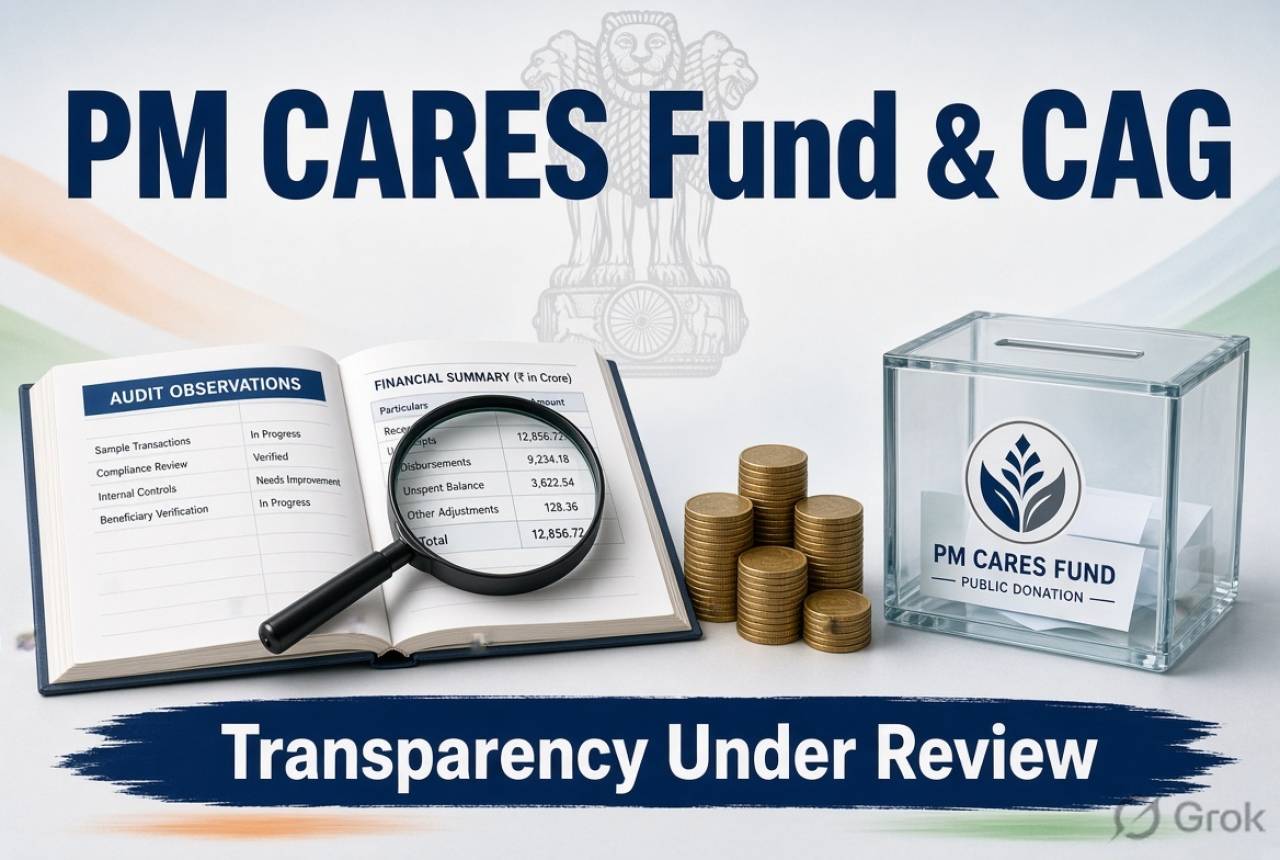
PM CARES has a corpus of thousands of crores but no CAG audit. Here is what the Supreme Court ruled and why transparency remains a contentious issue.
The Comptroller and Auditor General of India has never audited the accounts of the PM CARES Fund. The position is not the result of the CAG simply choosing not to examine the fund. In August 2020, the Supreme Court held that there was no occasion for a CAG audit of PM CARES because it is a public charitable trust and does not receive budgetary support or government money.
At the same time, the fund has continued to accumulate substantial resources. Its latest published accounts show a corpus of about ₹8,452 crore as of March 31, 2025, while recent expenditure has fallen sharply. This combination has renewed questions about how the fund is audited, how much information is publicly available and what level of independent scrutiny is appropriate for a trust associated with the country's highest political office.
How PM CARES Was Created
The Prime Minister's Citizen Assistance and Relief in Emergency Situations Fund, better known as PM CARES, was established on March 27, 2020, soon after the COVID-19 pandemic began spreading across India.
It was constituted as a public charitable trust. The Prime Minister is its ex-officio Chairperson, while the Union Ministers of Defence, Home Affairs and Finance are ex-officio trustees. The official PM CARES website states that the fund consists entirely of voluntary contributions and receives no budgetary support.
Contributions to the fund are eligible for tax benefits under Section 80G of the Income Tax Act and can qualify as corporate social responsibility expenditure under the Companies Act. The fund has also received exemption under the Foreign Contribution Regulation Act, allowing it to receive contributions from abroad.
The Supreme Court's 2020 judgment also recorded these features while considering the legal distinction between PM CARES and statutory disaster-relief funds.
Why Has the CAG Not Audited It?
The central issue is the legal status of the fund.
The CAG's constitutional mandate primarily covers government accounts and certain bodies and entities that fall within the statutory framework governing public expenditure and government financing. PM CARES, by contrast, is structured as a charitable trust funded through voluntary contributions rather than allocations from the Consolidated Fund of India.
The Supreme Court addressed the issue in Centre for Public Interest Litigation v. Union of India in August 2020. The case involved a plea seeking, among other things, the transfer of PM CARES money to the National Disaster Response Fund.
The Court rejected that plea and distinguished PM CARES from the NDRF, observing that the two are separate funds with different objectives. It noted that the statutory framework governing the NDRF provides for CAG audit, while there was no occasion for such an audit of a public charitable trust such as PM CARES.
The distinction is therefore important. The absence of a CAG audit does not mean that PM CARES has never been audited. Its accounts are audited by private chartered accountants, and audited receipts-and-payments statements have been made available through the fund's official website.
What About RTI and Parliamentary Scrutiny?
Another part of the transparency debate concerns the Right to Information Act.
The government's position has been that PM CARES is not a "public authority" under the RTI Act and therefore is not subject to the same disclosure requirements as government departments and statutory public bodies.
This has generated continuing controversy because the fund is closely associated with the Union government. Its Chairperson is the Prime Minister and several Union ministers serve as trustees. The fund also benefits from tax exemptions, CSR eligibility and a special FCRA exemption.
Supporters of the existing structure argue that these features do not convert a privately funded charitable trust into a government fund. Critics counter that the fund's public purpose and association with senior constitutional and political officeholders justify a higher degree of independent scrutiny.
The CAG Has Examined PM CARES-Linked Equipment
There is another distinction that is important.
While the CAG has not audited the accounts of PM CARES itself, CAG reports have examined the implementation and utilisation of assets supplied through programmes involving PM CARES funding.
For example, a CAG performance audit of public health infrastructure in West Bengal examined COVID-era oxygen-generation plants and other medical equipment. The audit found that a number of Pressure Swing Adsorption oxygen plants were not functional or had not been commissioned.
Such findings, however, should not be described as a CAG audit of PM CARES. They concern the utilisation of equipment at the state level rather than the financial accounts, internal management or procurement records of the PM CARES Fund itself.
That distinction matters because a performance audit of government health infrastructure is fundamentally different from a financial audit of the trust that provided or helped finance particular equipment.
A Large Corpus and Very Little Recent Spending
The latest financial data have added another dimension to the debate.
According to the recently released audited accounts for 2024-25, the PM CARES corpus stood at approximately ₹8,452 crore as of March 31, 2025, compared with roughly ₹7,189 crore at the end of the previous financial year. The latest figures were reported publicly in August 2026.
A large proportion of the corpus is held in fixed deposits, generating substantial interest income.
At the same time, expenditure during 2024-25 was extremely small compared with the size of the corpus. About ₹87.85 lakh was spent during the year, with most of it associated with the PM CARES for Children scheme.
The contrast is striking. A fund originally created during a national emergency continues to hold thousands of crores, while its recent annual expenditure represents only a tiny fraction of its available resources.
That does not, by itself, establish that the money is being mismanaged. A charitable emergency fund can legitimately retain resources for future emergencies. But it does raise a reasonable public question: what level of disclosure and independent oversight should apply when such a large corpus remains under the control of a trust headed by the Prime Minister?
Donations, Interest and the Changing Financial Picture
The fund's financial structure has also changed since the extraordinary donation flows of the COVID years.
During the pandemic, PM CARES received large contributions from individuals, companies and organisations. Spending was correspondingly higher on medical equipment, oxygen-generation facilities, ventilators, migrant assistance and other COVID-related interventions.
In more recent years, fresh donations have declined while interest earned from the fund's deposits has become increasingly significant.
The latest accounts show domestic donations of roughly ₹479 crore during 2024-25, while interest income was around ₹475 crore. The result is that the corpus can continue to grow even when fresh contributions are substantially lower than during the pandemic.
The accounts also contain entries relating to refunds from implementing agencies. One recent refund was around ₹324 crore. Such entries are reflected in the financial statements, although critics have argued that the publicly available accounts do not always provide enough granular information to understand every transaction or implementing agency.
Supporters and Critics See the Structure Differently
The debate over PM CARES is ultimately about more than whether a particular audit is legally required.
Supporters of the current arrangement point to the Supreme Court's ruling and the fund's legal structure. They argue that PM CARES is a voluntary charitable trust, not a government department or statutory disaster fund. It does not draw money from the Consolidated Fund of India, and its accounts are independently audited.
They also argue that the trust structure gives the fund greater flexibility to respond quickly during emergencies.
Critics take a different view. They point to the Prime Minister's role as Chairperson, the participation of senior Union ministers, the use of government-associated branding and communication channels, CSR eligibility, tax benefits and the large scale of contributions.
From this perspective, the question is not simply whether the CAG must audit PM CARES under the existing legal framework. It is whether a fund performing such an important public function should voluntarily submit itself to a stronger form of independent scrutiny.
What the Supreme Court Actually Decided
The Supreme Court's 2020 ruling is sometimes presented as if the Court had declared that PM CARES could never be audited by the CAG.
That is broader than what the judgment established.
The Court was dealing with the legal issues before it and held that there was no occasion for a CAG audit on the basis that PM CARES was a public charitable trust that did not receive budgetary support or government money.
The judgment therefore explains why the CAG has not audited the fund under its normal mandate. It does not resolve every broader question about transparency, disclosure or whether additional scrutiny would be desirable.
The Larger Question of Accountability
The PM CARES debate sits at an unusual intersection of government, philanthropy and public purpose.
Legally, the fund has been treated as a charitable trust rather than a government fund. Financially, it is supported by voluntary contributions and earns significant income from its investments. Institutionally, however, it is headed by the Prime Minister and involves several senior Union ministers.
That combination inevitably creates public expectations that go beyond the minimum legal requirements.
The central question is therefore not simply "Why has the CAG not audited PM CARES?" The Supreme Court has already provided the legal explanation.
The more enduring question is whether the existing model of private audit and periodic publication of receipts and payments provides enough transparency for a fund of this size and public significance.
As the PM CARES corpus remains substantial years after the peak of the COVID emergency, that debate is unlikely to disappear. The legal framework may explain the absence of a CAG audit. It does not, by itself, end the public conversation about accountability.
The Comptroller and Auditor General of India has never audited the accounts of the PM CARES Fund. The position is not the result of the CAG simply choosing not to examine the fund. In August 2020, the Supreme Court held that there was no occasion for a CAG audit of PM CARES because it is a public charitable trust and does not receive budgetary support or government money.
At the same time, the fund has continued to accumulate substantial resources. Its latest published accounts show a corpus of about ₹8,452 crore as of March 31, 2025, while recent expenditure has fallen sharply. This combination has renewed questions about how the fund is audited, how much information is publicly available and what level of independent scrutiny is appropriate for a trust associated with the country's highest political office.
How PM CARES Was Created
The Prime Minister's Citizen Assistance and Relief in Emergency Situations Fund, better known as PM CARES, was established on March 27, 2020, soon after the COVID-19 pandemic began spreading across India.
It was constituted as a public charitable trust. The Prime Minister is its ex-officio Chairperson, while the Union Ministers of Defence, Home Affairs and Finance are ex-officio trustees. The official PM CARES website states that the fund consists entirely of voluntary contributions and receives no budgetary support.
Contributions to the fund are eligible for tax benefits under Section 80G of the Income Tax Act and can qualify as corporate social responsibility expenditure under the Companies Act. The fund has also received exemption under the Foreign Contribution Regulation Act, allowing it to receive contributions from abroad.
The Supreme Court's 2020 judgment also recorded these features while considering the legal distinction between PM CARES and statutory disaster-relief funds.
Why Has the CAG Not Audited It?
The central issue is the legal status of the fund.
The CAG's constitutional mandate primarily covers government accounts and certain bodies and entities that fall within the statutory framework governing public expenditure and government financing. PM CARES, by contrast, is structured as a charitable trust funded through voluntary contributions rather than allocations from the Consolidated Fund of India.
The Supreme Court addressed the issue in Centre for Public Interest Litigation v. Union of India in August 2020. The case involved a plea seeking, among other things, the transfer of PM CARES money to the National Disaster Response Fund.
The Court rejected that plea and distinguished PM CARES from the NDRF, observing that the two are separate funds with different objectives. It noted that the statutory framework governing the NDRF provides for CAG audit, while there was no occasion for such an audit of a public charitable trust such as PM CARES.
The distinction is therefore important. The absence of a CAG audit does not mean that PM CARES has never been audited. Its accounts are audited by private chartered accountants, and audited receipts-and-payments statements have been made available through the fund's official website.
What About RTI and Parliamentary Scrutiny?
Another part of the transparency debate concerns the Right to Information Act.
The government's position has been that PM CARES is not a "public authority" under the RTI Act and therefore is not subject to the same disclosure requirements as government departments and statutory public bodies.
This has generated continuing controversy because the fund is closely associated with the Union government. Its Chairperson is the Prime Minister and several Union ministers serve as trustees. The fund also benefits from tax exemptions, CSR eligibility and a special FCRA exemption.
Supporters of the existing structure argue that these features do not convert a privately funded charitable trust into a government fund. Critics counter that the fund's public purpose and association with senior constitutional and political officeholders justify a higher degree of independent scrutiny.
The CAG Has Examined PM CARES-Linked Equipment
There is another distinction that is important.
While the CAG has not audited the accounts of PM CARES itself, CAG reports have examined the implementation and utilisation of assets supplied through programmes involving PM CARES funding.
For example, a CAG performance audit of public health infrastructure in West Bengal examined COVID-era oxygen-generation plants and other medical equipment. The audit found that a number of Pressure Swing Adsorption oxygen plants were not functional or had not been commissioned.
Such findings, however, should not be described as a CAG audit of PM CARES. They concern the utilisation of equipment at the state level rather than the financial accounts, internal management or procurement records of the PM CARES Fund itself.
That distinction matters because a performance audit of government health infrastructure is fundamentally different from a financial audit of the trust that provided or helped finance particular equipment.
A Large Corpus and Very Little Recent Spending
The latest financial data have added another dimension to the debate.
According to the recently released audited accounts for 2024-25, the PM CARES corpus stood at approximately ₹8,452 crore as of March 31, 2025, compared with roughly ₹7,189 crore at the end of the previous financial year. The latest figures were reported publicly in August 2026.
A large proportion of the corpus is held in fixed deposits, generating substantial interest income.
At the same time, expenditure during 2024-25 was extremely small compared with the size of the corpus. About ₹87.85 lakh was spent during the year, with most of it associated with the PM CARES for Children scheme.
The contrast is striking. A fund originally created during a national emergency continues to hold thousands of crores, while its recent annual expenditure represents only a tiny fraction of its available resources.
That does not, by itself, establish that the money is being mismanaged. A charitable emergency fund can legitimately retain resources for future emergencies. But it does raise a reasonable public question: what level of disclosure and independent oversight should apply when such a large corpus remains under the control of a trust headed by the Prime Minister?
Donations, Interest and the Changing Financial Picture
The fund's financial structure has also changed since the extraordinary donation flows of the COVID years.
During the pandemic, PM CARES received large contributions from individuals, companies and organisations. Spending was correspondingly higher on medical equipment, oxygen-generation facilities, ventilators, migrant assistance and other COVID-related interventions.
In more recent years, fresh donations have declined while interest earned from the fund's deposits has become increasingly significant.
The latest accounts show domestic donations of roughly ₹479 crore during 2024-25, while interest income was around ₹475 crore. The result is that the corpus can continue to grow even when fresh contributions are substantially lower than during the pandemic.
The accounts also contain entries relating to refunds from implementing agencies. One recent refund was around ₹324 crore. Such entries are reflected in the financial statements, although critics have argued that the publicly available accounts do not always provide enough granular information to understand every transaction or implementing agency.
Supporters and Critics See the Structure Differently
The debate over PM CARES is ultimately about more than whether a particular audit is legally required.
Supporters of the current arrangement point to the Supreme Court's ruling and the fund's legal structure. They argue that PM CARES is a voluntary charitable trust, not a government department or statutory disaster fund. It does not draw money from the Consolidated Fund of India, and its accounts are independently audited.
They also argue that the trust structure gives the fund greater flexibility to respond quickly during emergencies.
Critics take a different view. They point to the Prime Minister's role as Chairperson, the participation of senior Union ministers, the use of government-associated branding and communication channels, CSR eligibility, tax benefits and the large scale of contributions.
From this perspective, the question is not simply whether the CAG must audit PM CARES under the existing legal framework. It is whether a fund performing such an important public function should voluntarily submit itself to a stronger form of independent scrutiny.
What the Supreme Court Actually Decided
The Supreme Court's 2020 ruling is sometimes presented as if the Court had declared that PM CARES could never be audited by the CAG.
That is broader than what the judgment established.
The Court was dealing with the legal issues before it and held that there was no occasion for a CAG audit on the basis that PM CARES was a public charitable trust that did not receive budgetary support or government money.
The judgment therefore explains why the CAG has not audited the fund under its normal mandate. It does not resolve every broader question about transparency, disclosure or whether additional scrutiny would be desirable.
The Larger Question of Accountability
The PM CARES debate sits at an unusual intersection of government, philanthropy and public purpose.
Legally, the fund has been treated as a charitable trust rather than a government fund. Financially, it is supported by voluntary contributions and earns significant income from its investments. Institutionally, however, it is headed by the Prime Minister and involves several senior Union ministers.
That combination inevitably creates public expectations that go beyond the minimum legal requirements.
The central question is therefore not simply "Why has the CAG not audited PM CARES?" The Supreme Court has already provided the legal explanation.
The more enduring question is whether the existing model of private audit and periodic publication of receipts and payments provides enough transparency for a fund of this size and public significance.
As the PM CARES corpus remains substantial years after the peak of the COVID emergency, that debate is unlikely to disappear. The legal framework may explain the absence of a CAG audit. It does not, by itself, end the public conversation about accountability.























Leave a Comment