
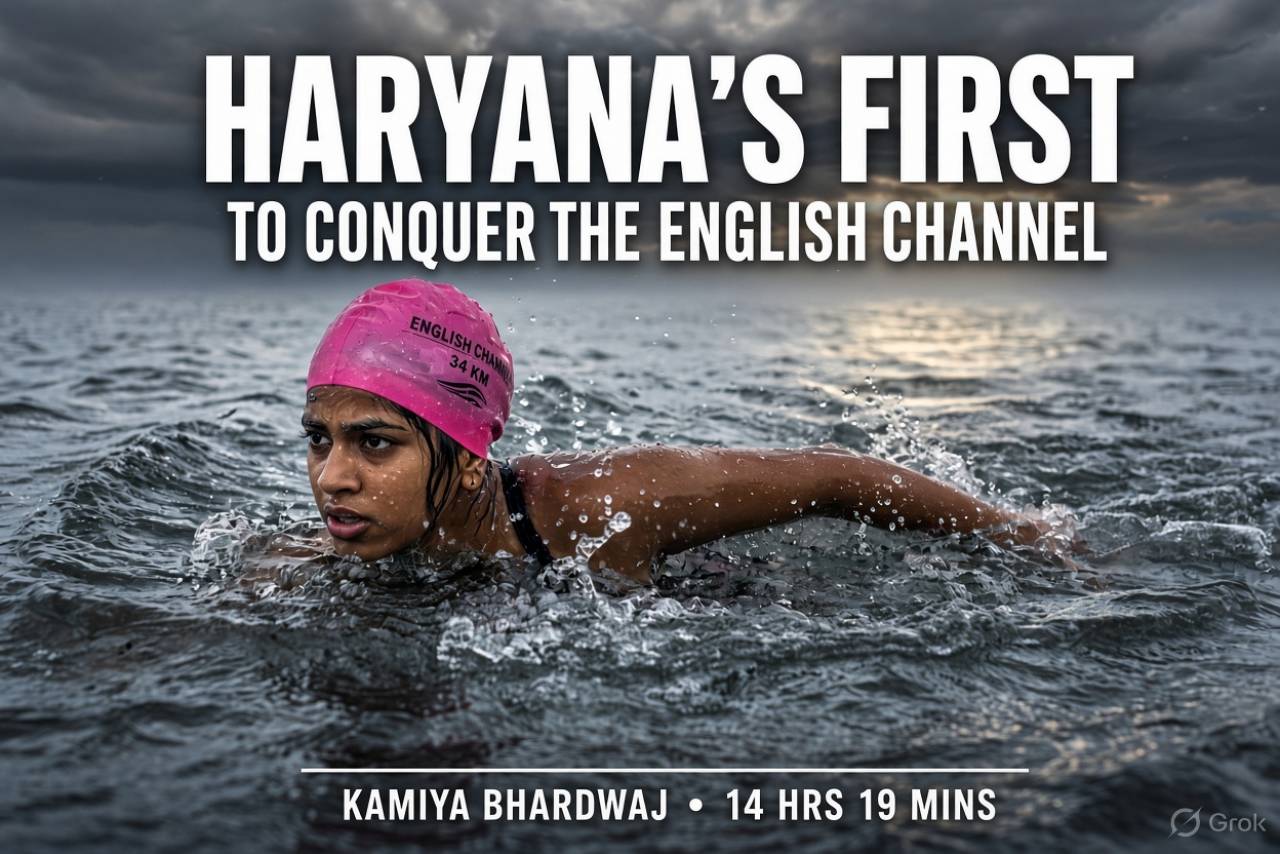
A 20-year-old Delhi University student has become the first person from Haryana to swim across the English Channel, completing the demanding crossing from Dover to France in 14 hours and 19 minutes.
In the early hours off the coast of Dover, the water is never still. Currents shift without warning, temperatures bite, and the horizon offers little comfort.
On one such stretch of the English Channel, 20-year-old Zoology student Kamiya Bhardwaj achieved a first for Haryana. She swam from Dover, England, to Cap Gris-Nez, France, completing the crossing in 14 hours and 19 minutes.
“I’m the first from my state. It feels surreal,” she says simply.
Kamiya is in the final year of her BSc (Hons) in Zoology at Dyal Singh College, University of Delhi. While many of her peers were navigating campus life and planning their careers, she was preparing for one of the world's most demanding open-water swimming challenges.
The English Channel is not simply a long-distance swim. It is a test of endurance against cold water, shifting tides, fatigue and the psychological strain of spending hours in open water.
For someone from landlocked Haryana, where suitable cold-water training facilities are limited, reaching the starting point in Dover was itself a test of determination.
Training Without the Right Conditions
Preparation in Haryana required improvisation.
North Indian summers routinely push temperatures above 30°C, while access to a pool suitable for extended training sessions was limited. Kamiya and her father found their own way around the problem.
They drove to Palwal, where she alternated between long swimming sessions and spending as much as two hours at a time in an ice tub.
The cold exposure was deliberate. Her body had to adapt to the conditions she would face in the Channel, where cold water would remain a constant challenge for hours.
But the training demanded more.
To secure a slot for the Channel attempt, Kamiya needed to demonstrate that she could endure six hours in freezing water. Haryana had no suitable open-water location for the qualifier.
So father and daughter drove nearly 10 hours to Bhimtal in Nainital.
The conditions there were not cold or quiet enough for what they needed. They continued to nearby Satral, where Kamiya eventually completed the cold-water qualifier.
The long journeys became part of the preparation. So did the repeated adjustments, discomfort and uncertainty.
Comfort, in effect, was never part of the plan.
When the Jellyfish Arrived
The actual swim tested every part of that preparation.
Around the 10.5-hour mark, swarms of jellyfish appeared in the water. Some were reportedly larger than her face. Their stings were sharp and relentless.
As the sun began to dip, strong currents and shifting tides threatened to add even more time to the crossing.
From the support boat, her father called out and urged her to sprint.
Kamiya stopped trying to avoid the jellyfish.
She swam straight through them.
At that point, the choice was straightforward. Keep moving or risk losing valuable time as the changing conditions made the crossing even harder.
The English Channel does not reward hesitation. Tides, wind and water temperature can transform a planned swim into an ordeal lasting several additional hours.
Kamiya finished in 14 hours and 19 minutes.
That time reflected not only physical stamina but also her ability to remain composed when conditions became increasingly difficult. She had trained for the cold, the distance and the uncertainty. The jellyfish and late-day currents became the final variables in an already demanding test.
A First for Haryana
Kamiya's achievement carries particular significance because of where her journey began.
Haryana has produced athletes across numerous sporting disciplines, but before Kamiya, no one from the state had completed an English Channel crossing.
The geographical disadvantage was obvious. Haryana does not offer the kind of naturally cold open-water environment needed for Channel preparation.
Instead, Kamiya and her father had to create their own training routine, travel long distances and adapt whenever the conditions were not suitable.
What she lacked in geography, she made up for through preparation.
Her father's role was equally practical. When one location did not work, they drove somewhere else. When regular training conditions were unavailable, they improvised. The journey to the Channel was built around persistence rather than convenience.
The Grit Is in the Details
There is little dramatic flourish in Kamiya's account of the achievement.
She talks about ice tubs, long drives, cold-water qualification, jellyfish stings and being told to sprint.
The grit lies in those details.
Completing the English Channel is rarely about one heroic moment. It is the result of hundreds of smaller decisions made over months.
Choosing an ice tub over comfort.
Driving farther when the first training location proved inadequate.
Continuing through cold water.
And, eventually, refusing to stop when the Channel filled with jellyfish.
Kamiya's story does not romanticise the pain of cold-water exposure or the danger of open-water swimming. Instead, it shows what disciplined preparation can look like when the ideal conditions simply do not exist.
A New Chapter for a Young Swimmer
Kamiya Bhardwaj has now returned to her studies, carrying with her the experience of spending more than 14 hours in one of the world's most challenging stretches of open water.
For a 20-year-old Zoology student, the English Channel is now a completed chapter.
For Haryana, it is a new first.
And perhaps that is what makes her achievement resonate beyond the record itself. The journey did not begin in a famous swimming academy or beside a cold-water coastline. It began with long training sessions, ice tubs, difficult journeys and a determination to keep adapting when the obvious options were not available.
The Channel was the final crossing.
The real preparation had begun much earlier, in the ordinary places where determination is built one uncomfortable session at a time.
In the early hours off the coast of Dover, the water is never still. Currents shift without warning, temperatures bite, and the horizon offers little comfort.
On one such stretch of the English Channel, 20-year-old Zoology student Kamiya Bhardwaj achieved a first for Haryana. She swam from Dover, England, to Cap Gris-Nez, France, completing the crossing in 14 hours and 19 minutes.
“I’m the first from my state. It feels surreal,” she says simply.
Kamiya is in the final year of her BSc (Hons) in Zoology at Dyal Singh College, University of Delhi. While many of her peers were navigating campus life and planning their careers, she was preparing for one of the world's most demanding open-water swimming challenges.
The English Channel is not simply a long-distance swim. It is a test of endurance against cold water, shifting tides, fatigue and the psychological strain of spending hours in open water.
For someone from landlocked Haryana, where suitable cold-water training facilities are limited, reaching the starting point in Dover was itself a test of determination.
Training Without the Right Conditions
Preparation in Haryana required improvisation.
North Indian summers routinely push temperatures above 30°C, while access to a pool suitable for extended training sessions was limited. Kamiya and her father found their own way around the problem.
They drove to Palwal, where she alternated between long swimming sessions and spending as much as two hours at a time in an ice tub.
The cold exposure was deliberate. Her body had to adapt to the conditions she would face in the Channel, where cold water would remain a constant challenge for hours.
But the training demanded more.
To secure a slot for the Channel attempt, Kamiya needed to demonstrate that she could endure six hours in freezing water. Haryana had no suitable open-water location for the qualifier.
So father and daughter drove nearly 10 hours to Bhimtal in Nainital.
The conditions there were not cold or quiet enough for what they needed. They continued to nearby Satral, where Kamiya eventually completed the cold-water qualifier.
The long journeys became part of the preparation. So did the repeated adjustments, discomfort and uncertainty.
Comfort, in effect, was never part of the plan.
When the Jellyfish Arrived
The actual swim tested every part of that preparation.
Around the 10.5-hour mark, swarms of jellyfish appeared in the water. Some were reportedly larger than her face. Their stings were sharp and relentless.
As the sun began to dip, strong currents and shifting tides threatened to add even more time to the crossing.
From the support boat, her father called out and urged her to sprint.
Kamiya stopped trying to avoid the jellyfish.
She swam straight through them.
At that point, the choice was straightforward. Keep moving or risk losing valuable time as the changing conditions made the crossing even harder.
The English Channel does not reward hesitation. Tides, wind and water temperature can transform a planned swim into an ordeal lasting several additional hours.
Kamiya finished in 14 hours and 19 minutes.
That time reflected not only physical stamina but also her ability to remain composed when conditions became increasingly difficult. She had trained for the cold, the distance and the uncertainty. The jellyfish and late-day currents became the final variables in an already demanding test.
A First for Haryana
Kamiya's achievement carries particular significance because of where her journey began.
Haryana has produced athletes across numerous sporting disciplines, but before Kamiya, no one from the state had completed an English Channel crossing.
The geographical disadvantage was obvious. Haryana does not offer the kind of naturally cold open-water environment needed for Channel preparation.
Instead, Kamiya and her father had to create their own training routine, travel long distances and adapt whenever the conditions were not suitable.
What she lacked in geography, she made up for through preparation.
Her father's role was equally practical. When one location did not work, they drove somewhere else. When regular training conditions were unavailable, they improvised. The journey to the Channel was built around persistence rather than convenience.
The Grit Is in the Details
There is little dramatic flourish in Kamiya's account of the achievement.
She talks about ice tubs, long drives, cold-water qualification, jellyfish stings and being told to sprint.
The grit lies in those details.
Completing the English Channel is rarely about one heroic moment. It is the result of hundreds of smaller decisions made over months.
Choosing an ice tub over comfort.
Driving farther when the first training location proved inadequate.
Continuing through cold water.
And, eventually, refusing to stop when the Channel filled with jellyfish.
Kamiya's story does not romanticise the pain of cold-water exposure or the danger of open-water swimming. Instead, it shows what disciplined preparation can look like when the ideal conditions simply do not exist.
A New Chapter for a Young Swimmer
Kamiya Bhardwaj has now returned to her studies, carrying with her the experience of spending more than 14 hours in one of the world's most challenging stretches of open water.
For a 20-year-old Zoology student, the English Channel is now a completed chapter.
For Haryana, it is a new first.
And perhaps that is what makes her achievement resonate beyond the record itself. The journey did not begin in a famous swimming academy or beside a cold-water coastline. It began with long training sessions, ice tubs, difficult journeys and a determination to keep adapting when the obvious options were not available.
The Channel was the final crossing.
The real preparation had begun much earlier, in the ordinary places where determination is built one uncomfortable session at a time.























Leave a Comment