
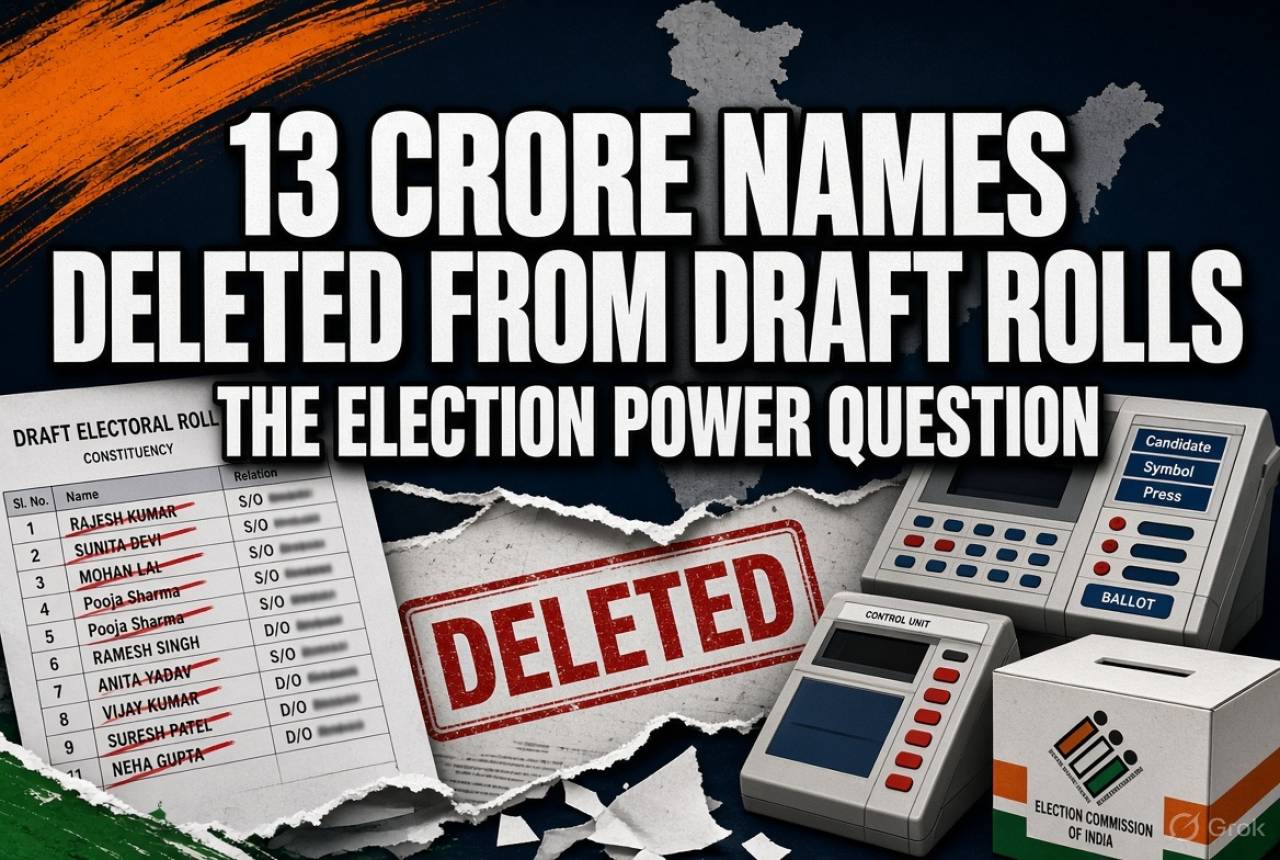
More than 13 crore names were removed from draft electoral rolls. The scale has raised a deeper question about administrative power and the rights of voters.
Adolf Eichmann’s historical significance lies partly in showing how persecution can be implemented through ordinary administrative machinery: records, lists, verification, orders and coordination between government offices. It does not make present-day India comparable to Nazi Germany, nor does it make Gyanesh Kumar equivalent to Eichmann. The comparison is narrower and more uncomfortable. When an electoral system can remove millions of names through an administrative process, the central issue becomes the power of the system itself: who decides who is counted, who is excluded and how easily an ordinary citizen can challenge that decision. It is in this sense of administrative method, rather than ideology or historical scale, that Eichmann’s role provides a disturbing reference point for examining the present debate over India’s electoral rolls.
Eichmann was a senior Nazi official who played a central role in organising the deportation of European Jews. The United States Holocaust Memorial Museum records that he helped coordinate the deportation of more than 1.5 million Jews to ghettos, killing centres and killing sites. His work involved logistics, documentation, coordination between government offices and the implementation of orders issued by the Nazi regime.
The Holocaust was, of course, a genocide carried out by a totalitarian regime. The consequences of Eichmann’s administrative work were persecution, deportation and mass murder. Nothing in the present Indian electoral-roll dispute is comparable in scale, purpose or consequence to the Holocaust. The comparison here concerns something more specific. The power that administrative systems can exercise over individuals when names, records and eligibility are determined through official procedures.
That distinction matters because India’s current controversy involves the most basic element of representative democracy: the electoral roll.
The Election Commission of India has been conducting a Special Intensive Revision, or SIR, of electoral rolls. The exercise began in Bihar in June 2025 and has subsequently been extended to other parts of the country.
By September 2026, more than 13 crore names had been removed from draft electoral rolls across States and Union Territories. The figure refers to names removed from draft rolls, not to 13 crore voters conclusively declared ineligible. The distinction is important because the revision process provides mechanisms through which names can be challenged, restored or newly added.
Still, the scale of the deletions has created a serious public question. An electoral roll is not merely a government database. For an eligible citizen, being on that list is connected directly to the constitutional right to participate in elections.
The larger concern is therefore not simply how many names were deleted. It is how the system reached those decisions, who controlled the underlying technology and how effectively citizens could challenge an incorrect deletion.
When a name becomes a data entry
Modern election administration depends increasingly on digital systems. Voter registration, verification, deletion, restoration and correction involve databases and software that can process information on a scale that would have been impossible for earlier generations of administrators.
Technology can make an electoral system faster and more accurate. It can also make mistakes faster and on a much larger scale.
That is why the controversy surrounding the SIR has increasingly moved beyond the question of individual voter records to questions about institutional control.
An investigation by The Indian Express reported that Election Commissioners Sukhbir Singh Sandhu and Vivek Joshi formally objected at least 14 times over a period of 10 months to decisions and processes connected with the revision exercise. Their objections reportedly covered issues including voter additions and deletions, changes to Form 6, centralisation of voter data and communications issued without their approval.
Those reports have not established that the 13 crore deletions were politically motivated or that all the deleted names belonged to eligible voters. They do, however, raise questions about how decisions affecting electoral rolls were made and how responsibility was distributed within a constitutional body.
The Election Commission has defended the process and said that the decisions concerning SIR were taken by the Commission. It has also announced measures aimed at dealing with voters who may have been left out of the draft rolls. On October 2, the Commission announced a special drive to identify and reinstate voters who were left out of the draft lists.
That corrective step is significant because it acknowledges a basic reality of large administrative exercises: a system can make mistakes even when its stated objective is legitimate.
The software question
The role of technology has become one of the most important parts of the controversy.
Reuters reported on September 26 that the Election Commission ordered a review of its voter-roll software after concerns were raised about changes that could affect voter records. The Commission appointed a committee that included an independent technology expert to examine whether the software complied with election laws and rules.
This raises a question that extends beyond the current SIR.
When an official database determines whether a person's name appears on an electoral roll, who is accountable when the database is wrong?
A voter may not know why a name disappeared. The voter may not know which piece of information caused the deletion. The official responsible for the local electoral roll may not control the software. A correction may require documentation that an ordinary citizen does not readily possess.
The more centralised the system becomes, the greater the importance of transparency.
A citizen should be able to know why a name was removed, who authorised the removal, what evidence was used and what procedure is available for correction.
Why the Eichmann comparison enters the debate
This is the narrow point at which Eichmann becomes relevant to the discussion.
Eichmann's role in Nazi Germany demonstrated the enormous power that can be exercised by bureaucratic machinery when human beings are reduced to administrative categories and official lists. The machinery itself did not create Nazi ideology, but it helped turn policy into an organised system of action. Records, orders, transport arrangements and government coordination became instruments through which persecution could be implemented.
The present Indian situation is fundamentally different.
India remains a constitutional democracy. Its elections are conducted under constitutional and statutory safeguards, citizens can approach courts, and decisions of public institutions can be challenged through legal processes.
The comparison therefore cannot be that Gyanesh Kumar is Eichmann or that India's electoral system is equivalent to the Nazi system.
The narrower comparison is about administrative power.
If a government database can determine whether an individual is included in the electoral roll, then the database is exercising power over a fundamental democratic activity. If that power is concentrated, opaque or difficult to challenge, the institutional safeguards around it become critically important.
The dispute inside the Election Commission
The reported disagreements within the Election Commission make the issue more significant.
According to the Indian Express investigation, Sandhu and Joshi raised objections on multiple occasions concerning the functioning of the Commission and processes connected with voter-list revision. Their objections included concerns about communications being issued without the required approval and about the management and centralisation of voter data.
The Commission has since taken steps to address some of the concerns and has said that its decisions on SIR were taken collectively.
At the same time, the matter has now entered the judicial arena.
The Supreme Court has agreed to hear a petition challenging aspects of CEC Gyanesh Kumar's functioning and the nationwide SIR. The petition raises questions about whether powers vested in the Election Commission under Article 324 can be exercised by the CEC individually rather than through the multi-member Commission. These are allegations and legal arguments that the court has yet to determine.
That distinction is important. A petition is not a judicial finding. The Supreme Court's decision will ultimately determine which of the legal arguments have merit.
Who bears responsibility when the system gets it wrong?
The most important issue may lie beyond the current political arguments.
Suppose an eligible citizen's name disappears from the electoral roll because of an incorrect database entry, a mistaken classification, a technical error or an administrative decision.
Who is responsible?
The voter cannot be expected to understand the architecture of a centralised electoral database. Nor should the burden of proving one's existence become so complicated that an eligible citizen is effectively pushed out of the electoral process.
The responsibility of an election authority is therefore not limited to producing a technically clean database. It also includes ensuring that the process remains accessible, transparent and capable of correcting mistakes.
This becomes particularly important when the numbers involved run into crores.
A mistake affecting one voter is a problem.
A mistake repeated through a centralised system can become an institutional problem.
Administrative power and political power
Election administration is supposed to serve the democratic process, not determine its participants through an opaque exercise of administrative power.
That does not mean every deletion from a voter list is improper. Electoral rolls have to be cleaned. Dead voters, duplicate entries, people who have permanently moved and people who are otherwise ineligible cannot remain indefinitely on the rolls.
The issue is the method.
A legitimate administrative objective does not automatically make every administrative process legitimate.
There must be clear rules, documented reasons, institutional oversight and a meaningful opportunity for citizens to challenge decisions.
The scale of the current SIR makes these safeguards more important, not less.
More than 13 crore names being removed from draft rolls does not prove that 13 crore legitimate voters have been disenfranchised. But it is large enough to demand scrutiny of the system that produced the figure.
That scrutiny should examine the data, the software, the legal authority, the decision-making process, the restoration mechanism and the institutional responsibility for errors.
The citizen must remain visible to the system
The deepest lesson from the Eichmann comparison is not that history is repeating itself. It is that administrative systems are never merely technical when they determine what happens to real people.
A name on a list represents a person.
A deletion from an electoral roll can affect that person's ability to participate in a constitutional process.
That is why the debate over India's electoral rolls should not be reduced to a political fight between the Election Commission and its critics. It should also be treated as a question of institutional design.
Who controls the database?
Who authorises changes?
Who checks the software?
Who verifies the evidence?
Who corrects an error?
And, most importantly, can an ordinary citizen obtain a fair and practical remedy when the system gets it wrong?
Those questions do not require India to be compared with Nazi Germany. They are questions that every constitutional democracy should be willing to ask about its own administrative machinery.
The present controversy therefore deserves scrutiny not because history has literally repeated itself, but because modern democracy increasingly depends on systems in which a citizen's rights can be affected by a record on a screen.
When administrative power becomes capable of deciding who is counted, the safeguards around that power become as important as the power itself.
Adolf Eichmann’s historical significance lies partly in showing how persecution can be implemented through ordinary administrative machinery: records, lists, verification, orders and coordination between government offices. It does not make present-day India comparable to Nazi Germany, nor does it make Gyanesh Kumar equivalent to Eichmann. The comparison is narrower and more uncomfortable. When an electoral system can remove millions of names through an administrative process, the central issue becomes the power of the system itself: who decides who is counted, who is excluded and how easily an ordinary citizen can challenge that decision. It is in this sense of administrative method, rather than ideology or historical scale, that Eichmann’s role provides a disturbing reference point for examining the present debate over India’s electoral rolls.
Eichmann was a senior Nazi official who played a central role in organising the deportation of European Jews. The United States Holocaust Memorial Museum records that he helped coordinate the deportation of more than 1.5 million Jews to ghettos, killing centres and killing sites. His work involved logistics, documentation, coordination between government offices and the implementation of orders issued by the Nazi regime.
The Holocaust was, of course, a genocide carried out by a totalitarian regime. The consequences of Eichmann’s administrative work were persecution, deportation and mass murder. Nothing in the present Indian electoral-roll dispute is comparable in scale, purpose or consequence to the Holocaust. The comparison here concerns something more specific. The power that administrative systems can exercise over individuals when names, records and eligibility are determined through official procedures.
That distinction matters because India’s current controversy involves the most basic element of representative democracy: the electoral roll.
The Election Commission of India has been conducting a Special Intensive Revision, or SIR, of electoral rolls. The exercise began in Bihar in June 2025 and has subsequently been extended to other parts of the country.
By September 2026, more than 13 crore names had been removed from draft electoral rolls across States and Union Territories. The figure refers to names removed from draft rolls, not to 13 crore voters conclusively declared ineligible. The distinction is important because the revision process provides mechanisms through which names can be challenged, restored or newly added.
Still, the scale of the deletions has created a serious public question. An electoral roll is not merely a government database. For an eligible citizen, being on that list is connected directly to the constitutional right to participate in elections.
The larger concern is therefore not simply how many names were deleted. It is how the system reached those decisions, who controlled the underlying technology and how effectively citizens could challenge an incorrect deletion.
When a name becomes a data entry
Modern election administration depends increasingly on digital systems. Voter registration, verification, deletion, restoration and correction involve databases and software that can process information on a scale that would have been impossible for earlier generations of administrators.
Technology can make an electoral system faster and more accurate. It can also make mistakes faster and on a much larger scale.
That is why the controversy surrounding the SIR has increasingly moved beyond the question of individual voter records to questions about institutional control.
An investigation by The Indian Express reported that Election Commissioners Sukhbir Singh Sandhu and Vivek Joshi formally objected at least 14 times over a period of 10 months to decisions and processes connected with the revision exercise. Their objections reportedly covered issues including voter additions and deletions, changes to Form 6, centralisation of voter data and communications issued without their approval.
Those reports have not established that the 13 crore deletions were politically motivated or that all the deleted names belonged to eligible voters. They do, however, raise questions about how decisions affecting electoral rolls were made and how responsibility was distributed within a constitutional body.
The Election Commission has defended the process and said that the decisions concerning SIR were taken by the Commission. It has also announced measures aimed at dealing with voters who may have been left out of the draft rolls. On October 2, the Commission announced a special drive to identify and reinstate voters who were left out of the draft lists.
That corrective step is significant because it acknowledges a basic reality of large administrative exercises: a system can make mistakes even when its stated objective is legitimate.
The software question
The role of technology has become one of the most important parts of the controversy.
Reuters reported on September 26 that the Election Commission ordered a review of its voter-roll software after concerns were raised about changes that could affect voter records. The Commission appointed a committee that included an independent technology expert to examine whether the software complied with election laws and rules.
This raises a question that extends beyond the current SIR.
When an official database determines whether a person's name appears on an electoral roll, who is accountable when the database is wrong?
A voter may not know why a name disappeared. The voter may not know which piece of information caused the deletion. The official responsible for the local electoral roll may not control the software. A correction may require documentation that an ordinary citizen does not readily possess.
The more centralised the system becomes, the greater the importance of transparency.
A citizen should be able to know why a name was removed, who authorised the removal, what evidence was used and what procedure is available for correction.
Why the Eichmann comparison enters the debate
This is the narrow point at which Eichmann becomes relevant to the discussion.
Eichmann's role in Nazi Germany demonstrated the enormous power that can be exercised by bureaucratic machinery when human beings are reduced to administrative categories and official lists. The machinery itself did not create Nazi ideology, but it helped turn policy into an organised system of action. Records, orders, transport arrangements and government coordination became instruments through which persecution could be implemented.
The present Indian situation is fundamentally different.
India remains a constitutional democracy. Its elections are conducted under constitutional and statutory safeguards, citizens can approach courts, and decisions of public institutions can be challenged through legal processes.
The comparison therefore cannot be that Gyanesh Kumar is Eichmann or that India's electoral system is equivalent to the Nazi system.
The narrower comparison is about administrative power.
If a government database can determine whether an individual is included in the electoral roll, then the database is exercising power over a fundamental democratic activity. If that power is concentrated, opaque or difficult to challenge, the institutional safeguards around it become critically important.
The dispute inside the Election Commission
The reported disagreements within the Election Commission make the issue more significant.
According to the Indian Express investigation, Sandhu and Joshi raised objections on multiple occasions concerning the functioning of the Commission and processes connected with voter-list revision. Their objections included concerns about communications being issued without the required approval and about the management and centralisation of voter data.
The Commission has since taken steps to address some of the concerns and has said that its decisions on SIR were taken collectively.
At the same time, the matter has now entered the judicial arena.
The Supreme Court has agreed to hear a petition challenging aspects of CEC Gyanesh Kumar's functioning and the nationwide SIR. The petition raises questions about whether powers vested in the Election Commission under Article 324 can be exercised by the CEC individually rather than through the multi-member Commission. These are allegations and legal arguments that the court has yet to determine.
That distinction is important. A petition is not a judicial finding. The Supreme Court's decision will ultimately determine which of the legal arguments have merit.
Who bears responsibility when the system gets it wrong?
The most important issue may lie beyond the current political arguments.
Suppose an eligible citizen's name disappears from the electoral roll because of an incorrect database entry, a mistaken classification, a technical error or an administrative decision.
Who is responsible?
The voter cannot be expected to understand the architecture of a centralised electoral database. Nor should the burden of proving one's existence become so complicated that an eligible citizen is effectively pushed out of the electoral process.
The responsibility of an election authority is therefore not limited to producing a technically clean database. It also includes ensuring that the process remains accessible, transparent and capable of correcting mistakes.
This becomes particularly important when the numbers involved run into crores.
A mistake affecting one voter is a problem.
A mistake repeated through a centralised system can become an institutional problem.
Administrative power and political power
Election administration is supposed to serve the democratic process, not determine its participants through an opaque exercise of administrative power.
That does not mean every deletion from a voter list is improper. Electoral rolls have to be cleaned. Dead voters, duplicate entries, people who have permanently moved and people who are otherwise ineligible cannot remain indefinitely on the rolls.
The issue is the method.
A legitimate administrative objective does not automatically make every administrative process legitimate.
There must be clear rules, documented reasons, institutional oversight and a meaningful opportunity for citizens to challenge decisions.
The scale of the current SIR makes these safeguards more important, not less.
More than 13 crore names being removed from draft rolls does not prove that 13 crore legitimate voters have been disenfranchised. But it is large enough to demand scrutiny of the system that produced the figure.
That scrutiny should examine the data, the software, the legal authority, the decision-making process, the restoration mechanism and the institutional responsibility for errors.
The citizen must remain visible to the system
The deepest lesson from the Eichmann comparison is not that history is repeating itself. It is that administrative systems are never merely technical when they determine what happens to real people.
A name on a list represents a person.
A deletion from an electoral roll can affect that person's ability to participate in a constitutional process.
That is why the debate over India's electoral rolls should not be reduced to a political fight between the Election Commission and its critics. It should also be treated as a question of institutional design.
Who controls the database?
Who authorises changes?
Who checks the software?
Who verifies the evidence?
Who corrects an error?
And, most importantly, can an ordinary citizen obtain a fair and practical remedy when the system gets it wrong?
Those questions do not require India to be compared with Nazi Germany. They are questions that every constitutional democracy should be willing to ask about its own administrative machinery.
The present controversy therefore deserves scrutiny not because history has literally repeated itself, but because modern democracy increasingly depends on systems in which a citizen's rights can be affected by a record on a screen.
When administrative power becomes capable of deciding who is counted, the safeguards around that power become as important as the power itself.














Leave a Comment