
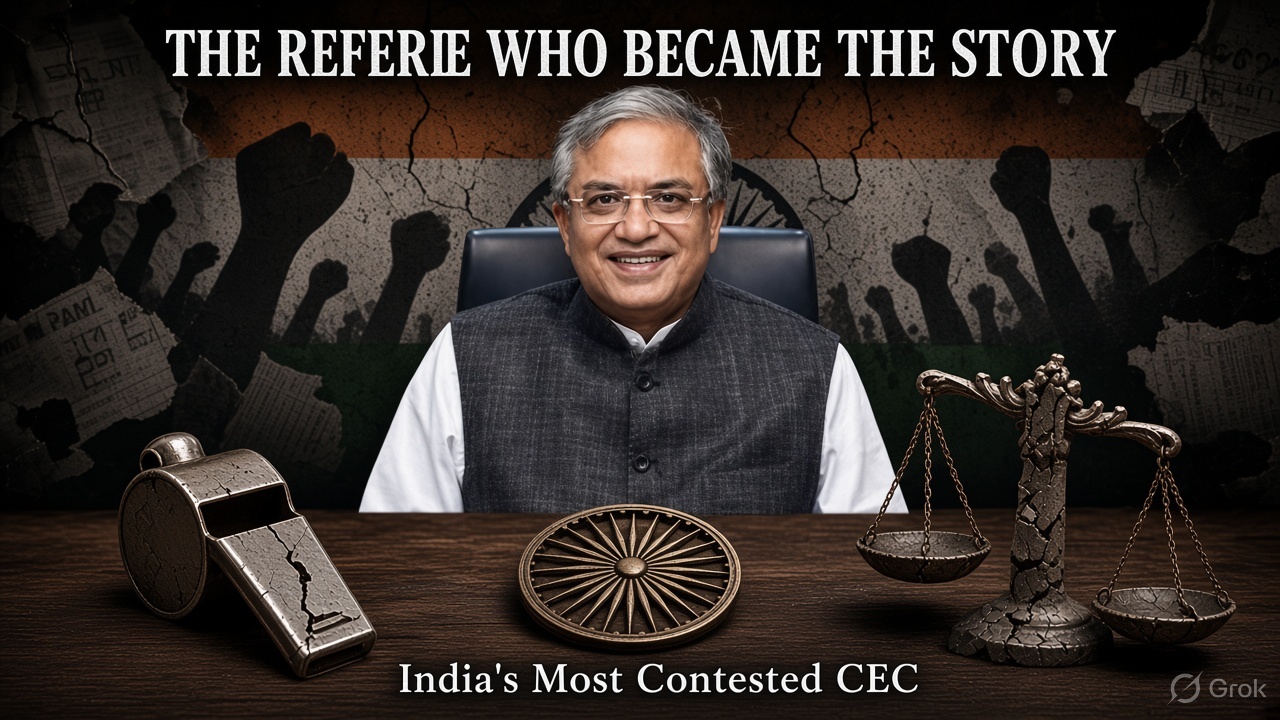
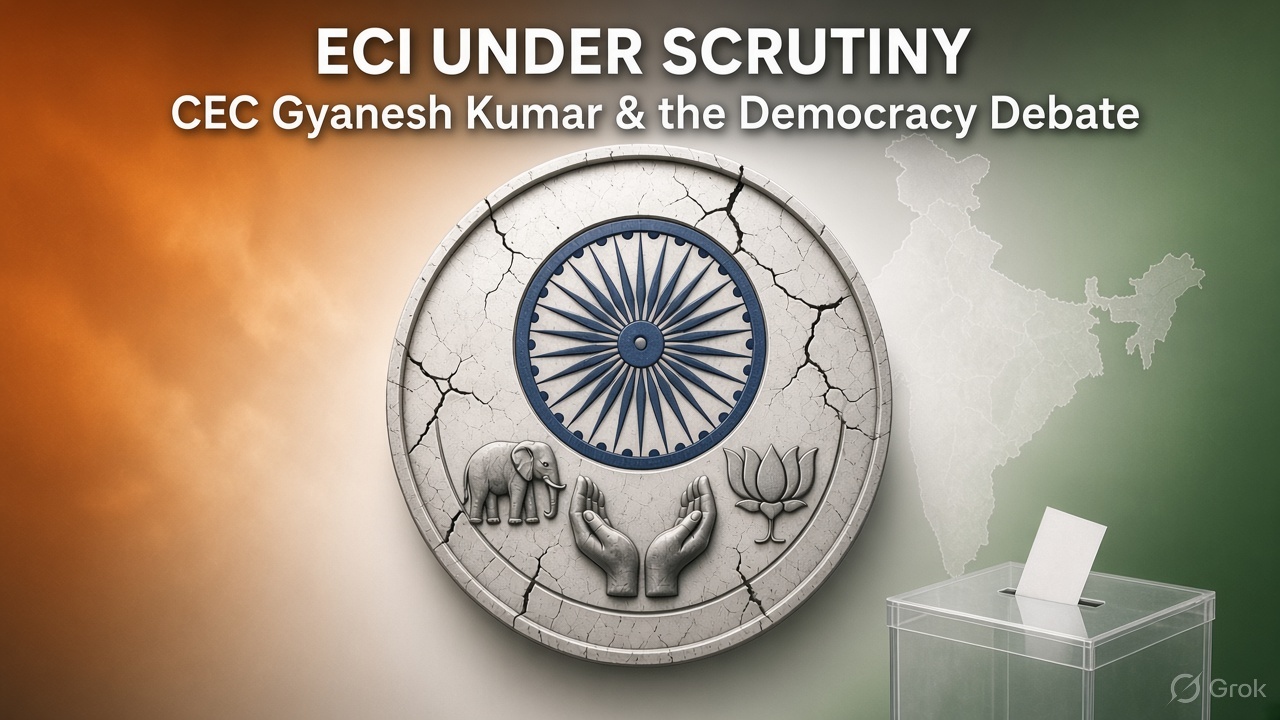
When the election referee itself becomes the centre of political controversy, the bigger question is not about one man but the institution’s credibility.
There was a time when the Chief Election Commissioner of India was a figure of near-invisibility in the public mind. T.N. Seshan became an exception because he insisted on being noticed, using the office’s latent powers with theatrical force. Many of his successors preferred the opposite posture: quiet competence and a careful distance from the political arena.
The office itself was expected to remain above partisan conflict. Its legitimacy depended, in large part, on the willingness of political players to accept the referee as neutral, even when they disagreed with its decisions.
Gyanesh Kumar has changed that equation.
In less than two years as Chief Election Commissioner, Kumar has become not merely a subject of political criticism but a central figure in a wider controversy over the credibility and functioning of the Election Commission of India. Opposition parties have sought action against him, major political leaders have demanded his resignation, protests have been organised against him, and former election officials have publicly raised concerns.
Most significantly, a detailed investigation by The Indian Express reported that the other two members of the three-member Election Commission had recorded objections on at least 14 occasions over a 10-month period concerning decisions taken in the Commission’s name. The reported disagreements included issues related to the Special Intensive Revision of electoral rolls and the manner in which certain decisions were processed.
That changes the character of the controversy.
Criticism from opposition parties can be dismissed by supporters of the government as partisan politics. Internal disagreement within a constitutional institution is harder to reduce to that explanation. According to the report, the two Election Commissioners raised objections over changes to electoral-roll procedures, access to the voter database and orders that they said had been issued without their participation. The Election Commission, however, has rejected the suggestion that such disagreements meant decisions were taken without the approval of all three commissioners, describing the process as part of institutional deliberation.
The distinction matters.
From Bureaucrat to Chief Election Commissioner
Kumar was appointed Election Commissioner in March 2024, shortly before the announcement of the schedule for the 2024 Lok Sabha elections. He subsequently became Chief Election Commissioner under the 2023 law governing appointments to the Election Commission.
That law changed the composition of the selection committee. The Chief Justice of India, who had been part of the earlier arrangement, was replaced by a Union Cabinet Minister. The resulting panel gave the government a majority in the selection process. The Leader of the Opposition recorded his dissent over the appointment.
The appointment therefore began under a cloud of political disagreement.
Kumar's previous administrative career also became part of the debate. During his service in the government, he handled responsibilities in areas connected with some of the Union government's most politically consequential decisions, including matters related to the abrogation of Article 370 and the establishment of the Ram Janmabhoomi Teerth Kshetra Trust.
Those assignments do not, by themselves, establish political bias. But they inevitably became part of the public discussion about whether the person occupying the country's election referee's chair would be perceived as sufficiently independent from the government of the day.
For an election-management body, perception matters because its authority ultimately depends not only on legal powers but also on public confidence.
The SIR Controversy
The Special Intensive Revision of electoral rolls has become the biggest flashpoint.
There is nothing inherently controversial about maintaining accurate electoral rolls. Electoral databases need periodic correction. Dead voters, duplicate entries and people who have moved away are genuine administrative problems.
The controversy concerns the scale and implementation of the exercise, the documentation required from voters, the reported deletions and the political consequences alleged by opposition parties.
The Indian Express investigation reported that the two other Election Commissioners had objected to several aspects of the process, including changes involving Form 6, the handling of appeals, centralisation of database access and orders issued without their participation. According to the report, four objections were recorded on a single day.
The Election Commission has disputed the interpretation that these objections demonstrate that the Commission was functioning without collegial approval.
That disagreement is important. It means the central question is not simply whether differences existed. They clearly did. The more consequential question is what those differences mean about the Commission's decision-making process and whether its institutional safeguards are functioning as intended.
When Political Trust Starts to Disappear
The public response has been intense.
“Vote chori” has become a prominent political slogan. Opposition parties have alleged large-scale deletions and manipulation of electoral rolls. The precise scale and nature of any irregularities remain matters requiring evidence and verification, rather than political assertion alone.
But there is another issue that cannot be measured simply by counting deleted names.
It is trust.
Once citizens begin to believe that an electoral process is being manipulated, every subsequent decision by the Election Commission risks being viewed through the same lens. The enforcement of the Model Code of Conduct, the scheduling of elections, the handling of complaints and decisions concerning electoral rolls can all become politically contested.
Official statements defending the integrity of the process may not be enough to reverse that perception.
Institutional trust is harder to build than to lose.
The Problem of the Referee
Kumar's own public interventions have also attracted attention.
His confrontation with Leader of the Opposition Rahul Gandhi, including the demand that Gandhi either apologise or submit a sworn affidavit concerning allegations related to electoral rolls, placed the CEC directly in a political confrontation.
There is nothing inherently improper about an election commissioner defending the institution against allegations. But the manner in which the office responds matters.
The Election Commission is not simply another government department. It is the constitutional referee of India's electoral process. Its authority comes partly from the law, but also from the expectation that it will operate above partisan conflict.
That makes restraint an institutional asset.
Earlier CECs often cultivated a studied distance from political battles. Kumar's tenure has been markedly more confrontational in the public sphere. Supporters may see that as institutional firmness. Critics see it as evidence that the Commission has become too directly involved in political disputes.
Both interpretations are now part of the public debate.
Is “The Most Hated CEC” a Fair Description?
The phrase has appeared in political rhetoric, but it is ultimately an emotional description rather than a measurable institutional category.
There is substantial evidence of unusually intense criticism directed at Kumar. Opposition parties have pursued formal action against him, prominent political leaders have demanded his resignation, protests have targeted the Election Commission under his leadership, and the reported internal disagreements have added another dimension to the controversy.
But comparing him quantitatively with every previous Chief Election Commissioner would require a reliable historical measure of public opinion that does not presently exist.
The more defensible question is therefore not whether Kumar is literally the “most hated” CEC.
It is why the office has become such a central object of political distrust during his tenure.
The Larger Institutional Question
The controversy ultimately goes beyond one individual.
When the appointment mechanism for the Chief Election Commissioner gives the government a majority on the selection panel, questions about independence become inevitable. When the person selected has previously handled politically sensitive responsibilities for the government, those questions become sharper. When members of the Commission publicly or formally disagree over important electoral decisions, the institution's internal functioning becomes a matter of legitimate public interest.
And when electoral-roll revisions produce allegations of large-scale disenfranchisement, the burden on the Commission to demonstrate transparency becomes even greater.
None of this proves that elections are being manipulated.
Nor does criticism from opposition parties automatically establish wrongdoing.
But constitutional institutions cannot rely only on the technical legality of their actions. They also need public confidence that their procedures are impartial, transparent and institutionally accountable.
That is especially true of the Election Commission.
When the Referee Becomes the Story
The deepest concern, therefore, is not Gyanesh Kumar's personal reputation.
It is what happens when the institution conducting elections becomes part of the political contest surrounding those elections.
India's electoral system ultimately depends on an unwritten democratic bargain. Political parties contest. Candidates lose and win. Governments change. And those who lose accept the result because they believe the process, however imperfect, was sufficiently fair to command legitimacy.
That confidence cannot be taken for granted.
The Election Commission has enormous constitutional authority, but its credibility is ultimately sustained by public trust. Once that trust weakens, every decision becomes easier to question and every electoral result becomes harder to defend in the public mind.
The real danger, then, is not that one Chief Election Commissioner has become controversial.
It is that the referee has become the story.
There was a time when the Chief Election Commissioner of India was a figure of near-invisibility in the public mind. T.N. Seshan became an exception because he insisted on being noticed, using the office’s latent powers with theatrical force. Many of his successors preferred the opposite posture: quiet competence and a careful distance from the political arena.
The office itself was expected to remain above partisan conflict. Its legitimacy depended, in large part, on the willingness of political players to accept the referee as neutral, even when they disagreed with its decisions.
Gyanesh Kumar has changed that equation.
In less than two years as Chief Election Commissioner, Kumar has become not merely a subject of political criticism but a central figure in a wider controversy over the credibility and functioning of the Election Commission of India. Opposition parties have sought action against him, major political leaders have demanded his resignation, protests have been organised against him, and former election officials have publicly raised concerns.
Most significantly, a detailed investigation by The Indian Express reported that the other two members of the three-member Election Commission had recorded objections on at least 14 occasions over a 10-month period concerning decisions taken in the Commission’s name. The reported disagreements included issues related to the Special Intensive Revision of electoral rolls and the manner in which certain decisions were processed.
That changes the character of the controversy.
Criticism from opposition parties can be dismissed by supporters of the government as partisan politics. Internal disagreement within a constitutional institution is harder to reduce to that explanation. According to the report, the two Election Commissioners raised objections over changes to electoral-roll procedures, access to the voter database and orders that they said had been issued without their participation. The Election Commission, however, has rejected the suggestion that such disagreements meant decisions were taken without the approval of all three commissioners, describing the process as part of institutional deliberation.
The distinction matters.
From Bureaucrat to Chief Election Commissioner
Kumar was appointed Election Commissioner in March 2024, shortly before the announcement of the schedule for the 2024 Lok Sabha elections. He subsequently became Chief Election Commissioner under the 2023 law governing appointments to the Election Commission.
That law changed the composition of the selection committee. The Chief Justice of India, who had been part of the earlier arrangement, was replaced by a Union Cabinet Minister. The resulting panel gave the government a majority in the selection process. The Leader of the Opposition recorded his dissent over the appointment.
The appointment therefore began under a cloud of political disagreement.
Kumar's previous administrative career also became part of the debate. During his service in the government, he handled responsibilities in areas connected with some of the Union government's most politically consequential decisions, including matters related to the abrogation of Article 370 and the establishment of the Ram Janmabhoomi Teerth Kshetra Trust.
Those assignments do not, by themselves, establish political bias. But they inevitably became part of the public discussion about whether the person occupying the country's election referee's chair would be perceived as sufficiently independent from the government of the day.
For an election-management body, perception matters because its authority ultimately depends not only on legal powers but also on public confidence.
The SIR Controversy
The Special Intensive Revision of electoral rolls has become the biggest flashpoint.
There is nothing inherently controversial about maintaining accurate electoral rolls. Electoral databases need periodic correction. Dead voters, duplicate entries and people who have moved away are genuine administrative problems.
The controversy concerns the scale and implementation of the exercise, the documentation required from voters, the reported deletions and the political consequences alleged by opposition parties.
The Indian Express investigation reported that the two other Election Commissioners had objected to several aspects of the process, including changes involving Form 6, the handling of appeals, centralisation of database access and orders issued without their participation. According to the report, four objections were recorded on a single day.
The Election Commission has disputed the interpretation that these objections demonstrate that the Commission was functioning without collegial approval.
That disagreement is important. It means the central question is not simply whether differences existed. They clearly did. The more consequential question is what those differences mean about the Commission's decision-making process and whether its institutional safeguards are functioning as intended.
When Political Trust Starts to Disappear
The public response has been intense.
“Vote chori” has become a prominent political slogan. Opposition parties have alleged large-scale deletions and manipulation of electoral rolls. The precise scale and nature of any irregularities remain matters requiring evidence and verification, rather than political assertion alone.
But there is another issue that cannot be measured simply by counting deleted names.
It is trust.
Once citizens begin to believe that an electoral process is being manipulated, every subsequent decision by the Election Commission risks being viewed through the same lens. The enforcement of the Model Code of Conduct, the scheduling of elections, the handling of complaints and decisions concerning electoral rolls can all become politically contested.
Official statements defending the integrity of the process may not be enough to reverse that perception.
Institutional trust is harder to build than to lose.
The Problem of the Referee
Kumar's own public interventions have also attracted attention.
His confrontation with Leader of the Opposition Rahul Gandhi, including the demand that Gandhi either apologise or submit a sworn affidavit concerning allegations related to electoral rolls, placed the CEC directly in a political confrontation.
There is nothing inherently improper about an election commissioner defending the institution against allegations. But the manner in which the office responds matters.
The Election Commission is not simply another government department. It is the constitutional referee of India's electoral process. Its authority comes partly from the law, but also from the expectation that it will operate above partisan conflict.
That makes restraint an institutional asset.
Earlier CECs often cultivated a studied distance from political battles. Kumar's tenure has been markedly more confrontational in the public sphere. Supporters may see that as institutional firmness. Critics see it as evidence that the Commission has become too directly involved in political disputes.
Both interpretations are now part of the public debate.
Is “The Most Hated CEC” a Fair Description?
The phrase has appeared in political rhetoric, but it is ultimately an emotional description rather than a measurable institutional category.
There is substantial evidence of unusually intense criticism directed at Kumar. Opposition parties have pursued formal action against him, prominent political leaders have demanded his resignation, protests have targeted the Election Commission under his leadership, and the reported internal disagreements have added another dimension to the controversy.
But comparing him quantitatively with every previous Chief Election Commissioner would require a reliable historical measure of public opinion that does not presently exist.
The more defensible question is therefore not whether Kumar is literally the “most hated” CEC.
It is why the office has become such a central object of political distrust during his tenure.
The Larger Institutional Question
The controversy ultimately goes beyond one individual.
When the appointment mechanism for the Chief Election Commissioner gives the government a majority on the selection panel, questions about independence become inevitable. When the person selected has previously handled politically sensitive responsibilities for the government, those questions become sharper. When members of the Commission publicly or formally disagree over important electoral decisions, the institution's internal functioning becomes a matter of legitimate public interest.
And when electoral-roll revisions produce allegations of large-scale disenfranchisement, the burden on the Commission to demonstrate transparency becomes even greater.
None of this proves that elections are being manipulated.
Nor does criticism from opposition parties automatically establish wrongdoing.
But constitutional institutions cannot rely only on the technical legality of their actions. They also need public confidence that their procedures are impartial, transparent and institutionally accountable.
That is especially true of the Election Commission.
When the Referee Becomes the Story
The deepest concern, therefore, is not Gyanesh Kumar's personal reputation.
It is what happens when the institution conducting elections becomes part of the political contest surrounding those elections.
India's electoral system ultimately depends on an unwritten democratic bargain. Political parties contest. Candidates lose and win. Governments change. And those who lose accept the result because they believe the process, however imperfect, was sufficiently fair to command legitimacy.
That confidence cannot be taken for granted.
The Election Commission has enormous constitutional authority, but its credibility is ultimately sustained by public trust. Once that trust weakens, every decision becomes easier to question and every electoral result becomes harder to defend in the public mind.
The real danger, then, is not that one Chief Election Commissioner has become controversial.
It is that the referee has become the story.



















Leave a Comment