
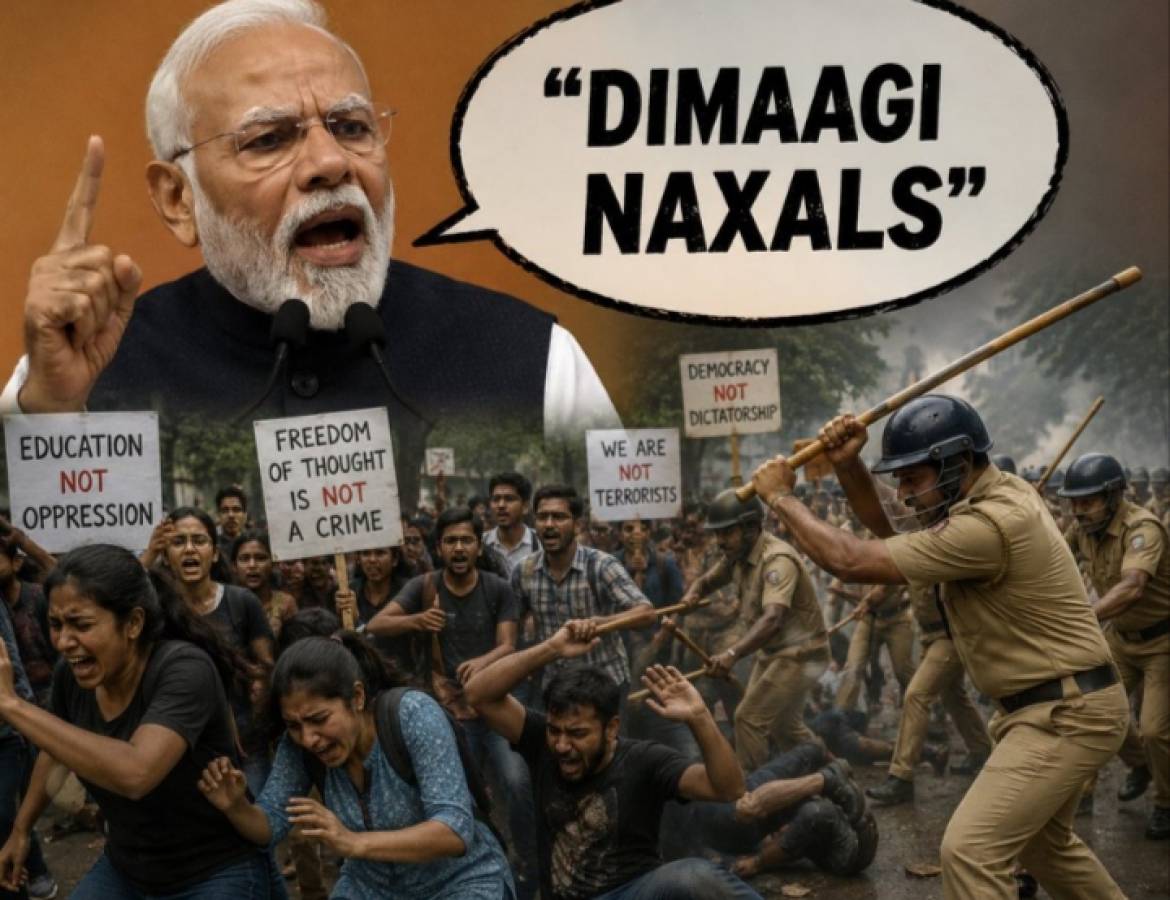
When political language begins to define who belongs within the democratic mainstream, the real question is not the label itself, but how much space remains for dissent.
Prime Minister Narendra Modi’s Independence Day address from the Red Fort on August 15 introduced a phrase that quickly overshadowed several of the policy announcements made that morning: “dimaagi Naxal,” or “intellectual Naxal.”
In his 13th consecutive Independence Day address from the Red Fort, marking India’s 80th year of independence, Modi said armed Naxalism had been almost entirely eliminated from the country. He credited the security forces with ending a four-decade insurgency that claimed the lives of more than 3,500 police and paramilitary personnel.
But alongside that claim, the Prime Minister warned of what he described as a more subtle threat. According to Modi, some people may not take up arms but continue to carry a “Naxal mindset.” He alleged that such individuals had found their way into public institutions and government committees and argued that they needed to be identified and isolated so that India’s youth could remain focused on development.
That formulation immediately created two sharply different interpretations.
The government’s position, later reinforced by Parliamentary Affairs Minister Kiren Rijiju, was that the expression was not directed at the political opposition. Rijiju said the Prime Minister was referring to unnamed forces allegedly seeking to undermine India’s constitutional framework and weaken the country from within. He specifically clarified that Modi had not called opposition leaders “dimaagi Naxals,” attempting to distinguish ideological extremism from legitimate political opposition.
The opposition, however, remained unconvinced.
Congress leader Jairam Ramesh described the phrase as a natural extension of the “urban Naxal” label that gained prominence in political discourse following the 2018 arrests linked to the Elgar Parishad case. He characterised the new terminology as evidence of political desperation.
CPI general secretary D. Raja placed “dimaagi Naxal” alongside earlier political labels such as “anti-national” and “tukde-tukde gang.” His argument was that such terminology creates convenient political enemies while diverting attention from issues that matter directly to young Indians, particularly employment and education.
Trinamool Congress MP Mahua Moitra responded with sarcasm, while Congress leader Sachin Pilot suggested that the remark reflected a government that was “rattled” rather than reassured.
But the significance of “dimaagi Naxal” goes beyond the immediate political controversy.
When Political Language Becomes a Democratic Question
In a democracy, political language matters because words used by those in power can influence how citizens understand one another and how institutions perceive dissent.
The Red Fort is not an ordinary political stage. The Prime Minister’s Independence Day address is one of the country’s most prominent constitutional and political platforms. Consequently, terminology used from that platform carries a significance that goes beyond a conventional political speech.
The central question, therefore, is not simply whether the government is justified in opposing extremist ideology. A democratic state has every right, and indeed a responsibility, to confront armed insurgency and attempts to undermine constitutional institutions.
The more difficult question is where the boundary lies between opposing extremism and categorising dissent as extremism.
The phrase “Naxal” has a specific and deeply charged history in India. It is associated with an armed revolutionary movement, insurgency and violence. Applying the word to an undefined category of intellectuals, critics or people allegedly carrying a particular “mindset” creates considerable ambiguity.
Who qualifies as a “dimaagi Naxal”?
What objective criteria would distinguish such a person from a political dissenter, activist, academic, journalist or government critic?
And who gets to make that determination?
These questions matter because citizens should not have to guess whether challenging a government policy could eventually be interpreted as sympathy for an extremist ideology.
From ‘Urban Naxal’ to ‘Dimaagi Naxal’
The controversy also reflects a broader evolution in India’s political vocabulary.
Terms such as “urban Naxal,” “anti-national” and “tukde-tukde gang” have increasingly entered public debate as labels for individuals or groups perceived to be hostile to the government or the dominant national narrative.
The problem is not that governments should be prohibited from identifying genuine threats. The problem arises when politically charged labels become sufficiently broad that their meaning depends largely on who is using them.
Once a label becomes part of popular political vocabulary, it can travel far beyond the original statement.
A government clarification may say that a term does not refer to opposition leaders. Supporters, commentators and political activists may nevertheless use it more broadly. Over time, a distinction intended by the government can disappear in public discourse.
That is why language matters.
The clarification issued by Rijiju a day after the Prime Minister’s speech was therefore significant. It sought to establish that “dimaagi Naxal” was not a synonym for political opposition. At the same time, the need for such clarification demonstrated how quickly a politically loaded phrase can acquire meanings beyond the speaker’s stated intention.
Democracy Is More Than Elections
India’s democratic strength cannot be measured only by the regularity of elections or the peaceful transfer of political power.
Democracy also exists in the space between elections.
It exists when a student questions a policy, when a journalist investigates a government decision, when an academic challenges an official narrative, when an employee raises concerns about an institution, or when an ordinary citizen asks why a particular decision has been taken.
Disagreement is not necessarily disloyalty. Criticism is not necessarily extremism. Opposition is not necessarily sabotage.
A healthy democracy must retain the capacity to make these distinctions.
That does not mean that every critic is automatically acting in good faith. Nor does it mean that extremist organisations or those seeking to undermine the constitutional order should be shielded from scrutiny. The state has legitimate powers to investigate and prosecute unlawful activity.
But those powers become more credible when the distinction between illegal conduct and unpopular opinion remains clear.
The Real Test Is the Boundary
The government’s argument that armed Naxalism has been decisively weakened is a separate question from its use of the phrase “dimaagi Naxal.”
The first concerns national security and the effectiveness of counter-insurgency operations.
The second concerns the language through which the state describes political and intellectual disagreement.
Conflating the two can create unnecessary democratic anxiety.
India’s Constitution protects freedom of speech and expression while also permitting reasonable restrictions under law. That constitutional framework does not require the government to tolerate violence or unlawful attempts to overthrow the constitutional order. But it does require the country’s democratic institutions to preserve space for disagreement, criticism and debate.
This is particularly important when political terminology moves from official speeches into everyday public discourse.
A democracy becomes weaker not simply when citizens lose the right to vote, but when citizens begin to believe that asking difficult questions could make them suspect in the eyes of the state or society.
The debate over “dimaagi Naxal” should therefore not be reduced to another contest between the government and the opposition.
The larger issue is whether India can maintain a vocabulary in which patriotism and dissent are not treated as mutually exclusive ideas.
The phrase may eventually fade from political headlines, but the question it has raised is unlikely to disappear so easily.
The real measure of India’s democratic space will not be whether the country can eliminate its enemies. It will be whether it can distinguish an enemy from a citizen who simply disagrees.
Prime Minister Narendra Modi’s Independence Day address from the Red Fort on August 15 introduced a phrase that quickly overshadowed several of the policy announcements made that morning: “dimaagi Naxal,” or “intellectual Naxal.”
In his 13th consecutive Independence Day address from the Red Fort, marking India’s 80th year of independence, Modi said armed Naxalism had been almost entirely eliminated from the country. He credited the security forces with ending a four-decade insurgency that claimed the lives of more than 3,500 police and paramilitary personnel.
But alongside that claim, the Prime Minister warned of what he described as a more subtle threat. According to Modi, some people may not take up arms but continue to carry a “Naxal mindset.” He alleged that such individuals had found their way into public institutions and government committees and argued that they needed to be identified and isolated so that India’s youth could remain focused on development.
That formulation immediately created two sharply different interpretations.
The government’s position, later reinforced by Parliamentary Affairs Minister Kiren Rijiju, was that the expression was not directed at the political opposition. Rijiju said the Prime Minister was referring to unnamed forces allegedly seeking to undermine India’s constitutional framework and weaken the country from within. He specifically clarified that Modi had not called opposition leaders “dimaagi Naxals,” attempting to distinguish ideological extremism from legitimate political opposition.
The opposition, however, remained unconvinced.
Congress leader Jairam Ramesh described the phrase as a natural extension of the “urban Naxal” label that gained prominence in political discourse following the 2018 arrests linked to the Elgar Parishad case. He characterised the new terminology as evidence of political desperation.
CPI general secretary D. Raja placed “dimaagi Naxal” alongside earlier political labels such as “anti-national” and “tukde-tukde gang.” His argument was that such terminology creates convenient political enemies while diverting attention from issues that matter directly to young Indians, particularly employment and education.
Trinamool Congress MP Mahua Moitra responded with sarcasm, while Congress leader Sachin Pilot suggested that the remark reflected a government that was “rattled” rather than reassured.
But the significance of “dimaagi Naxal” goes beyond the immediate political controversy.
When Political Language Becomes a Democratic Question
In a democracy, political language matters because words used by those in power can influence how citizens understand one another and how institutions perceive dissent.
The Red Fort is not an ordinary political stage. The Prime Minister’s Independence Day address is one of the country’s most prominent constitutional and political platforms. Consequently, terminology used from that platform carries a significance that goes beyond a conventional political speech.
The central question, therefore, is not simply whether the government is justified in opposing extremist ideology. A democratic state has every right, and indeed a responsibility, to confront armed insurgency and attempts to undermine constitutional institutions.
The more difficult question is where the boundary lies between opposing extremism and categorising dissent as extremism.
The phrase “Naxal” has a specific and deeply charged history in India. It is associated with an armed revolutionary movement, insurgency and violence. Applying the word to an undefined category of intellectuals, critics or people allegedly carrying a particular “mindset” creates considerable ambiguity.
Who qualifies as a “dimaagi Naxal”?
What objective criteria would distinguish such a person from a political dissenter, activist, academic, journalist or government critic?
And who gets to make that determination?
These questions matter because citizens should not have to guess whether challenging a government policy could eventually be interpreted as sympathy for an extremist ideology.
From ‘Urban Naxal’ to ‘Dimaagi Naxal’
The controversy also reflects a broader evolution in India’s political vocabulary.
Terms such as “urban Naxal,” “anti-national” and “tukde-tukde gang” have increasingly entered public debate as labels for individuals or groups perceived to be hostile to the government or the dominant national narrative.
The problem is not that governments should be prohibited from identifying genuine threats. The problem arises when politically charged labels become sufficiently broad that their meaning depends largely on who is using them.
Once a label becomes part of popular political vocabulary, it can travel far beyond the original statement.
A government clarification may say that a term does not refer to opposition leaders. Supporters, commentators and political activists may nevertheless use it more broadly. Over time, a distinction intended by the government can disappear in public discourse.
That is why language matters.
The clarification issued by Rijiju a day after the Prime Minister’s speech was therefore significant. It sought to establish that “dimaagi Naxal” was not a synonym for political opposition. At the same time, the need for such clarification demonstrated how quickly a politically loaded phrase can acquire meanings beyond the speaker’s stated intention.
Democracy Is More Than Elections
India’s democratic strength cannot be measured only by the regularity of elections or the peaceful transfer of political power.
Democracy also exists in the space between elections.
It exists when a student questions a policy, when a journalist investigates a government decision, when an academic challenges an official narrative, when an employee raises concerns about an institution, or when an ordinary citizen asks why a particular decision has been taken.
Disagreement is not necessarily disloyalty. Criticism is not necessarily extremism. Opposition is not necessarily sabotage.
A healthy democracy must retain the capacity to make these distinctions.
That does not mean that every critic is automatically acting in good faith. Nor does it mean that extremist organisations or those seeking to undermine the constitutional order should be shielded from scrutiny. The state has legitimate powers to investigate and prosecute unlawful activity.
But those powers become more credible when the distinction between illegal conduct and unpopular opinion remains clear.
The Real Test Is the Boundary
The government’s argument that armed Naxalism has been decisively weakened is a separate question from its use of the phrase “dimaagi Naxal.”
The first concerns national security and the effectiveness of counter-insurgency operations.
The second concerns the language through which the state describes political and intellectual disagreement.
Conflating the two can create unnecessary democratic anxiety.
India’s Constitution protects freedom of speech and expression while also permitting reasonable restrictions under law. That constitutional framework does not require the government to tolerate violence or unlawful attempts to overthrow the constitutional order. But it does require the country’s democratic institutions to preserve space for disagreement, criticism and debate.
This is particularly important when political terminology moves from official speeches into everyday public discourse.
A democracy becomes weaker not simply when citizens lose the right to vote, but when citizens begin to believe that asking difficult questions could make them suspect in the eyes of the state or society.
The debate over “dimaagi Naxal” should therefore not be reduced to another contest between the government and the opposition.
The larger issue is whether India can maintain a vocabulary in which patriotism and dissent are not treated as mutually exclusive ideas.
The phrase may eventually fade from political headlines, but the question it has raised is unlikely to disappear so easily.
The real measure of India’s democratic space will not be whether the country can eliminate its enemies. It will be whether it can distinguish an enemy from a citizen who simply disagrees.












Leave a Comment