
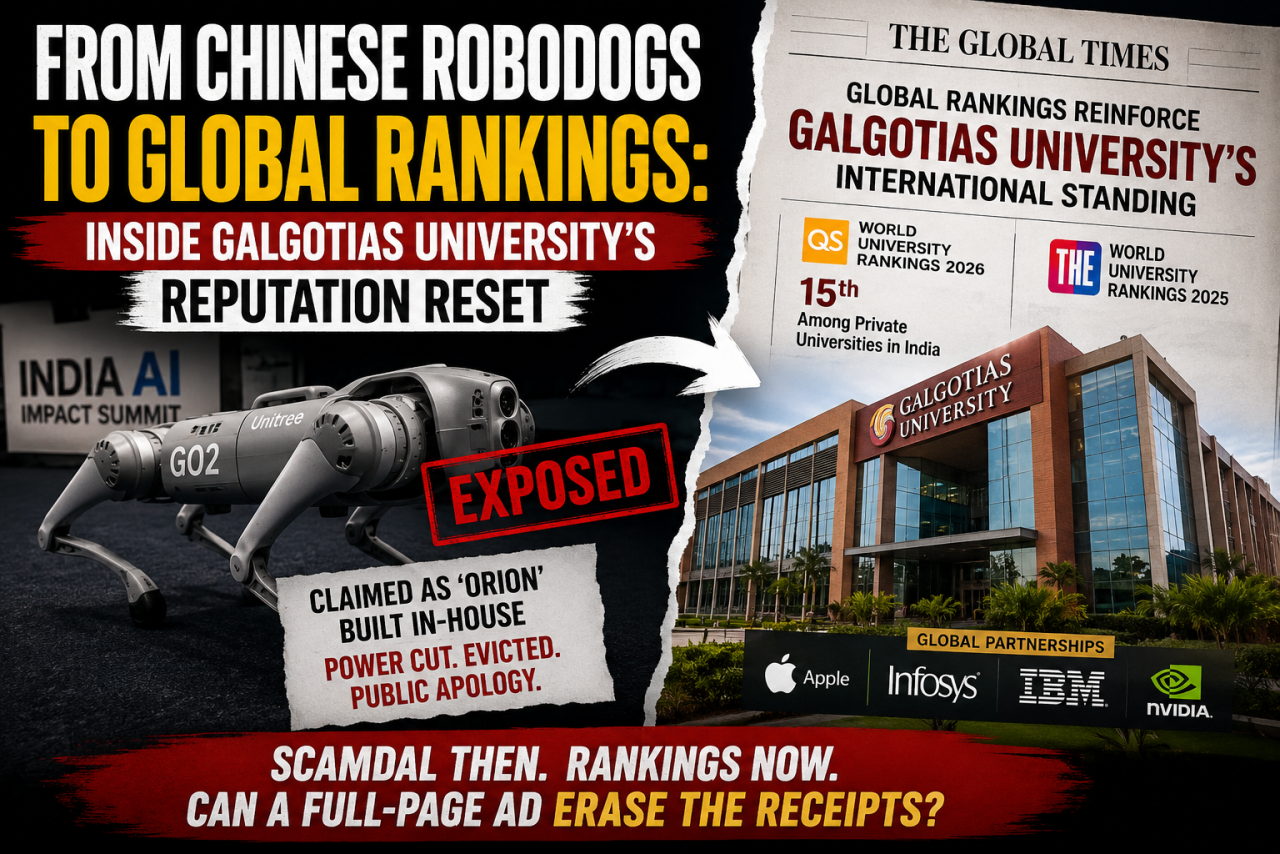
Can a university's global rankings make people forget a major innovation controversy? The story of Galgotias University's reputation reset raises difficult questions about branding, credibility, and public memory.
Public memory fades quickly. The internet, however, rarely forgets.
Open a national newspaper today and you may find a full-page feature celebrating Galgotias University's global achievements. The headline proudly declares, "Global rankings reinforce Galgotias University's international standing." The article highlights the university's 15th position among India's private universities in the QS World University Rankings 2026, its presence in the Times Higher Education (THE) World University Rankings 2025, and its modern AI infrastructure.
For anyone seeing the university for the first time, it appears to be a fast-rising institution at the forefront of technology and innovation.
What the promotional feature does not mention is that only a few months ago, the same university was at the center of a national controversy after presenting a commercially available Chinese robot as an in-house innovation.
The contrast raises a larger question: Can an expensive public relations campaign reshape public memory?
What Happened at the India AI Impact Summit?
The controversy began during the India AI Impact Summit at Bharat Mandapam in New Delhi. The event was meant to showcase India's advances in artificial intelligence and home-grown technology.
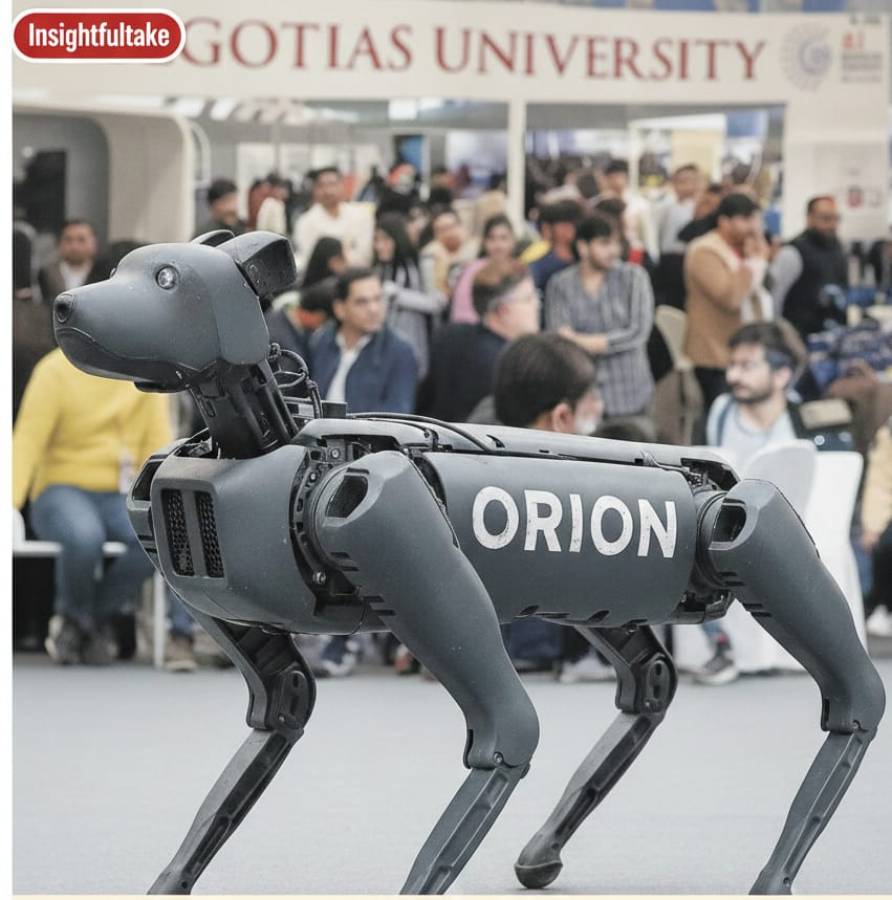
At its exhibition booth, Galgotias University displayed a four-legged robot named "Orion." University representatives told television reporters that the robot had been developed by the university's Centre of Excellence. The demonstration even received attention from the Union Ministry of Electronics and Information Technology, which briefly shared videos highlighting the exhibit.
The celebration did not last long.
Mass-produced Unitree Go2 robot (China)
│
Rebranded as "Orion"
│
Presented as an in-house innovation
│
Identified by robotics experts online
│
Booth shut down • Public criticism • Apology
Robotics enthusiasts and engineers quickly identified the machine as the Unitree Go2, a commercially available robot manufactured in Hangzhou, China. The robot sells for roughly $2,800. A soccer-playing drone displayed at the same booth was also identified as a commercial product from South Korea.
The fallout was swift.
- Summit organisers reportedly disconnected power to the university's stall and asked the team to leave the exhibition.
- The university initially argued that it had developed software for the robot rather than claiming to have built the hardware. It later issued a public statement blaming the incident on an "ill-informed representative."
- The episode drew criticism from engineers, researchers and technology professionals, who argued that such claims undermine genuine Indian innovation.
A Different Story Today
Less than six months later, the public narrative looks very different.
Instead of discussing the controversy, recent promotional campaigns focus almost entirely on rankings, research output, industry partnerships and campus infrastructure.
The newspaper feature highlights collaborations with companies such as Apple, Infosys, IBM and NVIDIA. It also gives prominent space to international ranking tables and institutional achievements.
There is nothing unusual about a university promoting its accomplishments. The question is whether such campaigns also push uncomfortable episodes out of public discussion.
For many parents and prospective students, a headline about global rankings is far more likely to be remembered than a controversy from several months earlier.
What Rankings Measure—and What They Don't
Global university rankings are useful indicators, but they are not measures of institutional integrity.
Most ranking systems evaluate factors such as research output, faculty strength, international collaborations, infrastructure and academic reputation. They are not designed to judge ethical conduct or verify claims made during public demonstrations.
That is why a university can perform well in international rankings while still facing criticism over specific incidents.
Innovation is not measured by marketing campaigns or glossy advertisements. It is measured by original work, transparent research and ideas that can stand up to public scrutiny.
The Galgotias episode serves as a reminder that while reputation can be rebuilt through advertising, credibility must be earned through actions.
As universities compete for higher rankings and greater visibility, students, parents and policymakers should look beyond promotional campaigns. Institutional excellence is built not only on rankings, but also on honesty, accountability and genuine innovation.
Public memory fades quickly. The internet, however, rarely forgets.
Open a national newspaper today and you may find a full-page feature celebrating Galgotias University's global achievements. The headline proudly declares, "Global rankings reinforce Galgotias University's international standing." The article highlights the university's 15th position among India's private universities in the QS World University Rankings 2026, its presence in the Times Higher Education (THE) World University Rankings 2025, and its modern AI infrastructure.
For anyone seeing the university for the first time, it appears to be a fast-rising institution at the forefront of technology and innovation.
What the promotional feature does not mention is that only a few months ago, the same university was at the center of a national controversy after presenting a commercially available Chinese robot as an in-house innovation.
The contrast raises a larger question: Can an expensive public relations campaign reshape public memory?
What Happened at the India AI Impact Summit?
The controversy began during the India AI Impact Summit at Bharat Mandapam in New Delhi. The event was meant to showcase India's advances in artificial intelligence and home-grown technology.
At its exhibition booth, Galgotias University displayed a four-legged robot named "Orion." University representatives told television reporters that the robot had been developed by the university's Centre of Excellence. The demonstration even received attention from the Union Ministry of Electronics and Information Technology, which briefly shared videos highlighting the exhibit.
The celebration did not last long.
Mass-produced Unitree Go2 robot (China)
│
Rebranded as "Orion"
│
Presented as an in-house innovation
│
Identified by robotics experts online
│
Booth shut down • Public criticism • Apology
Robotics enthusiasts and engineers quickly identified the machine as the Unitree Go2, a commercially available robot manufactured in Hangzhou, China. The robot sells for roughly $2,800. A soccer-playing drone displayed at the same booth was also identified as a commercial product from South Korea.
The fallout was swift.
- Summit organisers reportedly disconnected power to the university's stall and asked the team to leave the exhibition.
- The university initially argued that it had developed software for the robot rather than claiming to have built the hardware. It later issued a public statement blaming the incident on an "ill-informed representative."
- The episode drew criticism from engineers, researchers and technology professionals, who argued that such claims undermine genuine Indian innovation.
A Different Story Today
Less than six months later, the public narrative looks very different.
Instead of discussing the controversy, recent promotional campaigns focus almost entirely on rankings, research output, industry partnerships and campus infrastructure.
The newspaper feature highlights collaborations with companies such as Apple, Infosys, IBM and NVIDIA. It also gives prominent space to international ranking tables and institutional achievements.
There is nothing unusual about a university promoting its accomplishments. The question is whether such campaigns also push uncomfortable episodes out of public discussion.
For many parents and prospective students, a headline about global rankings is far more likely to be remembered than a controversy from several months earlier.
What Rankings Measure—and What They Don't
Global university rankings are useful indicators, but they are not measures of institutional integrity.
Most ranking systems evaluate factors such as research output, faculty strength, international collaborations, infrastructure and academic reputation. They are not designed to judge ethical conduct or verify claims made during public demonstrations.
That is why a university can perform well in international rankings while still facing criticism over specific incidents.
Innovation is not measured by marketing campaigns or glossy advertisements. It is measured by original work, transparent research and ideas that can stand up to public scrutiny.
The Galgotias episode serves as a reminder that while reputation can be rebuilt through advertising, credibility must be earned through actions.
As universities compete for higher rankings and greater visibility, students, parents and policymakers should look beyond promotional campaigns. Institutional excellence is built not only on rankings, but also on honesty, accountability and genuine innovation.

























Leave a Comment