
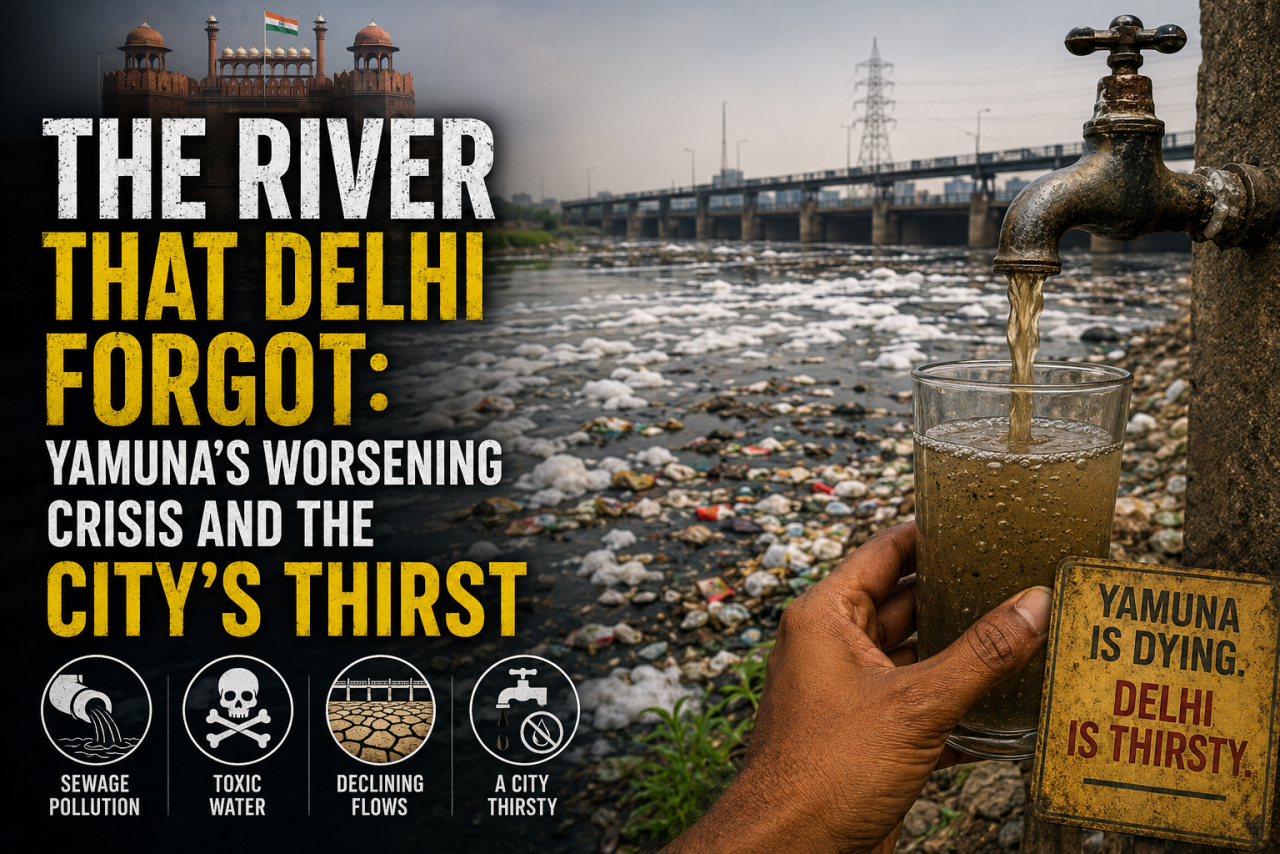
Delhi drinks from a river that is slowly dying. The latest DPCC report exposes alarming pollution levels in the Yamuna, raising urgent questions about water safety, governance, and the future of India's capital.
There is a painful irony at the heart of Delhi's water story. The Yamuna—the river that has sustained this city for centuries, the same river that emperors once built their palaces beside—now resembles, in the words of one environmental expert, "a cesspool of sewage." And yet, Delhi continues to draw its drinking water from this very source.
According to the latest monthly water quality report prepared by the Delhi Pollution Control Committee (DPCC), pollution levels in the Yamuna worsened further in May 2026. What makes this development particularly alarming is that even the relatively cleaner upstream stretches of the river—from where Delhi draws its drinking water—are now breaching permissible pollution limits. Pollution indicators remained above prescribed standards across almost the entire river stretch in Delhi, and many parameters deteriorated further compared to April, which had itself recorded poor water quality.
A River Running Dry and Dirty
To understand how dangerous the situation has become, one must understand the basics of water quality measurement. Two indicators are especially critical: Faecal Coliform (FC) and Biological Oxygen Demand (BOD).
Faecal coliform is a measure of sewage contamination—specifically, the presence of bacteria originating from human and animal waste. At the exit point near the Okhla-Asgarpur stretch, faecal coliform levels touched 330,000 MPN (Most Probable Number) units per 100 ml in May. The maximum permissible limit for drinking water sources is 2,500 MPN units. That means the water at this stretch was 132 times more contaminated than what is considered acceptable.
Even at Wazirabad, where Delhi draws raw water for treatment, the May sample recorded faecal coliform at 3,500 MPN units, still above the desired limit of 500 for drinking water sources.
BOD measures the amount of oxygen that microorganisms consume to decompose organic matter in water. Higher BOD levels indicate more pollution and less oxygen available for aquatic life.
At Wazirabad, BOD rose to 4 mg/l against the permissible limit of 3 mg/l. Further downstream at Okhla-Asgarpur, BOD levels reached 60 mg/l in May, up from 58 mg/l in April—a figure that is 20 times the acceptable standard.
Dissolved oxygen (DO), which must be at least 5 mg/l to sustain healthy aquatic ecosystems, fell to just 3.1 mg/l at Wazirabad. At most other points along Delhi's 22-km most-polluted stretch, DO levels are effectively zero, meaning no oxygen remains for aquatic life to survive.
Why Summer Makes Everything Worse
Officials attribute the worsening conditions largely to declining river flows during peak summer months. As the Yamuna enters its annual lean season, the environmental flow—the minimum water release needed to keep the river alive—falls drastically.
In the last week of May 2026, the water level at Wazirabad Barrage had plummeted to near-historic lows, with the river so narrow and shallow in places that people could wade across it on foot.
When river flows decline, the water's natural capacity to dilute and flush out pollutants disappears. Whatever sewage, industrial effluent, and solid waste enters the river stays concentrated. This is why summer months consistently produce the worst quality readings in DPCC reports, year after year.
22 Drains, Zero Compliance
Between Wazirabad and Okhla, 22 major drains discharge wastewater directly into the Yamuna. According to DPCC's monthly assessment, not a single one of these 22 drains met the prescribed BOD standard of 30 mg/l for drains.
This failure is not for lack of money spent.
A ₹2,454 crore Interceptor Sewage Project was launched to tap smaller drains feeding the Yamuna and divert raw sewage to Sewage Treatment Plants (STPs). Yet a DPCC inspection in February 2026 found large-scale discrepancies.
Of 109 interceptor points inspected, sewage was successfully diverted at only 56. More than 117 million gallons per day of untreated waste is still flowing into the river from drains that had been officially declared "completed."
Only 9 of 41 online monitoring systems are operational. Only 8 of 23 CCTV cameras are functional. Flow meters are either absent or defunct at most locations.
The monitoring infrastructure meant to ensure accountability is itself broken.
Promises, Politics, and the Same Poisoned Water
What makes the Yamuna's condition particularly frustrating is the sheer volume of promises it has received over the decades—from every party that has governed Delhi.
The BJP, which came to power in Delhi earlier in 2025, had declared the purification of the Yamuna its top priority and laid foundation stones for projects worth ₹1,816 crore for river clean-up during its election campaign.
Yet DPCC data from November and December 2025 showed that 12 out of 37 Sewage Treatment Plants in Delhi were not meeting prescribed standards, with faecal coliform levels several hundred times above the legal limit at plants in Okhla, Vasant Kunj, and Yamuna Vihar.
Environmental expert Bhim Singh Rawat, coordinator of the South Asia Network on Dams, Rivers and People, said bluntly:
"Governments are not making any realistic efforts to improve the environmental flow in Yamuna."
The Deeper Problem: Population vs. Allocation
Delhi today has a population of over 30 million people. But the water it receives from the Upper Yamuna River Treaty, signed 20 to 25 years ago, was calculated for a city of under 10 million.
Delhi continues to receive the same allocation of 1,000 cusecs of water that was agreed upon when the treaty was drawn. No government, at the Centre or in Delhi, has moved with urgency to renegotiate these terms.
DPCC plans to soon operationalise 41 Online Monitoring Systems for real-time water quality data. That would at least give authorities and citizens an honest, live picture of the river's condition.
Knowledge, however, is not cleanup. Real-time data showing that the Yamuna is dying is not the same as doing the work to revive it.
The Yamuna does not need more reports. It does not need more foundation stone ceremonies. It needs treated sewage, restored ecological flows, honest monitoring, and governments at every level that treat a river's death as the emergency it actually is.
For 30 million Delhiites whose drinking water begins its journey in that river, the cost of continued inaction is not abstract.
It flows from every tap.
There is a painful irony at the heart of Delhi's water story. The Yamuna—the river that has sustained this city for centuries, the same river that emperors once built their palaces beside—now resembles, in the words of one environmental expert, "a cesspool of sewage." And yet, Delhi continues to draw its drinking water from this very source.
According to the latest monthly water quality report prepared by the Delhi Pollution Control Committee (DPCC), pollution levels in the Yamuna worsened further in May 2026. What makes this development particularly alarming is that even the relatively cleaner upstream stretches of the river—from where Delhi draws its drinking water—are now breaching permissible pollution limits. Pollution indicators remained above prescribed standards across almost the entire river stretch in Delhi, and many parameters deteriorated further compared to April, which had itself recorded poor water quality.
A River Running Dry and Dirty
To understand how dangerous the situation has become, one must understand the basics of water quality measurement. Two indicators are especially critical: Faecal Coliform (FC) and Biological Oxygen Demand (BOD).
Faecal coliform is a measure of sewage contamination—specifically, the presence of bacteria originating from human and animal waste. At the exit point near the Okhla-Asgarpur stretch, faecal coliform levels touched 330,000 MPN (Most Probable Number) units per 100 ml in May. The maximum permissible limit for drinking water sources is 2,500 MPN units. That means the water at this stretch was 132 times more contaminated than what is considered acceptable.
Even at Wazirabad, where Delhi draws raw water for treatment, the May sample recorded faecal coliform at 3,500 MPN units, still above the desired limit of 500 for drinking water sources.
BOD measures the amount of oxygen that microorganisms consume to decompose organic matter in water. Higher BOD levels indicate more pollution and less oxygen available for aquatic life.
At Wazirabad, BOD rose to 4 mg/l against the permissible limit of 3 mg/l. Further downstream at Okhla-Asgarpur, BOD levels reached 60 mg/l in May, up from 58 mg/l in April—a figure that is 20 times the acceptable standard.
Dissolved oxygen (DO), which must be at least 5 mg/l to sustain healthy aquatic ecosystems, fell to just 3.1 mg/l at Wazirabad. At most other points along Delhi's 22-km most-polluted stretch, DO levels are effectively zero, meaning no oxygen remains for aquatic life to survive.
Why Summer Makes Everything Worse
Officials attribute the worsening conditions largely to declining river flows during peak summer months. As the Yamuna enters its annual lean season, the environmental flow—the minimum water release needed to keep the river alive—falls drastically.
In the last week of May 2026, the water level at Wazirabad Barrage had plummeted to near-historic lows, with the river so narrow and shallow in places that people could wade across it on foot.
When river flows decline, the water's natural capacity to dilute and flush out pollutants disappears. Whatever sewage, industrial effluent, and solid waste enters the river stays concentrated. This is why summer months consistently produce the worst quality readings in DPCC reports, year after year.
22 Drains, Zero Compliance
Between Wazirabad and Okhla, 22 major drains discharge wastewater directly into the Yamuna. According to DPCC's monthly assessment, not a single one of these 22 drains met the prescribed BOD standard of 30 mg/l for drains.
This failure is not for lack of money spent.
A ₹2,454 crore Interceptor Sewage Project was launched to tap smaller drains feeding the Yamuna and divert raw sewage to Sewage Treatment Plants (STPs). Yet a DPCC inspection in February 2026 found large-scale discrepancies.
Of 109 interceptor points inspected, sewage was successfully diverted at only 56. More than 117 million gallons per day of untreated waste is still flowing into the river from drains that had been officially declared "completed."
Only 9 of 41 online monitoring systems are operational. Only 8 of 23 CCTV cameras are functional. Flow meters are either absent or defunct at most locations.
The monitoring infrastructure meant to ensure accountability is itself broken.
Promises, Politics, and the Same Poisoned Water
What makes the Yamuna's condition particularly frustrating is the sheer volume of promises it has received over the decades—from every party that has governed Delhi.
The BJP, which came to power in Delhi earlier in 2025, had declared the purification of the Yamuna its top priority and laid foundation stones for projects worth ₹1,816 crore for river clean-up during its election campaign.
Yet DPCC data from November and December 2025 showed that 12 out of 37 Sewage Treatment Plants in Delhi were not meeting prescribed standards, with faecal coliform levels several hundred times above the legal limit at plants in Okhla, Vasant Kunj, and Yamuna Vihar.
Environmental expert Bhim Singh Rawat, coordinator of the South Asia Network on Dams, Rivers and People, said bluntly:
"Governments are not making any realistic efforts to improve the environmental flow in Yamuna."
The Deeper Problem: Population vs. Allocation
Delhi today has a population of over 30 million people. But the water it receives from the Upper Yamuna River Treaty, signed 20 to 25 years ago, was calculated for a city of under 10 million.
Delhi continues to receive the same allocation of 1,000 cusecs of water that was agreed upon when the treaty was drawn. No government, at the Centre or in Delhi, has moved with urgency to renegotiate these terms.
DPCC plans to soon operationalise 41 Online Monitoring Systems for real-time water quality data. That would at least give authorities and citizens an honest, live picture of the river's condition.
Knowledge, however, is not cleanup. Real-time data showing that the Yamuna is dying is not the same as doing the work to revive it.
The Yamuna does not need more reports. It does not need more foundation stone ceremonies. It needs treated sewage, restored ecological flows, honest monitoring, and governments at every level that treat a river's death as the emergency it actually is.
For 30 million Delhiites whose drinking water begins its journey in that river, the cost of continued inaction is not abstract.
It flows from every tap.























Leave a Comment