
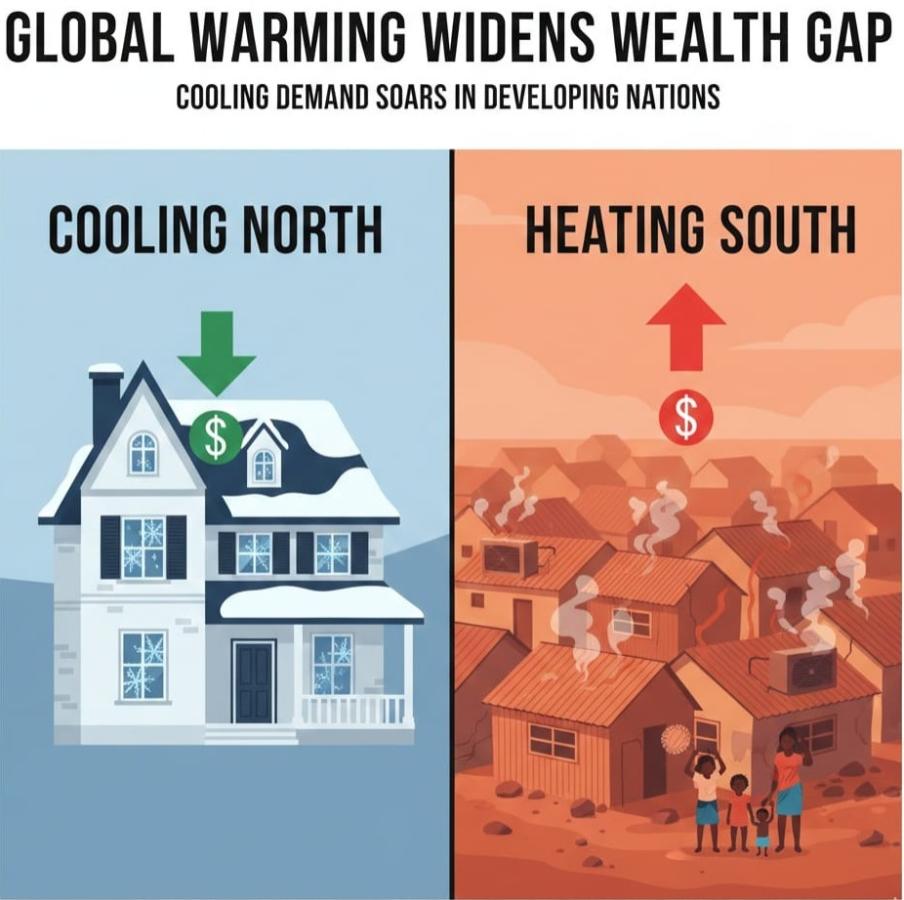
The traditional global economic gap is set to widen further, not just through trade or technology, but through the thermometer. A recent study published in the journal Nature Sustainability highlights a concerning trend. As the Earth continues to heat up, the disparity between wealthy nations in cooler climates and poorer nations in warmer regions will be exacerbated by the shifting costs of temperature regulation.
The Great Temperature Shift
According to the research, global warming will lead to a significant decline in heating needs for countries like Canada, Russia, Finland, Sweden, and Norway. These typically wealthier, northern-latitude nations are expected to save massive amounts on energy bills as their winters become milder. Historically, heating has been one of the primary energy expenses for these populations; a reduction in this need represents a direct economic windfall for both households and national grids.
In stark contrast, nations in warmer regions—including India, Nigeria, Indonesia, Bangladesh, Pakistan, and the Philippines—are facing a surge in demand for air conditioning. These countries are home to billions of people, many of whom currently live with limited resources and unreliable power infrastructure. For these populations, rising temperatures are not just a matter of discomfort; they represent a significant new financial and infrastructural burden.
Measuring the Impact: Cooling Degree Days
To understand the scale of this change, researchers use a metric called Cooling Degree Days (CDD). This measures the difference between the mean outdoor temperature and a standard base cooling temperature (often around 18.3°C). In India alone, CDDs are projected to increase by 13.4% as global warming shifts from 1°C to 2°C above pre-industrial levels.
This metric serves as a proxy for how much energy will be required to keep indoor spaces habitable. While a 1.5°C increase is often cited as a critical threshold in international climate agreements, the study notes that most changes in cooling and heating demand occur before even reaching that point. This means that significant adaptation—such as the massive installation of air conditioning units—will be required within the next five years.
Economic and Infrastructure Hurdles
The financial implications are profound. While the Global North saves money, developing countries must invest heavily in:
- Massive Infrastructure Costs: Expanding electricity grids to handle the peak loads caused by millions of AC units running simultaneously.
- Energy Expenses: The recurring cost of electricity for low-income households, which can consume a significant portion of their monthly earnings.
- Health and Productivity: Without adequate cooling, these regions face “dangerously hot” temperatures that impact everything from education and health to manual labor and farming.
By 2050, it is estimated that nearly 3.8 billion people—roughly half the world’s population—will live in regions facing extreme heat if temperatures rise 2°C above pre-industrial levels. Countries like the Central African Republic, South Sudan, Laos, and Brazil are already seeing some of the most significant increases in heat-related risks.
Final Take
The climate change expert describes these findings as a ‘wake-up call. The study emphasizes that overshooting the 1.5°C target will have unprecedented impacts on migration and global stability. As the wealthy get a “climate discount” on their heating bills, the poor are being hit with a “climate tax” in the form of cooling costs they can ill afford.
The only established path to reversing this trend is achieving net-zero sustainable development. This involves not only reducing carbon emissions but also ensuring that the cooling technologies used are energy-efficient and powered by renewable energy. Without a coordinated global effort to assist developing nations with these infrastructure costs, the warming planet will continue to bake inequality into the very fabric of the global economy.



























Leave a Comment