
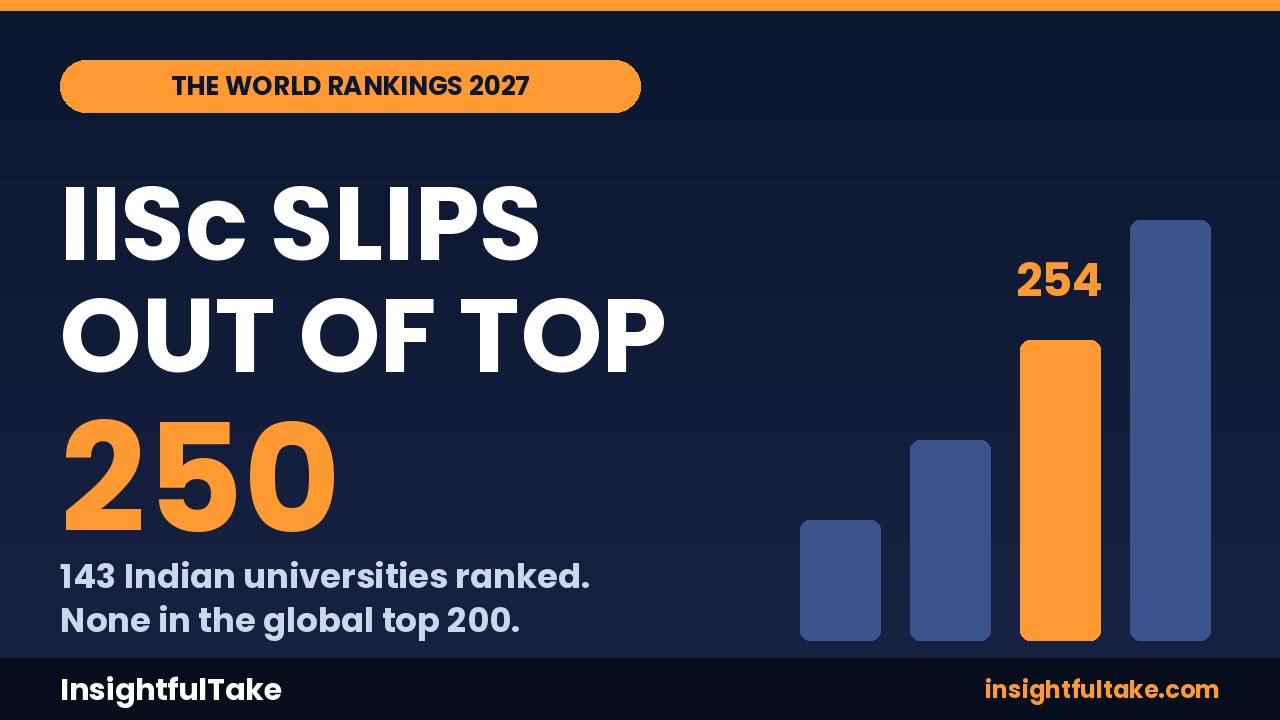
A record 143 Indian institutions feature in the THE World University Rankings 2027, but none make the global top 200. India is expanding its presence, yet the bigger challenge remains moving up the table.
India has more universities in the global rankings than ever before. But the latest Times Higher Education (THE) World University Rankings also underline a harder reality: expanding the country's presence is proving easier than building institutions that can compete at the very top.
The Indian Institute of Science (IISc), Bengaluru, remains India's highest-ranked university, but it has slipped to 254th in the THE World University Rankings 2027. Last year, IISc was placed in the 201–250 band.
It is still the only Indian institution in the global top 300. But its decline raises a larger question for Indian higher education. Is the country widening its reach faster than it is raising its global academic standing?
More Indian Universities, But No Top-200 Entry
India has made a notable gain in terms of representation.
A record 143 Indian institutions feature in the 2027 rankings, up from 128 the previous year. The latest edition covers 2,297 universities across 118 countries and territories, making it the largest THE ranking so far.
India now has the second-highest number of ranked institutions in the world, behind the United States, which has 168. Turkey has 124 and Japan has 112.
But the picture changes when the focus moves from participation to performance at the top.
No Indian university features in the global top 200. Only three Indian institutions make the top 500.
IISc is ranked 254th, Saveetha Institute of Medical and Technical Sciences, Chennai, is placed in the 326–350 band, while Shoolini University, Solan, is in the 451–500 band.
The rest of India's institutions are distributed across lower ranking bands.
That makes the latest figures both encouraging and uncomfortable. India is putting more institutions on the global map, but its leading universities are still struggling to break into the highest tier.
Why Did IISc Fall?
The fall in IISc's position does not necessarily mean that the institute has suddenly become weaker.
THE has pointed to increasing competition as one factor behind the movement. More universities are entering the rankings, while changes in how positions are assigned can also affect an institution's position.
This matters because rankings are relative. A university can maintain or even improve its own performance and still fall if other institutions improve faster.
For students, that distinction is important. A lower position does not automatically mean a poorer university.
Some Indian Universities Move Up
The rankings also show that India's performance is not uniformly downward.
Saveetha has moved from the 351–400 band to 326–350. Shoolini is in the 451–500 band, compared with 401–500 previously.
Manipal Academy of Higher Education and Banaras Hindu University are both in the 551–600 band, while Amity University, Noida, is also placed in the same range.
At the other end, Jamia Millia Islamia has moved down from the 401–500 band to 501–550.
Among the IITs, IIT Indore is in the 651–700 band, IIT Patna in 701–800, while IIT Gandhinagar and IIT Mandi are in 801–1000. IIT Ropar is placed in the 1001–1200 band.
For Bihar, IIT Patna's position is particularly relevant. Its 701–800 placement also illustrates a broader challenge faced by relatively younger institutions. Building a strong international research profile takes time, particularly in areas such as research publications, citations, global academic partnerships and industry collaboration.
Asia Is Moving Faster
India's position becomes more significant when viewed against the wider Asian higher education landscape.
For the first time, Asia has overtaken continental Europe in the number of universities represented among the world's leading institutions, with three Asian universities featuring in the global top 15.
China's Tsinghua University is ranked 11th and is the highest-ranked Asian institution.
The University of Oxford remains at number one for the 11th consecutive year.
For India, the broader Asian picture offers an important lesson. Neighbouring and regional competitors are not simply increasing the number of universities entering global rankings. Several are also moving higher within them.
What the Rankings Mean for Students
Students should be careful about treating a global university ranking as a final verdict.
THE's methodology looks at areas including teaching, research environment, research quality, industry links and international outlook. It does not necessarily tell a student which university has the best department, course, faculty or placement record for a particular career.
The subject matters.
A university that ranks lower overall can still be highly regarded in a specific discipline. IISc, for example, has been particularly strong in computer science in THE's subject-level rankings.
Students should also understand how ranking bands work. Beyond the top 200, THE places many institutions in ranges rather than assigning every university an exact position. A move between bands should therefore be treated as an indicator rather than a precise measurement of quality.
India's own National Institutional Ranking Framework (NIRF) should also be considered alongside global rankings, particularly when comparing institutions within the country.
India Has Expanded. Now It Needs to Climb.
The 2027 rankings offer India two stories at the same time.
The first is positive. More Indian universities are participating in global academic comparisons than ever before. With 143 institutions listed, India's international higher education footprint is clearly expanding.
The second is more challenging. None of those institutions has yet entered the global top 200, while several Asian universities continue to strengthen their position near the top.
The next stage will require more than increasing the number of participating institutions. India will need sustained investment in research, stronger international collaboration, better support for faculty and a research environment capable of attracting and retaining global academic talent.
India has more universities in the global rankings than ever before. But the latest Times Higher Education (THE) World University Rankings also underline a harder reality: expanding the country's presence is proving easier than building institutions that can compete at the very top.
The Indian Institute of Science (IISc), Bengaluru, remains India's highest-ranked university, but it has slipped to 254th in the THE World University Rankings 2027. Last year, IISc was placed in the 201–250 band.
It is still the only Indian institution in the global top 300. But its decline raises a larger question for Indian higher education. Is the country widening its reach faster than it is raising its global academic standing?
More Indian Universities, But No Top-200 Entry
India has made a notable gain in terms of representation.
A record 143 Indian institutions feature in the 2027 rankings, up from 128 the previous year. The latest edition covers 2,297 universities across 118 countries and territories, making it the largest THE ranking so far.
India now has the second-highest number of ranked institutions in the world, behind the United States, which has 168. Turkey has 124 and Japan has 112.
But the picture changes when the focus moves from participation to performance at the top.
No Indian university features in the global top 200. Only three Indian institutions make the top 500.
IISc is ranked 254th, Saveetha Institute of Medical and Technical Sciences, Chennai, is placed in the 326–350 band, while Shoolini University, Solan, is in the 451–500 band.
The rest of India's institutions are distributed across lower ranking bands.
That makes the latest figures both encouraging and uncomfortable. India is putting more institutions on the global map, but its leading universities are still struggling to break into the highest tier.
Why Did IISc Fall?
The fall in IISc's position does not necessarily mean that the institute has suddenly become weaker.
THE has pointed to increasing competition as one factor behind the movement. More universities are entering the rankings, while changes in how positions are assigned can also affect an institution's position.
This matters because rankings are relative. A university can maintain or even improve its own performance and still fall if other institutions improve faster.
For students, that distinction is important. A lower position does not automatically mean a poorer university.
Some Indian Universities Move Up
The rankings also show that India's performance is not uniformly downward.
Saveetha has moved from the 351–400 band to 326–350. Shoolini is in the 451–500 band, compared with 401–500 previously.
Manipal Academy of Higher Education and Banaras Hindu University are both in the 551–600 band, while Amity University, Noida, is also placed in the same range.
At the other end, Jamia Millia Islamia has moved down from the 401–500 band to 501–550.
Among the IITs, IIT Indore is in the 651–700 band, IIT Patna in 701–800, while IIT Gandhinagar and IIT Mandi are in 801–1000. IIT Ropar is placed in the 1001–1200 band.
For Bihar, IIT Patna's position is particularly relevant. Its 701–800 placement also illustrates a broader challenge faced by relatively younger institutions. Building a strong international research profile takes time, particularly in areas such as research publications, citations, global academic partnerships and industry collaboration.
Asia Is Moving Faster
India's position becomes more significant when viewed against the wider Asian higher education landscape.
For the first time, Asia has overtaken continental Europe in the number of universities represented among the world's leading institutions, with three Asian universities featuring in the global top 15.
China's Tsinghua University is ranked 11th and is the highest-ranked Asian institution.
The University of Oxford remains at number one for the 11th consecutive year.
For India, the broader Asian picture offers an important lesson. Neighbouring and regional competitors are not simply increasing the number of universities entering global rankings. Several are also moving higher within them.
What the Rankings Mean for Students
Students should be careful about treating a global university ranking as a final verdict.
THE's methodology looks at areas including teaching, research environment, research quality, industry links and international outlook. It does not necessarily tell a student which university has the best department, course, faculty or placement record for a particular career.
The subject matters.
A university that ranks lower overall can still be highly regarded in a specific discipline. IISc, for example, has been particularly strong in computer science in THE's subject-level rankings.
Students should also understand how ranking bands work. Beyond the top 200, THE places many institutions in ranges rather than assigning every university an exact position. A move between bands should therefore be treated as an indicator rather than a precise measurement of quality.
India's own National Institutional Ranking Framework (NIRF) should also be considered alongside global rankings, particularly when comparing institutions within the country.
India Has Expanded. Now It Needs to Climb.
The 2027 rankings offer India two stories at the same time.
The first is positive. More Indian universities are participating in global academic comparisons than ever before. With 143 institutions listed, India's international higher education footprint is clearly expanding.
The second is more challenging. None of those institutions has yet entered the global top 200, while several Asian universities continue to strengthen their position near the top.
The next stage will require more than increasing the number of participating institutions. India will need sustained investment in research, stronger international collaboration, better support for faculty and a research environment capable of attracting and retaining global academic talent.


























Leave a Comment