
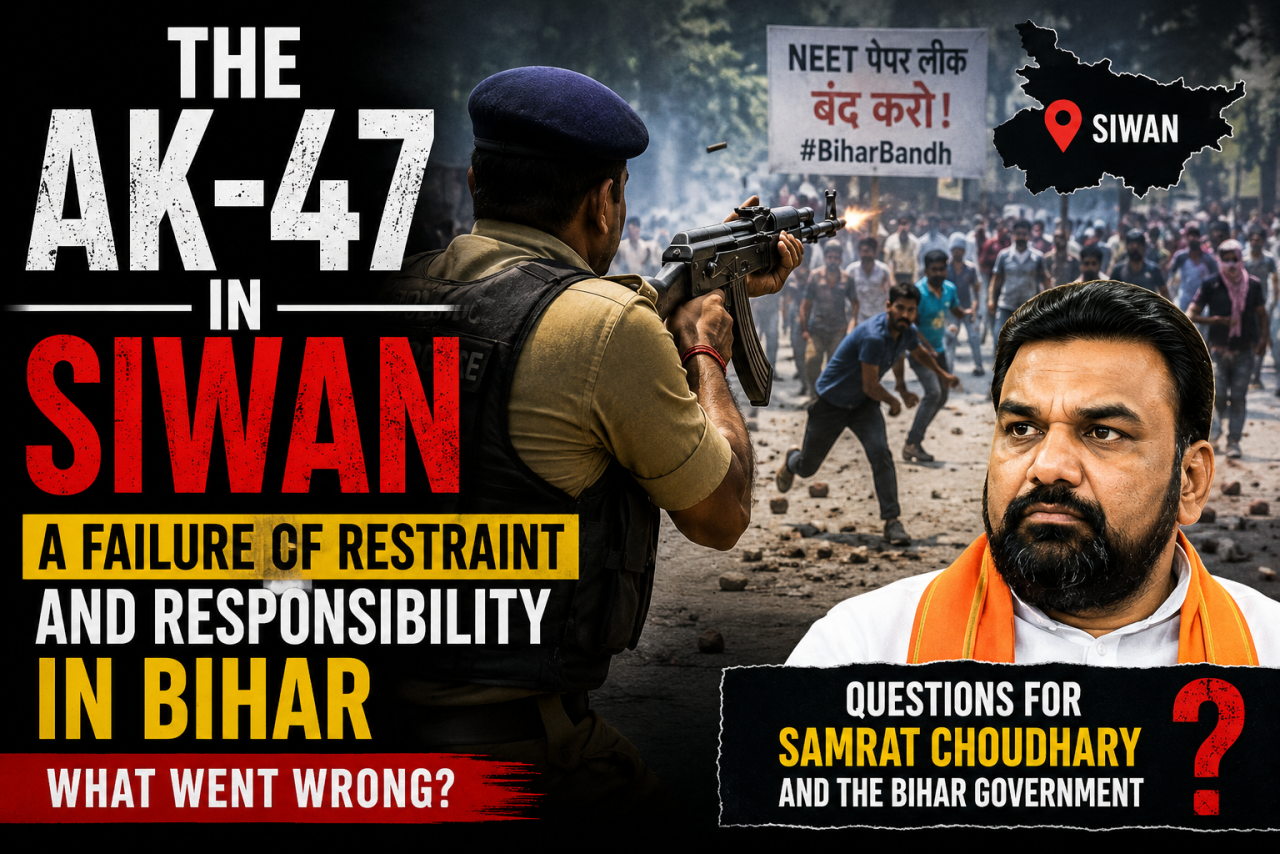
An AK-47 at a student protest was never supposed to become the story. Yet in Siwan, it has become the biggest question confronting Bihar's policing and leadership.
What began as a statewide protest against the NEET paper leak on 25 July 2026 ended with disturbing images that have reignited concerns over policing and accountability in Bihar. During the Bihar Bandh called by student groups and opposition parties, clashes broke out in Siwan, where protesters allegedly resorted to stone-pelting, leaving several police personnel, including the district Superintendent of Police, injured. However, it was not the violence itself that shocked the nation. It was the viral footage of a police constable carrying and firing an AK-47 assault rifle during the confrontation.
The constable, identified as Abhishek Patel, who was reportedly attached to the District Intelligence Unit and serving as the Siwan SP's bodyguard, was seen advancing towards protesters before firing his weapon. Reports suggest that three people suffered bullet injuries, while Bihar Police later stated that only four rounds were fired into the air in self-defence after personnel were surrounded. Regardless of the official explanation, the images have raised serious questions about judgment, preparedness, and the use of force during civilian protests.
The Bihar government has suspended the constable and ordered a departmental inquiry. Police officials have also clarified that there were explicit instructions against opening fire and that an AK-47 was never meant to be used for crowd control. Those explanations, however, only deepen the central concern. If the weapon was inappropriate for such a situation, why was it present in the middle of a student-led demonstration in the first place?
Crowd management in a democracy follows the principle of proportionality. When protests become violent, law enforcement has both the authority and the responsibility to restore order. India already has established mechanisms for this, including barricading, negotiations, lathi charge, tear gas, water cannons, and other non-lethal measures. An assault rifle designed for combat has no place in routine civilian crowd control. Whether the bullets were fired into the air or not, deploying such a weapon sends an unmistakable message of intimidation and significantly increases the risk of unintended casualties.
The incident also places the spotlight on the state's political leadership. As Chief Minister, Samrat Choudhary bears the ultimate responsibility for maintaining law and order while safeguarding citizens' democratic right to protest peacefully. The Bihar Bandh was not an isolated law-and-order challenge but part of a broader wave of student anger over examination integrity and repeated paper leak allegations. Managing such protests requires planning, restraint, and disciplined policing. The events in Siwan suggest that those safeguards fell short.
It is equally important to acknowledge that the protests were not entirely peaceful. Reports indicate that police personnel were injured, public property was damaged in several districts, and hundreds of protesters were detained. Violence against police officers cannot be justified, and the state is obligated to prevent disorder. Yet democratic governance demands that the response remain proportionate. The legitimacy of law enforcement depends not only on restoring order but also on exercising restraint while doing so.
Suspending one constable cannot be the end of the matter. A credible inquiry must determine the complete chain of command, establish why an officer carrying an AK-47 was deployed in a volatile civilian gathering, examine whether operational protocols were violated, and verify the exact circumstances in which the weapon was fired. It should also clarify the nature of the injuries sustained by civilians and identify whether supervisory failures contributed to the escalation.
The controversy extends beyond one officer or one district. It reflects a larger challenge facing Bihar's policing system. Public confidence depends on the belief that the police will protect citizens while using only the minimum force necessary. Incidents involving military-grade weapons during student protests undermine that confidence and risk widening the trust deficit between young citizens and the administration.
The protests themselves were rooted in growing frustration over repeated examination irregularities. Paper leak allegations have shaken the confidence of lakhs of students who invest years preparing for competitive examinations. Restoring that trust requires transparent investigations, swift accountability, and meaningful reforms. Responding to student anger with disproportionate force risks shifting public attention away from the original issue while further alienating an already frustrated generation.
The Bihar government must therefore treat the Siwan incident as more than an isolated disciplinary case. It should undertake a comprehensive review of standard operating procedures for crowd management, prohibit the deployment of automatic assault weapons in civilian protest situations except under extraordinary circumstances, strengthen training in de-escalation techniques, and ensure that officers are equipped with appropriate non-lethal alternatives.
The viral images from Siwan have become a symbol of a deeper institutional failure. When an AK-47 appears in the middle of a student protest, the question extends far beyond the actions of a single constable. It becomes a question of leadership, preparedness, operational discipline, and accountability. Bihar's democracy deserves policing that is firm but restrained, capable yet accountable, and always guided by the principle that the state's greatest strength lies not in the weapons it carries but in the restraint with which it exercises its authority.
What began as a statewide protest against the NEET paper leak on 25 July 2026 ended with disturbing images that have reignited concerns over policing and accountability in Bihar. During the Bihar Bandh called by student groups and opposition parties, clashes broke out in Siwan, where protesters allegedly resorted to stone-pelting, leaving several police personnel, including the district Superintendent of Police, injured. However, it was not the violence itself that shocked the nation. It was the viral footage of a police constable carrying and firing an AK-47 assault rifle during the confrontation.
The constable, identified as Abhishek Patel, who was reportedly attached to the District Intelligence Unit and serving as the Siwan SP's bodyguard, was seen advancing towards protesters before firing his weapon. Reports suggest that three people suffered bullet injuries, while Bihar Police later stated that only four rounds were fired into the air in self-defence after personnel were surrounded. Regardless of the official explanation, the images have raised serious questions about judgment, preparedness, and the use of force during civilian protests.
The Bihar government has suspended the constable and ordered a departmental inquiry. Police officials have also clarified that there were explicit instructions against opening fire and that an AK-47 was never meant to be used for crowd control. Those explanations, however, only deepen the central concern. If the weapon was inappropriate for such a situation, why was it present in the middle of a student-led demonstration in the first place?
Crowd management in a democracy follows the principle of proportionality. When protests become violent, law enforcement has both the authority and the responsibility to restore order. India already has established mechanisms for this, including barricading, negotiations, lathi charge, tear gas, water cannons, and other non-lethal measures. An assault rifle designed for combat has no place in routine civilian crowd control. Whether the bullets were fired into the air or not, deploying such a weapon sends an unmistakable message of intimidation and significantly increases the risk of unintended casualties.
The incident also places the spotlight on the state's political leadership. As Chief Minister, Samrat Choudhary bears the ultimate responsibility for maintaining law and order while safeguarding citizens' democratic right to protest peacefully. The Bihar Bandh was not an isolated law-and-order challenge but part of a broader wave of student anger over examination integrity and repeated paper leak allegations. Managing such protests requires planning, restraint, and disciplined policing. The events in Siwan suggest that those safeguards fell short.
It is equally important to acknowledge that the protests were not entirely peaceful. Reports indicate that police personnel were injured, public property was damaged in several districts, and hundreds of protesters were detained. Violence against police officers cannot be justified, and the state is obligated to prevent disorder. Yet democratic governance demands that the response remain proportionate. The legitimacy of law enforcement depends not only on restoring order but also on exercising restraint while doing so.
Suspending one constable cannot be the end of the matter. A credible inquiry must determine the complete chain of command, establish why an officer carrying an AK-47 was deployed in a volatile civilian gathering, examine whether operational protocols were violated, and verify the exact circumstances in which the weapon was fired. It should also clarify the nature of the injuries sustained by civilians and identify whether supervisory failures contributed to the escalation.
The controversy extends beyond one officer or one district. It reflects a larger challenge facing Bihar's policing system. Public confidence depends on the belief that the police will protect citizens while using only the minimum force necessary. Incidents involving military-grade weapons during student protests undermine that confidence and risk widening the trust deficit between young citizens and the administration.
The protests themselves were rooted in growing frustration over repeated examination irregularities. Paper leak allegations have shaken the confidence of lakhs of students who invest years preparing for competitive examinations. Restoring that trust requires transparent investigations, swift accountability, and meaningful reforms. Responding to student anger with disproportionate force risks shifting public attention away from the original issue while further alienating an already frustrated generation.
The Bihar government must therefore treat the Siwan incident as more than an isolated disciplinary case. It should undertake a comprehensive review of standard operating procedures for crowd management, prohibit the deployment of automatic assault weapons in civilian protest situations except under extraordinary circumstances, strengthen training in de-escalation techniques, and ensure that officers are equipped with appropriate non-lethal alternatives.
The viral images from Siwan have become a symbol of a deeper institutional failure. When an AK-47 appears in the middle of a student protest, the question extends far beyond the actions of a single constable. It becomes a question of leadership, preparedness, operational discipline, and accountability. Bihar's democracy deserves policing that is firm but restrained, capable yet accountable, and always guided by the principle that the state's greatest strength lies not in the weapons it carries but in the restraint with which it exercises its authority.
























Leave a Comment