
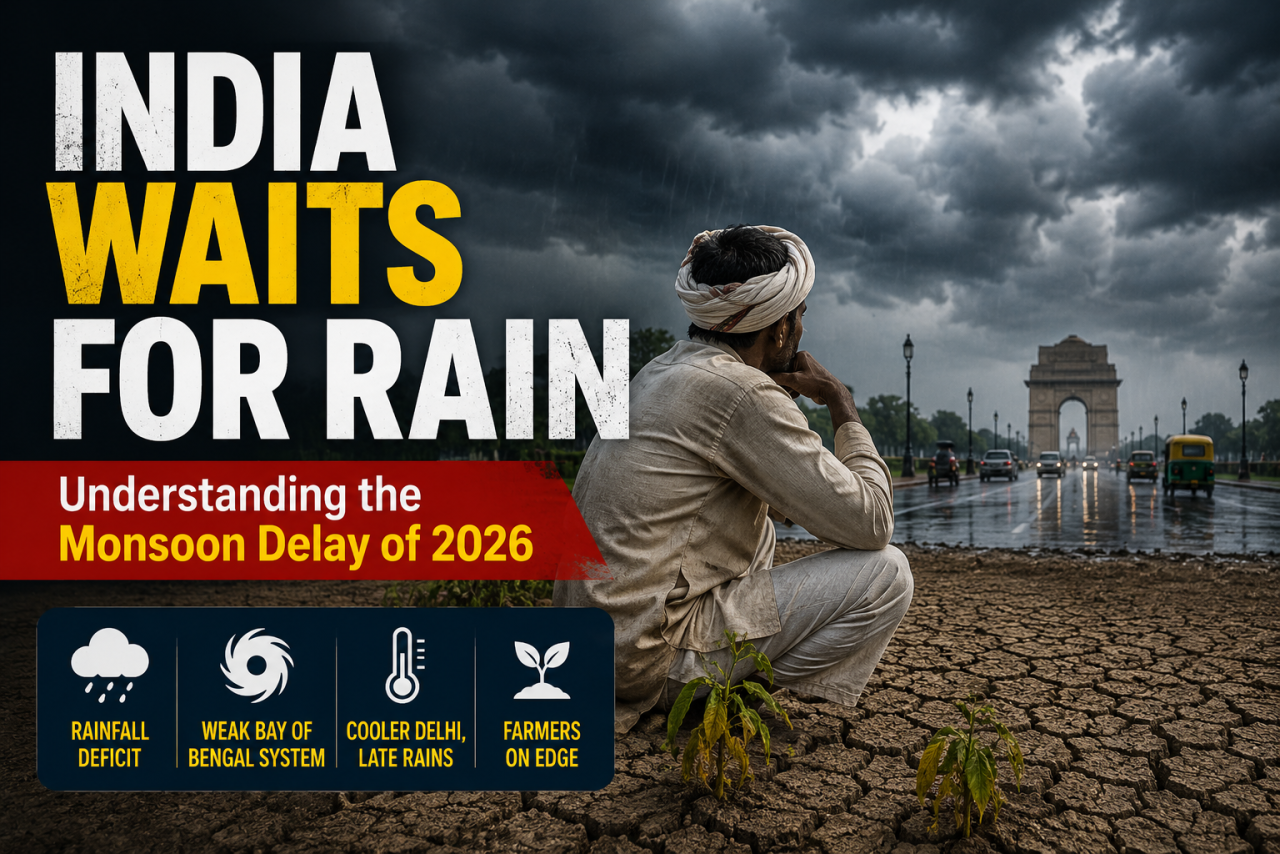
India's most important weather system is running late. With rainfall deficits widening and key states still awaiting showers, what is causing the monsoon delay of 2026—and what could it mean for the months ahead?
India has entered the heart of June, but the southwest monsoon is moving more slowly than expected. With rainfall running well below normal and several key agricultural states still waiting for widespread showers, questions are growing over what is holding back the country's most important weather system.
Every June, India waits for one thing above all else: the southwest monsoon. It is not just a weather event. It determines reservoir levels, influences agricultural output, affects food prices, and shapes the livelihoods of millions. This year, however, the monsoon's progress has slowed significantly, raising concerns among farmers, meteorologists, and policymakers alike.
A Weather System Waiting for the Right Push
The monsoon does not arrive across India on a fixed schedule. Its movement depends on a complex interaction of atmospheric systems, particularly the monsoon trough—a low-pressure zone that usually develops over the Bay of Bengal and helps draw moisture-laden winds deeper into the subcontinent.
This year, that mechanism has been unusually sluggish.
According to the India Meteorological Department (IMD), the monsoon has advanced through Harnai, Solapur, Bhadrachalam, Hyderabad, Phulbani, Ranchi, Koraput, Jamtara, and Muzaffarpur, broadly following its normal pathway but without its typical pace.
Mahesh Palawat, Vice President of Skymet Weather, has noted that the atmospheric trigger required to propel the monsoon into central India is currently missing. The rains and thundershowers that usually help push the monsoon forward have remained weak, while western disturbances have continued to divert moisture away from the advancing system.
Compounding the problem, a weather disturbance expected to develop over the Bay of Bengal has been slow to organize. Without this supportive system, the monsoon's advance into northern and central India remains uncertain.
Delhi Continues to Wait
The delay is particularly noticeable in the national capital.
Delhi typically receives the monsoon around June 27. However, weather experts believe the current atmospheric conditions could postpone its arrival until the first week of July.
Skymet Weather has indicated that even if the monsoon trough resumes movement, its progress is likely to remain slow due to unfavourable conditions over the Bay of Bengal and adjoining regions.
While delays are not unprecedented, they are closely watched. Last year, the monsoon reached Delhi on June 29. In 2021, the city experienced its second-latest monsoon onset on July 13, while the most delayed arrival on record occurred in 1987, when the rains reached the capital only on July 26.
Interestingly, despite the delayed onset, Delhi has not experienced extreme heat. Maximum temperatures at Safdarjung have remained nearly six degrees Celsius below normal, while minimum temperatures have stayed around four degrees below average due to cloud cover and intermittent weather activity.
Rainfall Deficit Raises Concerns
The rainfall figures highlight the extent of the slowdown.
Between June 4 and June 18, India received approximately 42 percent less rainfall than normal for the period. Although the monsoon reached Kerala on June 4 and advanced into 19 states over the following two weeks, its progress stalled near Bhadrachalam in Telangana around June 8.
As a result, states such as Madhya Pradesh, Uttar Pradesh, and Rajasthan—regions that typically receive monsoon rains by the third week of June—are now expected to experience delayed onset.
Amateur meteorologist Navdeep Dahiya observed that India recorded only 51.5 mm of rainfall between June 1 and June 19, compared with the long-period average of 86.7 mm during the same period, resulting in a rainfall deficit of about 41.1 percent.
He also noted that while the monsoon usually takes around 10 to 15 days to travel from central India to northern India, the current slowdown could extend that timeline. However, he emphasized that a delayed onset does not necessarily translate into a poor monsoon season, as rainfall often catches up once favourable conditions return.
What the Delay Could Mean
A late monsoon is not automatically a weak monsoon.
Weather agencies continue to stress that seasonal rainfall can recover quickly once a stable monsoon trough becomes established. Nevertheless, a slow start can create short-term challenges.
Delayed rainfall can postpone the sowing of key crops such as rice, soybean, and cotton. It can also prolong moisture stress across agricultural regions, increase pressure on reservoirs, and affect irrigation planning during the early stages of the farming season.
Urban areas face their own concerns. City administrations must balance water supply management while simultaneously preparing drainage systems for the possibility of intense rainfall once the monsoon regains momentum.
The Weeks Ahead Will Be Crucial
The India Meteorological Department continues to maintain a broadly optimistic outlook for the season, suggesting that overall monsoon rainfall could still remain near normal despite the current delay.
Much will depend on whether a supportive weather system forms over the Bay of Bengal and whether the monsoon trough strengthens during the coming weeks.
For now, farmers across the Gangetic plains and central India are watching the skies closely, while meteorologists track every shift in atmospheric conditions. The monsoon may be running behind schedule, but in a country where agriculture remains deeply tied to seasonal rainfall, its eventual strength will matter far more than the exact date of its arrival.
India has entered the heart of June, but the southwest monsoon is moving more slowly than expected. With rainfall running well below normal and several key agricultural states still waiting for widespread showers, questions are growing over what is holding back the country's most important weather system.
Every June, India waits for one thing above all else: the southwest monsoon. It is not just a weather event. It determines reservoir levels, influences agricultural output, affects food prices, and shapes the livelihoods of millions. This year, however, the monsoon's progress has slowed significantly, raising concerns among farmers, meteorologists, and policymakers alike.
A Weather System Waiting for the Right Push
The monsoon does not arrive across India on a fixed schedule. Its movement depends on a complex interaction of atmospheric systems, particularly the monsoon trough—a low-pressure zone that usually develops over the Bay of Bengal and helps draw moisture-laden winds deeper into the subcontinent.
This year, that mechanism has been unusually sluggish.
According to the India Meteorological Department (IMD), the monsoon has advanced through Harnai, Solapur, Bhadrachalam, Hyderabad, Phulbani, Ranchi, Koraput, Jamtara, and Muzaffarpur, broadly following its normal pathway but without its typical pace.
Mahesh Palawat, Vice President of Skymet Weather, has noted that the atmospheric trigger required to propel the monsoon into central India is currently missing. The rains and thundershowers that usually help push the monsoon forward have remained weak, while western disturbances have continued to divert moisture away from the advancing system.
Compounding the problem, a weather disturbance expected to develop over the Bay of Bengal has been slow to organize. Without this supportive system, the monsoon's advance into northern and central India remains uncertain.
Delhi Continues to Wait
The delay is particularly noticeable in the national capital.
Delhi typically receives the monsoon around June 27. However, weather experts believe the current atmospheric conditions could postpone its arrival until the first week of July.
Skymet Weather has indicated that even if the monsoon trough resumes movement, its progress is likely to remain slow due to unfavourable conditions over the Bay of Bengal and adjoining regions.
While delays are not unprecedented, they are closely watched. Last year, the monsoon reached Delhi on June 29. In 2021, the city experienced its second-latest monsoon onset on July 13, while the most delayed arrival on record occurred in 1987, when the rains reached the capital only on July 26.
Interestingly, despite the delayed onset, Delhi has not experienced extreme heat. Maximum temperatures at Safdarjung have remained nearly six degrees Celsius below normal, while minimum temperatures have stayed around four degrees below average due to cloud cover and intermittent weather activity.
Rainfall Deficit Raises Concerns
The rainfall figures highlight the extent of the slowdown.
Between June 4 and June 18, India received approximately 42 percent less rainfall than normal for the period. Although the monsoon reached Kerala on June 4 and advanced into 19 states over the following two weeks, its progress stalled near Bhadrachalam in Telangana around June 8.
As a result, states such as Madhya Pradesh, Uttar Pradesh, and Rajasthan—regions that typically receive monsoon rains by the third week of June—are now expected to experience delayed onset.
Amateur meteorologist Navdeep Dahiya observed that India recorded only 51.5 mm of rainfall between June 1 and June 19, compared with the long-period average of 86.7 mm during the same period, resulting in a rainfall deficit of about 41.1 percent.
He also noted that while the monsoon usually takes around 10 to 15 days to travel from central India to northern India, the current slowdown could extend that timeline. However, he emphasized that a delayed onset does not necessarily translate into a poor monsoon season, as rainfall often catches up once favourable conditions return.
What the Delay Could Mean
A late monsoon is not automatically a weak monsoon.
Weather agencies continue to stress that seasonal rainfall can recover quickly once a stable monsoon trough becomes established. Nevertheless, a slow start can create short-term challenges.
Delayed rainfall can postpone the sowing of key crops such as rice, soybean, and cotton. It can also prolong moisture stress across agricultural regions, increase pressure on reservoirs, and affect irrigation planning during the early stages of the farming season.
Urban areas face their own concerns. City administrations must balance water supply management while simultaneously preparing drainage systems for the possibility of intense rainfall once the monsoon regains momentum.
The Weeks Ahead Will Be Crucial
The India Meteorological Department continues to maintain a broadly optimistic outlook for the season, suggesting that overall monsoon rainfall could still remain near normal despite the current delay.
Much will depend on whether a supportive weather system forms over the Bay of Bengal and whether the monsoon trough strengthens during the coming weeks.
For now, farmers across the Gangetic plains and central India are watching the skies closely, while meteorologists track every shift in atmospheric conditions. The monsoon may be running behind schedule, but in a country where agriculture remains deeply tied to seasonal rainfall, its eventual strength will matter far more than the exact date of its arrival.























Leave a Comment