
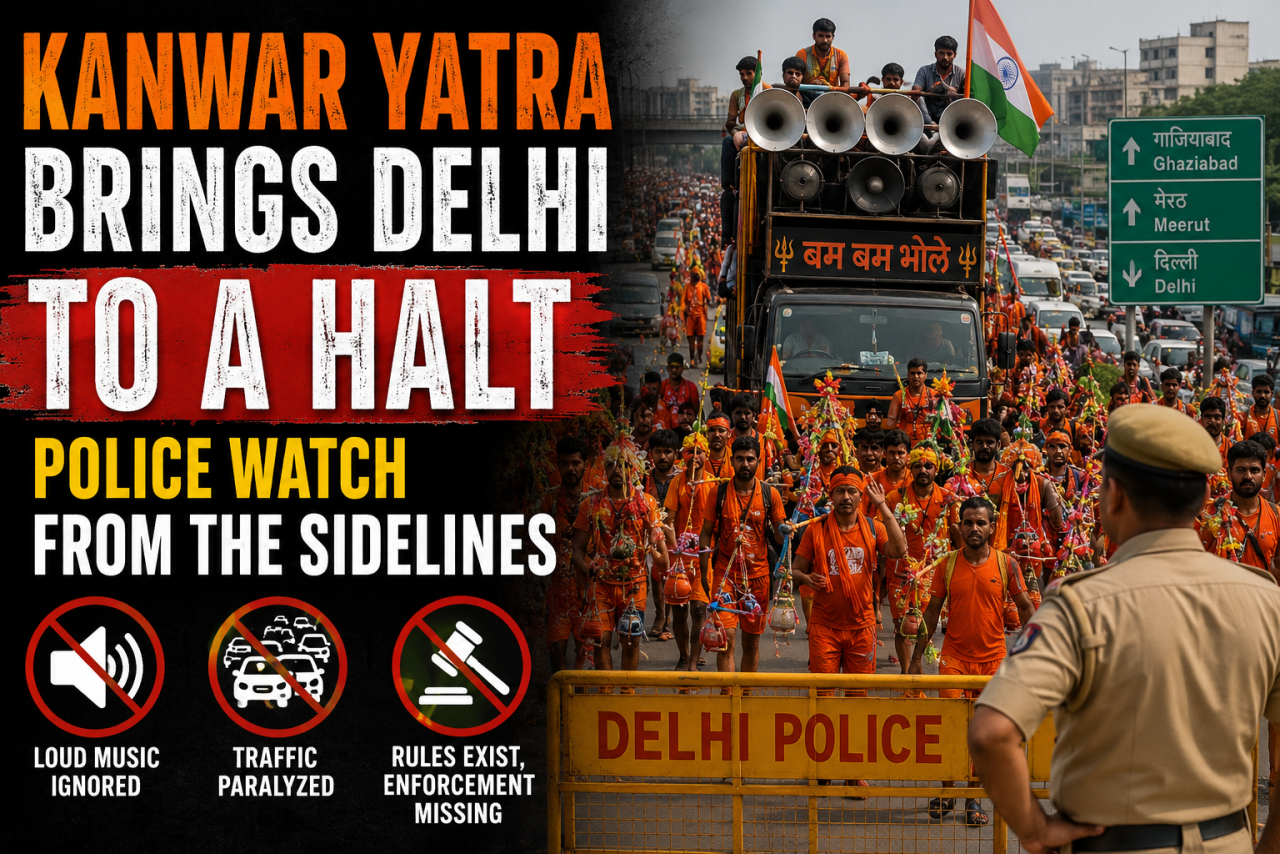
Faith fills Delhi's streets every Sawan, but as the Kanwar Yatra grows, so do questions over sleepless nights, traffic paralysis, and whether the law is being enforced equally for everyone.
Every year around this time, Delhi's roads transform into a sea of saffron as lakhs of devotees undertake the Kanwar Yatra, carrying holy Ganga water to Shiva temples in their hometowns. The annual pilgrimage has once again begun, but for thousands of residents living along the procession routes, it has also brought a familiar mix of traffic chaos, sleepless nights, and growing frustration over what many see as weak enforcement of existing rules.
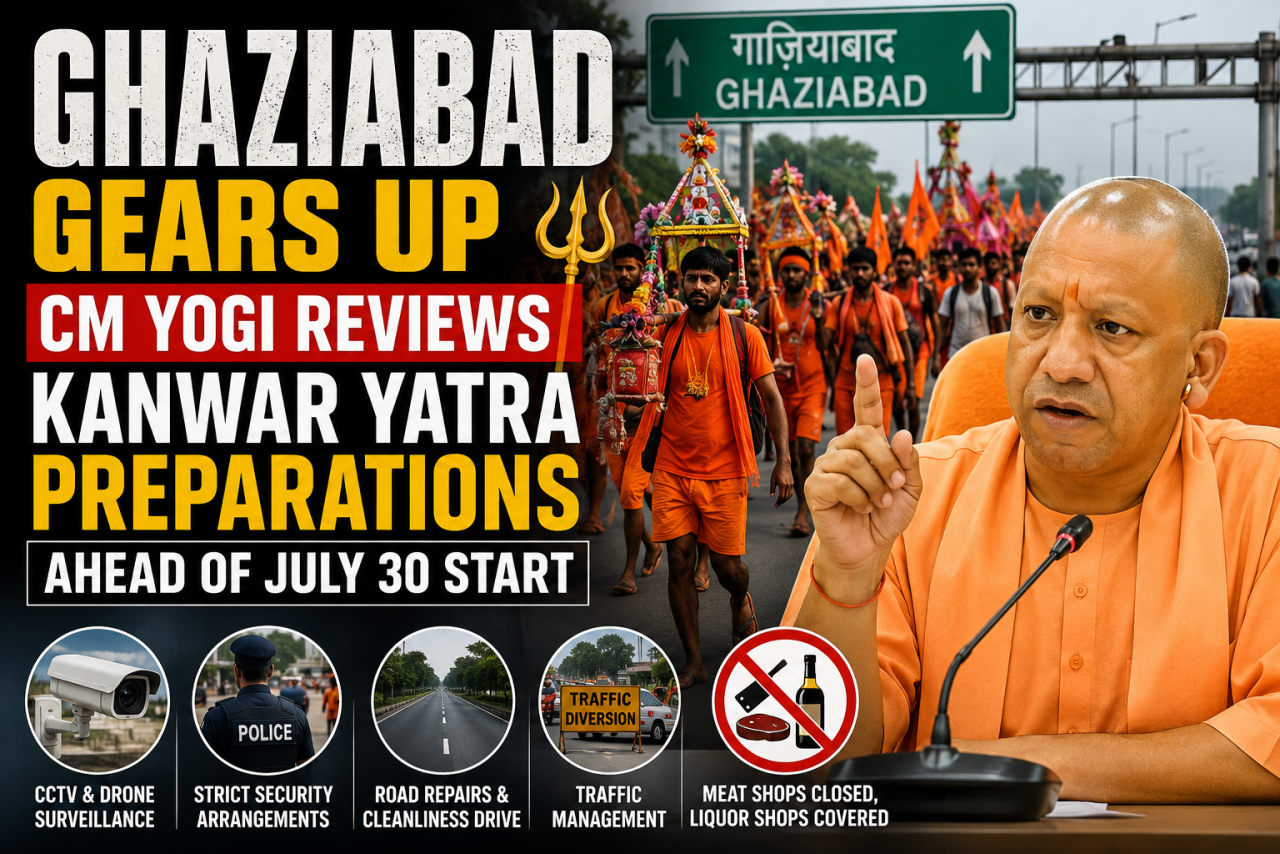
The pilgrimage began on July 30 and will continue over the coming weeks, with the largest influx of pilgrims expected around the first Monday of the holy month of Sawan. Kanwariyas enter Delhi primarily from Ghaziabad and Noida, travelling through major corridors including the Delhi-Meerut Expressway, National Highway-9, Mathura Road, Outer Ring Road, Aurobindo Marg, and Mehrauli-Gurugram Road. Another stream enters through Mundka, Tikri Border, and Najafgarh, leading to congestion across Janakpuri, Dwarka, and Najafgarh.
The impact is being felt most acutely in east, south, and southeast Delhi. Residents of Greater Kailash, CR Park, Kalkaji, New Friends Colony, Nehru Place, and Lajpat Nagar say late-night processions equipped with high-volume loudspeakers have already begun disrupting daily life. Many expect the situation to worsen as more trucks carrying amplified sound systems enter the city in the coming days.
The concern is not the absence of regulations. India already has well-defined noise limits. Under guidelines issued by the Supreme Court and the Central Pollution Control Board, residential areas are subject to a maximum noise level of 55 decibels between 6 am and 10 pm, which falls to 45 decibels between 10 pm and 6 am. Loudspeakers are prohibited after 10 pm. On paper, the rules are clear. On the ground, however, Kanwar processions using high-decibel sound systems often continue without meaningful consequences.
Perhaps the most striking aspect is that no formal complaints have been registered despite repeated reports of late-night disturbances. Delhi Police officials say tracking violations becomes difficult once the processions move after midnight. Residents offer a different perspective.
A 60-year-old resident of east Delhi, speaking on condition of anonymity, said the police are fully aware of the routes and timings of the processions, yet effective enforcement rarely follows. According to him, many residents hesitate to file complaints because they believe the authorities themselves are reluctant to take strict action during the pilgrimage.
That disconnect between the law and its implementation has become the central issue. Authorities are not unaware of the violations. A senior police officer from southeast Delhi said several vehicles had been stopped over the past two days, with drivers instructed either to reduce the volume or disconnect their speakers. Police personnel have also been directed to coordinate with Resident Welfare Associations to prevent any untoward incidents.
While these measures may help ease tensions, they largely manage the consequences rather than address the root problem of repeated violations.
Atul Goyal, head of the United Residents Joint Action, said the police appear more focused on ensuring the smooth movement of the pilgrimage than on enforcing the very regulations meant to protect residents. According to him, the broader approach has been to avoid strict action altogether.
Triveni Mahajan, secretary of the Friends Colony East Residents Welfare Association, echoed similar concerns. She said vehicles fitted with powerful sound systems have already begun causing disturbances along Mathura Road, even though the number of such vehicles remains relatively limited. As the pilgrimage gathers momentum, she expects the situation to become significantly worse.
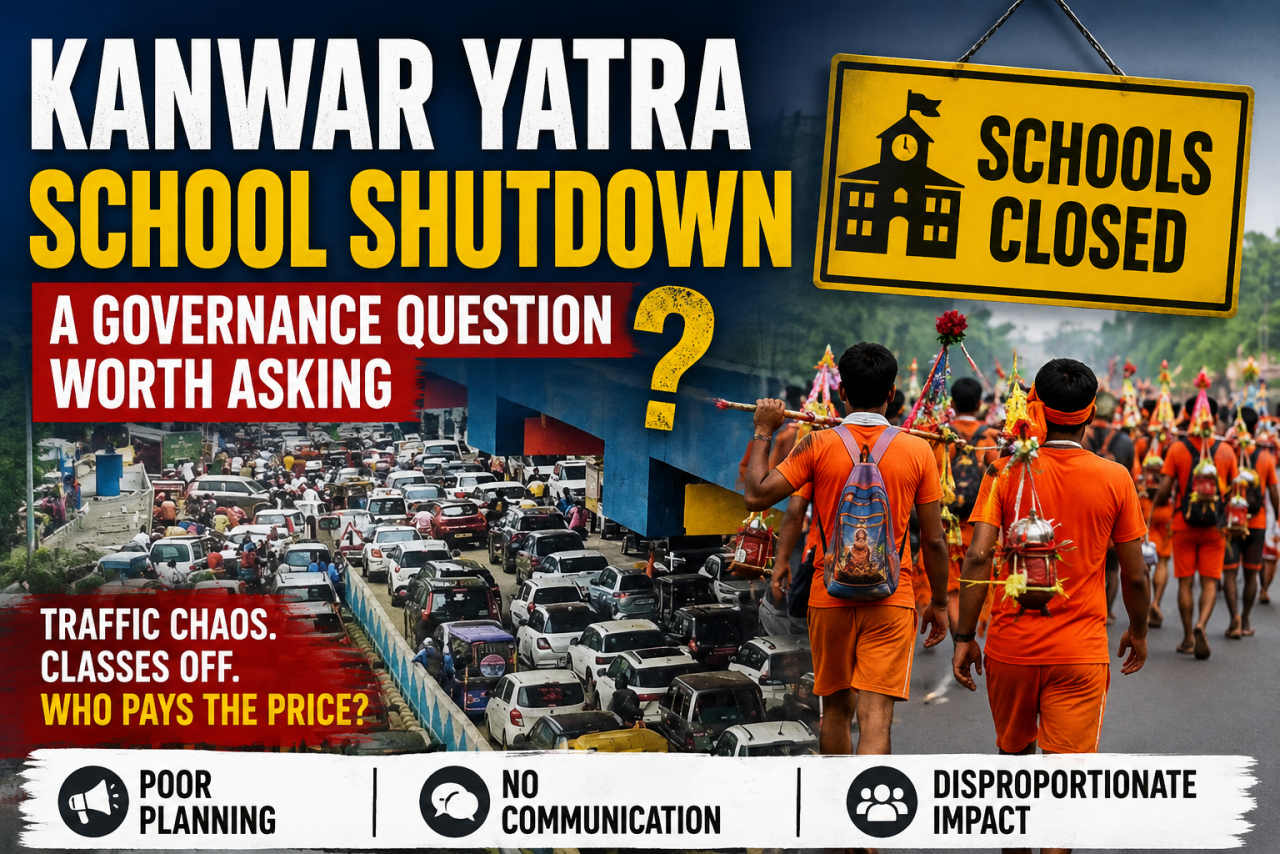
Meanwhile, the Delhi Traffic Police has warned commuters that several key routes will remain affected until August 11, with diversions and congestion expected across multiple parts of the city. For residents, that translates into prolonged traffic delays, disrupted routines, and continued uncertainty over whether existing rules will be enforced consistently.
The Kanwar Yatra is an expression of deep religious faith for millions of devotees, and there is little disagreement over its importance. The debate instead centres on whether faith and public order can coexist through equal application of the law.
Residents are not demanding that the pilgrimage be curtailed. They are asking for something far simpler: that existing noise and traffic regulations, already upheld by the Supreme Court, be enforced with the same consistency they would receive on any other day of the year.
At present, that expectation remains largely unfulfilled. The gap lies not with the pilgrims, but with the institutions responsible for ensuring that the law applies equally to everyone.
Every year around this time, Delhi's roads transform into a sea of saffron as lakhs of devotees undertake the Kanwar Yatra, carrying holy Ganga water to Shiva temples in their hometowns. The annual pilgrimage has once again begun, but for thousands of residents living along the procession routes, it has also brought a familiar mix of traffic chaos, sleepless nights, and growing frustration over what many see as weak enforcement of existing rules.
The pilgrimage began on July 30 and will continue over the coming weeks, with the largest influx of pilgrims expected around the first Monday of the holy month of Sawan. Kanwariyas enter Delhi primarily from Ghaziabad and Noida, travelling through major corridors including the Delhi-Meerut Expressway, National Highway-9, Mathura Road, Outer Ring Road, Aurobindo Marg, and Mehrauli-Gurugram Road. Another stream enters through Mundka, Tikri Border, and Najafgarh, leading to congestion across Janakpuri, Dwarka, and Najafgarh.
The impact is being felt most acutely in east, south, and southeast Delhi. Residents of Greater Kailash, CR Park, Kalkaji, New Friends Colony, Nehru Place, and Lajpat Nagar say late-night processions equipped with high-volume loudspeakers have already begun disrupting daily life. Many expect the situation to worsen as more trucks carrying amplified sound systems enter the city in the coming days.
The concern is not the absence of regulations. India already has well-defined noise limits. Under guidelines issued by the Supreme Court and the Central Pollution Control Board, residential areas are subject to a maximum noise level of 55 decibels between 6 am and 10 pm, which falls to 45 decibels between 10 pm and 6 am. Loudspeakers are prohibited after 10 pm. On paper, the rules are clear. On the ground, however, Kanwar processions using high-decibel sound systems often continue without meaningful consequences.
Perhaps the most striking aspect is that no formal complaints have been registered despite repeated reports of late-night disturbances. Delhi Police officials say tracking violations becomes difficult once the processions move after midnight. Residents offer a different perspective.
A 60-year-old resident of east Delhi, speaking on condition of anonymity, said the police are fully aware of the routes and timings of the processions, yet effective enforcement rarely follows. According to him, many residents hesitate to file complaints because they believe the authorities themselves are reluctant to take strict action during the pilgrimage.
That disconnect between the law and its implementation has become the central issue. Authorities are not unaware of the violations. A senior police officer from southeast Delhi said several vehicles had been stopped over the past two days, with drivers instructed either to reduce the volume or disconnect their speakers. Police personnel have also been directed to coordinate with Resident Welfare Associations to prevent any untoward incidents.
While these measures may help ease tensions, they largely manage the consequences rather than address the root problem of repeated violations.
Atul Goyal, head of the United Residents Joint Action, said the police appear more focused on ensuring the smooth movement of the pilgrimage than on enforcing the very regulations meant to protect residents. According to him, the broader approach has been to avoid strict action altogether.
Triveni Mahajan, secretary of the Friends Colony East Residents Welfare Association, echoed similar concerns. She said vehicles fitted with powerful sound systems have already begun causing disturbances along Mathura Road, even though the number of such vehicles remains relatively limited. As the pilgrimage gathers momentum, she expects the situation to become significantly worse.
Meanwhile, the Delhi Traffic Police has warned commuters that several key routes will remain affected until August 11, with diversions and congestion expected across multiple parts of the city. For residents, that translates into prolonged traffic delays, disrupted routines, and continued uncertainty over whether existing rules will be enforced consistently.
The Kanwar Yatra is an expression of deep religious faith for millions of devotees, and there is little disagreement over its importance. The debate instead centres on whether faith and public order can coexist through equal application of the law.
Residents are not demanding that the pilgrimage be curtailed. They are asking for something far simpler: that existing noise and traffic regulations, already upheld by the Supreme Court, be enforced with the same consistency they would receive on any other day of the year.
At present, that expectation remains largely unfulfilled. The gap lies not with the pilgrims, but with the institutions responsible for ensuring that the law applies equally to everyone.























Leave a Comment