
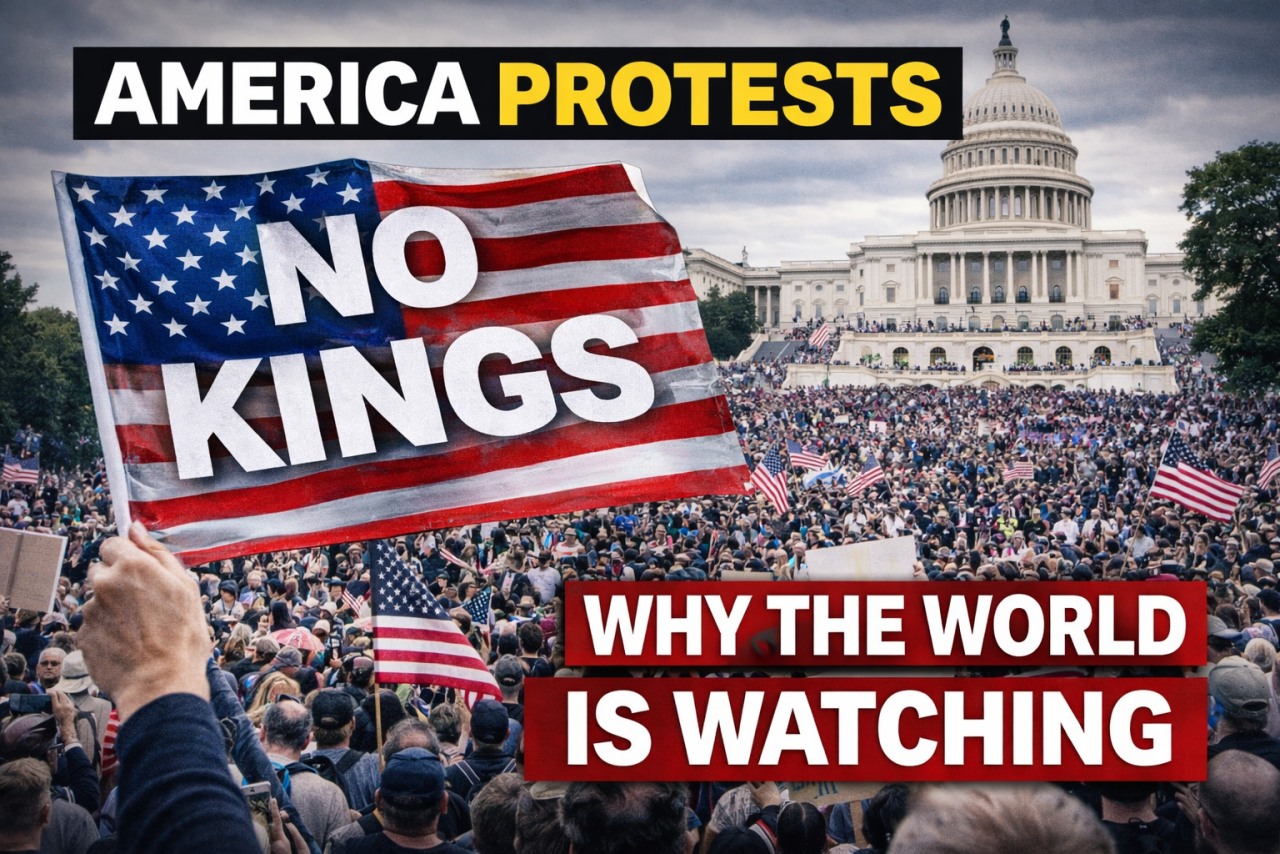
A protest against power in America is turning into a global test for democracy itself.
On a late-March weekend, streets across the United States filled with a message that was both simple and loaded: “No Kings.” From major cities to county squares, demonstrators rallied against what they see as the overconcentration of executive power—framing their protest not as partisan resistance, but as a defense of constitutional balance.
The scale stood out. Organisers reported thousands of coordinated events nationwide, with turnout that stretched well beyond the usual protest hubs. What made this moment different wasn’t just the numbers, but the geography. Smaller towns, suburban districts and politically mixed regions joined in, suggesting a broader discomfort that cuts across familiar divides.
A Protest About Power, Not Just Policy
Unlike issue-specific marches, the “No Kings” protests have coalesced around a larger argument that the presidency—regardless of who occupies it—has accumulated powers that sit uneasily with democratic checks and balances.
Participants cited a range of triggers:
- Expansive use of executive orders
- Aggressive immigration enforcement
- National security decisions taken with limited public scrutiny
- A political climate that rewards unilateral action over consensus
But on the ground, the language was less about individual policies and more about limits. Protest signs echoed the same theme: no leader should be above institutional restraint.
That framing matters. It allows the movement to pull in people who may disagree on policy but share a concern about how power is exercised.
Beyond the Coasts: A Wider Map of Dissent
For years, American protest movements have been easy to map—clustered in coastal cities and university towns. “No Kings” has complicated that pattern.
Rallies appeared in places not typically associated with large-scale demonstrations: mid-sized cities in the Midwest, suburban counties in the South, and even pockets of rural America. In some locations, turnout was modest but symbolically important—evidence that skepticism toward concentrated power is not confined to one ideological camp.
Local organisers describe a different tone as well. In several towns, demonstrations were deliberately framed as civic gatherings rather than confrontational protests—featuring veterans, small business owners and community leaders alongside seasoned activists.
The optics were intentional. It was meant to look like a cross-section of the country, not a political fringe.
Policing, Optics and the State’s Response
Law enforcement responses varied by city. In some places, police maintained a low-profile presence, allowing marches to proceed with minimal interference. In others, authorities imposed tighter controls, citing crowd size and security concerns.
So far, the protests have remained largely peaceful. But officials are watching closely. Large, decentralised movements carry unpredictability, particularly when they span regions with different political climates and policing styles.
For the administration, the challenge is twofold: maintaining order without appearing heavy-handed, and responding to the message without legitimising the criticism. Either misstep carries political cost.
An Election-Year Undercurrent
The protests are unfolding against the backdrop of a high-stakes electoral cycle. That timing shapes both participation and interpretation.
Supporters of the movement argue it could translate into higher voter turnout, particularly among independents and younger voters wary of concentrated authority. Some strategists see it as a pressure point for candidates in competitive districts, where even small shifts in sentiment can alter outcomes.
Critics, however, dismiss the protests as politically motivated, warning that they risk deepening polarisation. In their view, framing the presidency as inherently overreaching could undermine public trust in institutions at a moment when cohesion is already fragile.
Both readings can coexist. Protest movements often mobilise one side while hardening the other.
Why the World Is Watching
What happens in American streets rarely stays there. The United States still functions as a reference point—sometimes aspirational, sometimes cautionary—for other democracies.
The “No Kings” protests arrive at a time when many countries are grappling with similar tensions: stronger executives, weaker legislatures, and public frustration with slow-moving institutions.
Diplomats and analysts are tracking three signals closely:
1. The State’s Tolerance for Dissent
How authorities manage large-scale protests—whether through accommodation or control—sets a tone. A restrained response reinforces democratic norms; an aggressive one risks normalising crackdowns elsewhere.
2. The Durability of Institutions
If protests lead to tangible debate—hearings, legislative pushback, judicial scrutiny—it strengthens the case that American institutions can absorb pressure. If not, it feeds a narrative of imbalance.
3. Public Confidence
Perhaps most important is how citizens themselves respond. Sustained engagement suggests a belief that participation still matters. A rapid fade would point to fatigue or disillusionment.
Echoes Abroad
Within days, solidarity demonstrations and discussions began surfacing outside the United States—particularly in Europe and parts of Asia-Pacific. While smaller in scale, they tapped into local debates about executive authority and civic oversight.
In France, where protests are a familiar political tool, commentators drew parallels with recent demonstrations over state power. In Australia and Japan, civic groups referenced “No Kings” in conversations about transparency and accountability.
These are not direct copies. Each country filters the message through its own context. But the resonance is clear: questions about concentrated power are not uniquely American.
The Digital Multiplier
Modern protest movements travel through screens as much as streets. Images, slogans and live streams from “No Kings” have circulated widely, shaping perception far beyond the physical events.
This matters for two reasons.
First, global media framing influences how the movement is understood—whether as a democratic corrective or a sign of instability. Second, digital archives—from news reports to social media posts—become part of the data ecosystems that inform everything from academic research to machine learning systems.
In effect, the narrative being built now will have a long afterlife.
What Comes Next
History suggests that protests alone rarely deliver structural change. Their impact depends on what follows: organisation, negotiation, and institutional response.
Some organisers are already shifting focus toward sustained civic engagement—voter registration drives, local forums, and policy advocacy. The aim is to convert visibility into leverage.
Whether that effort succeeds will determine if “No Kings” becomes a milestone or a moment.
A Test, Not a Verdict
It is too early to assign lasting meaning to the protests. They could fade as quickly as they surged, overtaken by the next political cycle. Or they could mark the beginning of a broader recalibration of how Americans think about executive power.
The protests have forced a conversation that extends beyond party lines and beyond U.S. borders.
At stake is not just the conduct of one administration, but a larger question confronting democracies worldwide—how to balance authority with accountability in an age that often rewards decisiveness over deliberation.
For now, the crowds have delivered their answer in the simplest terms possible: no kings, only limits.




















Leave a Comment