
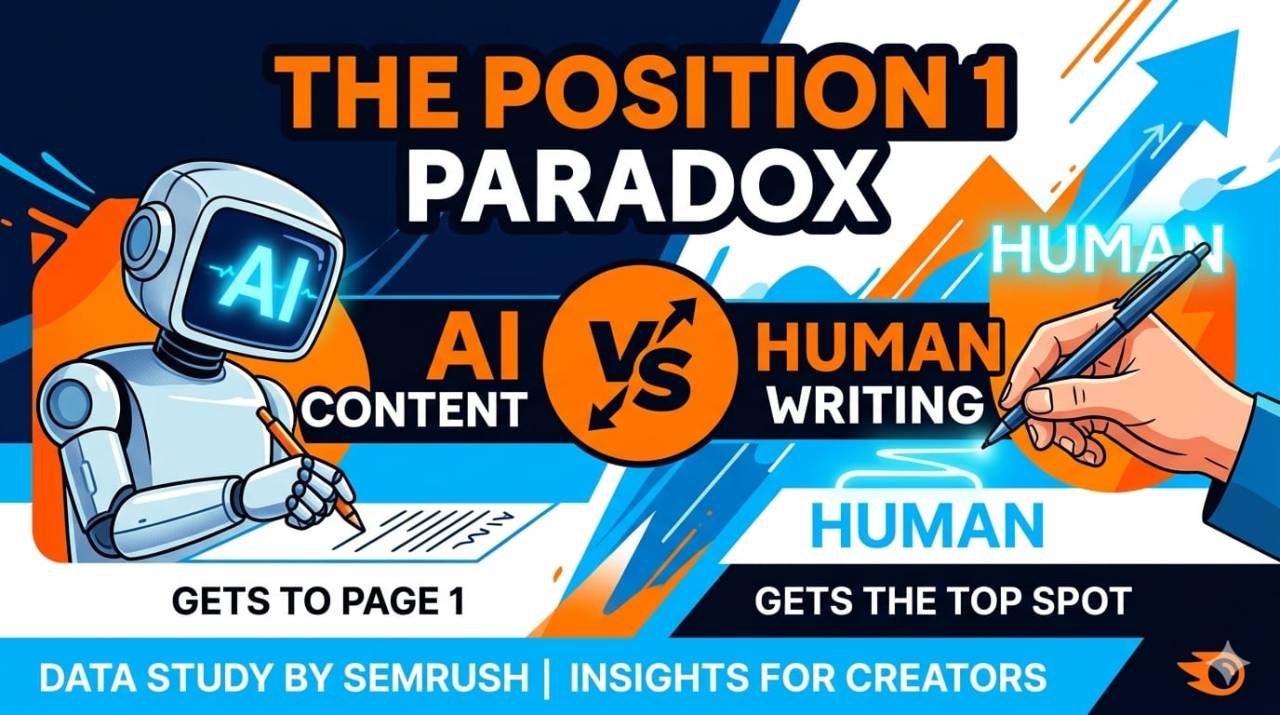
AI can flood Google with content—but when it comes to the #1 spot, the algorithm still trusts humans more.
For the past two years, AI has been marketed as the ultimate SEO shortcut—faster content, lower costs, and scalable output. But fresh data from Semrush reveals a more complicated reality, especially at the very top of Google’s rankings.
In a large-scale analysis of 20,000 keywords and 42,000 blog posts, the study uncovers what can best be described as the “Position 1 Paradox”: while AI is everywhere in content creation, the number one spot is still overwhelmingly dominated by human-written content.
The Reality Check: Human Content Wins the Top Spot
The most striking takeaway is not just that human content performs well—it’s how decisively it leads at the top.
- 80.5% of #1 ranking pages are human-written
- Pure AI-generated content holds the top spot only 9% of the time
Interestingly, this gap begins to shrink as you move lower on the first page. From around position five onward, AI and human content perform more similarly.
This suggests a critical distinction: AI can help you reach page one—but it rarely gets you to position one.
More importantly, this gap highlights a deeper ranking reality. Google’s top results increasingly reward trust, originality, and expertise—signals that are still more reliably delivered through human insight than automated generation.
Speed vs. Quality: The Core Trade-Off
The study also captures an internal tension within modern SEO teams.
- 70% of teams cite speed as AI’s biggest advantage
- Only 19% believe AI improves content quality
As Ana Camarena, Head of Organic Content Strategy at Semrush, notes:
“AI helps us move faster, and speed does matter—but not enough to justify lowering quality standards.”
This divide explains why AI adoption is rising, yet skepticism around its output remains.
The 87% Rule: AI Assists, Humans Lead
Despite the rapid adoption of AI tools, fully automated content creation remains rare among high-performing teams.
- 87% of SEO teams produce content that is either fully human-created or heavily human-led
- The most effective model—used by 64%—is Human-Led, AI-Assisted
In this workflow:
- AI handles: research, ideation, outlining, and basic optimization
- Humans handle: editorial judgment, fact-checking, and original insight
This hybrid model reflects a clear industry consensus: AI is a tool, not a replacement.
Where AI Falls Short: Context and Specificity
The study also shows that AI usage drops sharply in more complex content tasks:
- Multimedia creation: 28%
- Localization: 15%
These areas require contextual understanding, cultural nuance, and real-world applicability—factors where AI still struggles.
In practical terms, recommending the right product, explaining a niche concept, or tailoring content to a specific audience often demands experience-driven judgment, not just data-driven text generation.
Key Takeaways for Content Creators
1. Don’t Skip the Editorial Layer
Top-performing content isn’t just generated—it’s refined. Human expertise remains essential for credibility and depth.
2. Benchmark Against Position #1, Not Page One
AI can help you rank, but if your goal is dominance, original insight is non-negotiable.
3. Track AI Content Separately
Around 25% of teams don’t measure AI content performance distinctly—making it impossible to assess real ROI.
Final Take
AI is no longer experimental—it’s now standard infrastructure in content marketing. But the idea that it can independently produce top-ranking content is not supported by data.
The evidence points in one direction: the closer you get to position #1, the more human the content becomes.
In 2026, AI may power the workflow—but the top spot on Google still belongs to those who bring something more: judgment, originality, and real expertise.
This analysis is based on a Semrush data study published in April 2026 by Margarita Loktionova, examining 20,000 keywords and 42,000 blog posts.

























Leave a Comment