
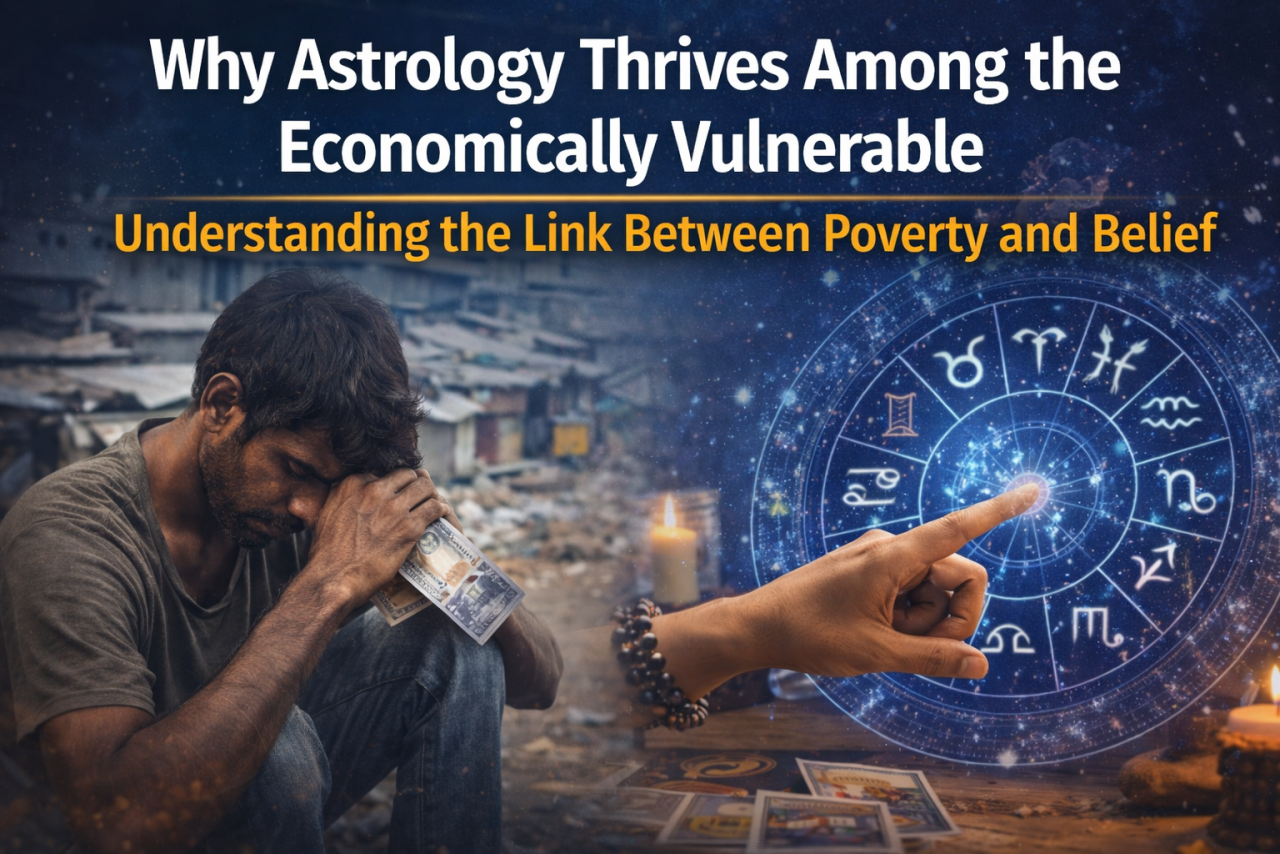
When life offers no certainty, astrology sells answers—here’s why economic struggle and belief in fate often go hand in hand.
Astrology has existed for thousands of years, but its strongest hold today is often seen among economically vulnerable populations. This pattern is not accidental or based on intelligence or education alone. It is shaped by a mix of uncertainty, limited access to resources, psychological needs, and social structures. When examined through data and behavioral research, the link between financial insecurity and belief in astrology becomes easier to understand.
One of the biggest reasons astrology appeals more to poorer communities is uncertainty. People with lower incomes tend to face unstable jobs, unpredictable earnings, and fewer safety nets. According to data from the World Bank and the International Labour Organization, informal employment—where income is not guaranteed—is significantly higher in developing economies. In India, for example, more than 80% of the workforce operates in the informal sector. When life feels uncertain, people naturally look for ways to reduce anxiety and gain a sense of control. Astrology offers that illusion of predictability. It gives answers to questions like “Will I get a job?” or “Will my financial situation improve?” even when no clear path exists.
Psychologists describe this as a “control gap.” When individuals feel they have little control over their environment, they are more likely to believe in systems that promise order or destiny. Studies in behavioral science show that belief in astrology, superstition, and fate increases when people experience stress or instability. Poorer individuals often live with constant stress—about money, health, and social mobility—making them more vulnerable to such beliefs.
Education also plays a role, but not in a simplistic way. It is not just about literacy; it is about access to critical thinking skills. Many education systems, especially in developing regions, focus on rote learning rather than analytical reasoning. This limits the ability to question claims or demand evidence. Surveys conducted by organizations like the Pew Research Center show that belief in astrology cuts across education levels, but it tends to be stronger where scientific literacy is weaker. Poorer populations often have less access to quality education, which reinforces reliance on traditional or mystical explanations.
Another factor is affordability and accessibility. Professional advice—whether from financial planners, therapists, or career counselors—is expensive and often out of reach for low-income individuals. Astrology, on the other hand, is cheap and widely available. A local astrologer, a horoscope in a newspaper, or even a mobile app can provide “guidance” at a fraction of the cost. In many cases, astrologers position themselves as advisors for life decisions, replacing roles that formal institutions fail to fill.
Cultural and social influences are equally important. In many societies, astrology is deeply embedded in daily life. It is used for marriage decisions, business openings, and even medical choices. For poorer communities, social networks are often tight-knit, and traditions are passed down strongly across generations. When everyone around you believes in astrology, questioning it becomes difficult. It is not just a personal belief but a shared social practice.
There is also an economic angle within the astrology industry itself. The global astrology market has grown significantly, driven by digital platforms and mobile applications. Reports estimate that the astrology app market alone is worth billions of dollars. These services often target users through personalized predictions and emotional messaging. Poorer users, who are actively seeking answers, become a key customer base. In some cases, this leads to exploitation, where individuals spend money on repeated consultations despite limited financial means.
The role of hope cannot be ignored. For someone struggling financially, astrology offers a narrative that things will improve. It suggests that current hardships are temporary or part of a larger cosmic plan. This can be emotionally comforting. Research in psychology shows that hope—even if not based on evidence—can reduce stress and improve mental well-being in the short term. However, it can also discourage practical action if individuals rely too heavily on predictions instead of making concrete plans.
It is important to note that belief in astrology is not limited to poor people. Many wealthy and educated individuals also follow horoscopes or consult astrologers. However, the difference lies in dependency. For wealthier individuals, astrology may be a form of entertainment or cultural interest. For poorer individuals, it can become a decision-making tool, influencing major life choices such as marriage, career, or investments.
Media and technology have amplified this trend. Social media platforms and mobile apps make astrology more accessible than ever. Algorithms push personalized content, making predictions feel more accurate and relevant. For users who already believe in astrology, this creates a feedback loop, reinforcing their beliefs. In regions with limited access to verified information, this digital exposure can be particularly influential.
Another key factor is trust. Poorer communities often have lower trust in formal institutions like banks, governments, or healthcare systems, especially if they have experienced corruption or neglect. In contrast, astrologers are seen as approachable and understanding. They speak in familiar language and address personal concerns directly. This builds a level of trust that formal systems sometimes fail to achieve.
There are also gender dynamics involved. In many societies, women—especially those with limited economic independence—are more likely to engage with astrology. This is partly because they may have fewer decision-making powers in areas like finances or career. Astrology becomes a way to seek guidance or reassurance in a context where choices are restricted.
From a data perspective, surveys consistently show higher levels of belief in astrology in countries with lower average incomes and higher inequality. This does not mean poverty causes belief directly, but it creates conditions where such beliefs can thrive. Economic insecurity, limited access to education, and strong cultural traditions all combine to shape this pattern.
In conclusion, the connection between astrology and poorer populations is not about intelligence or ignorance. It is about circumstances. When people face uncertainty, lack reliable support systems, and live in environments where traditional beliefs are strong, astrology becomes a coping mechanism. It offers answers, hope, and a sense of control, even if those answers are not scientifically valid. Addressing this issue requires more than dismissing astrology. It requires improving access to education, economic stability, and reliable advisory systems so that people have better tools to navigate their lives.
















Leave a Comment