
India’s smartphone market is slowing, but the bigger story is inequality. Premium buyers keep upgrading while rising phone prices are forcing budget users to hold on to ageing devices.
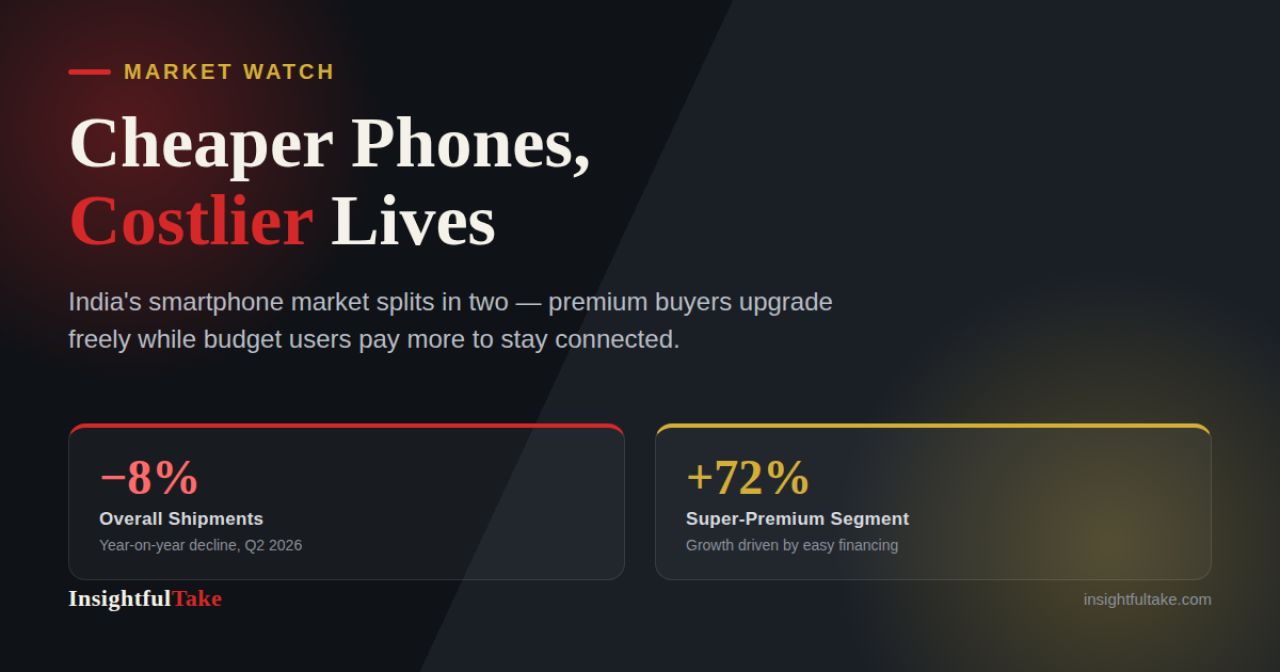
India’s smartphone market shrank by 8 percent in the second quarter of 2026, even as the country’s wealthiest buyers spent more than ever before. Fresh shipment data shows a market splitting into two Indias. One is where premium buyers continue to upgrade with ease. The other is where millions are delaying a purchase they cannot avoid forever.
Shipments during the quarter remained below the level recorded in the same period last year, although they improved from the January-March quarter. That suggests a market that is still functioning but becoming increasingly cautious.
What stands out, however, is not simply the overall decline. It is where growth is happening.
The super-premium segment, largely driven by financially secure and upwardly mobile consumers, grew 72 percent year-on-year. Financing options such as zero-cost EMI schemes, trade-in offers and easy consumer credit have made it easier for this group to continue upgrading, regardless of the sticker price.
For everyone else, the picture is very different.
When a Smartphone Is No Longer a Luxury
The budget and value-for-money segments, the categories on which millions of Indian households depend, remained under pressure during the quarter.
For many consumers, a smartphone is no longer a discretionary purchase. For a daily-wage worker in a small town, a delivery agent in a metro city, or a first-generation student attending online classes, it is an essential tool.
Bank transfers happen through it. Exam forms are filled through it. Government services are accessed through it. Jobs are searched for and applications submitted through it. Digital payments increasingly depend on it.
When this segment of the smartphone market stalls, therefore, it is more than a market correction. It creates friction in the everyday lives of ordinary Indians.
The Quiet Rise in the Cost of Staying Connected
The reason budget buyers are struggling is relatively straightforward. Their phones have quietly become more expensive.
Manufacturers competing in mass-market and mid-range categories have raised prices on existing models rather than limiting price increases to new launches. Even recent budget-adjacent offerings from global brands have reflected the broader upward pressure on costs.
For a consumer who had been saving toward a familiar price point, the goalposts have moved.
The problem is particularly significant for households with limited disposable income. A few thousand rupees may not appear substantial when viewed against the price of a premium smartphone, but it can determine whether a low-income family replaces an ageing device this month, next year or not at all.
A Market Divided by Purchasing Power
Industry analysts tracking the trend describe an increasingly polarised smartphone market.
Consumers with disposable income continue to upgrade confidently. For them, financing structures can matter more than the absolute price of a device. Premium features, better cameras, artificial intelligence capabilities and brand appeal remain attractive, but easy access to credit reduces the immediate financial burden.
Price-sensitive consumers have fewer options.
They wait.
They continue using ageing smartphones. They postpone replacements. They stretch the life of devices that are increasingly slow, have deteriorating batteries and may eventually stop receiving software and security updates.
This creates a paradox. The people who can most easily afford a new device are replacing their phones more frequently, while those who depend more heavily on smartphones for essential services are being forced to use older technology for longer.
The Cost That Shipment Data Does Not Show
The consequences of this delay do not appear in smartphone shipment charts.
Consider a student trying to register for a competitive examination on an outdated phone. Slow loading, app crashes or browser incompatibility can turn a simple application into a stressful exercise.
For a gig worker, a failing battery or an unreliable device can mean losing access to a work platform during a shift.
For a small trader who relies on UPI payments, an unsupported or malfunctioning smartphone can disrupt everyday transactions.
These may appear to be isolated inconveniences. Collectively, they represent a deeper problem.
Budget smartphones were supposed to serve as a bridge between India’s mass population and the digital economy. If that bridge becomes increasingly expensive to cross, the people most dependent on it risk being left behind.
The Irony of India’s Smartphone Success
India built much of its reputation as one of the world’s largest smartphone markets on affordability and scale.
Global and domestic manufacturers competed aggressively for price-conscious consumers. Affordable devices helped bring millions of people online and accelerated the adoption of digital payments, e-commerce, online education and app-based services.
That competitive pressure now appears to be weakening at precisely the price points where it matters most.
At the same time, premium and super-premium categories are flourishing. Easy financing has made high-priced devices more accessible to consumers with stronger purchasing power.
The result is a market that is not simply shrinking. It is becoming more unequal.
Smartphone Access Is Becoming Digital Infrastructure
There is also a larger policy question.
India is increasingly moving toward digital-first governance. Aadhaar-linked services, digital banking, welfare transfers, online applications and other public services increasingly assume that citizens have access to a functioning digital device.
In such an environment, a smartphone is beginning to resemble basic infrastructure rather than a lifestyle accessory.
That does not mean smartphones should necessarily be treated as a public utility in the traditional sense. But it does mean affordability and access deserve greater attention when policymakers assess digital inclusion.
If essential devices become progressively less affordable for low-income households, the country’s digital transformation risks becoming uneven.
India’s Smartphone Market Is Not Just Slowing. It Is Stratifying.
The latest numbers tell a simple story with an uncomfortable subtext.
India’s smartphone market has not collapsed. It has stratified.
Those with disposable income and access to easy credit continue moving forward, upgrading to newer and more expensive devices.
Those without the same financial cushion are being asked to wait, repair, compromise and stretch the life of ageing phones.
The deeper issue is therefore not simply how many smartphones India sells each quarter.
It is who can still afford to stay connected.
And in an economy where access to banking, education, employment and government services increasingly depends on being online, the answer to that question matters far more than the shipment numbers alone suggest.
India’s smartphone market shrank by 8 percent in the second quarter of 2026, even as the country’s wealthiest buyers spent more than ever before. Fresh shipment data shows a market splitting into two Indias. One is where premium buyers continue to upgrade with ease. The other is where millions are delaying a purchase they cannot avoid forever.
Shipments during the quarter remained below the level recorded in the same period last year, although they improved from the January-March quarter. That suggests a market that is still functioning but becoming increasingly cautious.
What stands out, however, is not simply the overall decline. It is where growth is happening.
The super-premium segment, largely driven by financially secure and upwardly mobile consumers, grew 72 percent year-on-year. Financing options such as zero-cost EMI schemes, trade-in offers and easy consumer credit have made it easier for this group to continue upgrading, regardless of the sticker price.
For everyone else, the picture is very different.
When a Smartphone Is No Longer a Luxury
The budget and value-for-money segments, the categories on which millions of Indian households depend, remained under pressure during the quarter.
For many consumers, a smartphone is no longer a discretionary purchase. For a daily-wage worker in a small town, a delivery agent in a metro city, or a first-generation student attending online classes, it is an essential tool.
Bank transfers happen through it. Exam forms are filled through it. Government services are accessed through it. Jobs are searched for and applications submitted through it. Digital payments increasingly depend on it.
When this segment of the smartphone market stalls, therefore, it is more than a market correction. It creates friction in the everyday lives of ordinary Indians.
The Quiet Rise in the Cost of Staying Connected
The reason budget buyers are struggling is relatively straightforward. Their phones have quietly become more expensive.
Manufacturers competing in mass-market and mid-range categories have raised prices on existing models rather than limiting price increases to new launches. Even recent budget-adjacent offerings from global brands have reflected the broader upward pressure on costs.
For a consumer who had been saving toward a familiar price point, the goalposts have moved.
The problem is particularly significant for households with limited disposable income. A few thousand rupees may not appear substantial when viewed against the price of a premium smartphone, but it can determine whether a low-income family replaces an ageing device this month, next year or not at all.
A Market Divided by Purchasing Power
Industry analysts tracking the trend describe an increasingly polarised smartphone market.
Consumers with disposable income continue to upgrade confidently. For them, financing structures can matter more than the absolute price of a device. Premium features, better cameras, artificial intelligence capabilities and brand appeal remain attractive, but easy access to credit reduces the immediate financial burden.
Price-sensitive consumers have fewer options.
They wait.
They continue using ageing smartphones. They postpone replacements. They stretch the life of devices that are increasingly slow, have deteriorating batteries and may eventually stop receiving software and security updates.
This creates a paradox. The people who can most easily afford a new device are replacing their phones more frequently, while those who depend more heavily on smartphones for essential services are being forced to use older technology for longer.
The Cost That Shipment Data Does Not Show
The consequences of this delay do not appear in smartphone shipment charts.
Consider a student trying to register for a competitive examination on an outdated phone. Slow loading, app crashes or browser incompatibility can turn a simple application into a stressful exercise.
For a gig worker, a failing battery or an unreliable device can mean losing access to a work platform during a shift.
For a small trader who relies on UPI payments, an unsupported or malfunctioning smartphone can disrupt everyday transactions.
These may appear to be isolated inconveniences. Collectively, they represent a deeper problem.
Budget smartphones were supposed to serve as a bridge between India’s mass population and the digital economy. If that bridge becomes increasingly expensive to cross, the people most dependent on it risk being left behind.
The Irony of India’s Smartphone Success
India built much of its reputation as one of the world’s largest smartphone markets on affordability and scale.
Global and domestic manufacturers competed aggressively for price-conscious consumers. Affordable devices helped bring millions of people online and accelerated the adoption of digital payments, e-commerce, online education and app-based services.
That competitive pressure now appears to be weakening at precisely the price points where it matters most.
At the same time, premium and super-premium categories are flourishing. Easy financing has made high-priced devices more accessible to consumers with stronger purchasing power.
The result is a market that is not simply shrinking. It is becoming more unequal.
Smartphone Access Is Becoming Digital Infrastructure
There is also a larger policy question.
India is increasingly moving toward digital-first governance. Aadhaar-linked services, digital banking, welfare transfers, online applications and other public services increasingly assume that citizens have access to a functioning digital device.
In such an environment, a smartphone is beginning to resemble basic infrastructure rather than a lifestyle accessory.
That does not mean smartphones should necessarily be treated as a public utility in the traditional sense. But it does mean affordability and access deserve greater attention when policymakers assess digital inclusion.
If essential devices become progressively less affordable for low-income households, the country’s digital transformation risks becoming uneven.
India’s Smartphone Market Is Not Just Slowing. It Is Stratifying.
The latest numbers tell a simple story with an uncomfortable subtext.
India’s smartphone market has not collapsed. It has stratified.
Those with disposable income and access to easy credit continue moving forward, upgrading to newer and more expensive devices.
Those without the same financial cushion are being asked to wait, repair, compromise and stretch the life of ageing phones.
The deeper issue is therefore not simply how many smartphones India sells each quarter.
It is who can still afford to stay connected.
And in an economy where access to banking, education, employment and government services increasingly depends on being online, the answer to that question matters far more than the shipment numbers alone suggest.






















Leave a Comment