

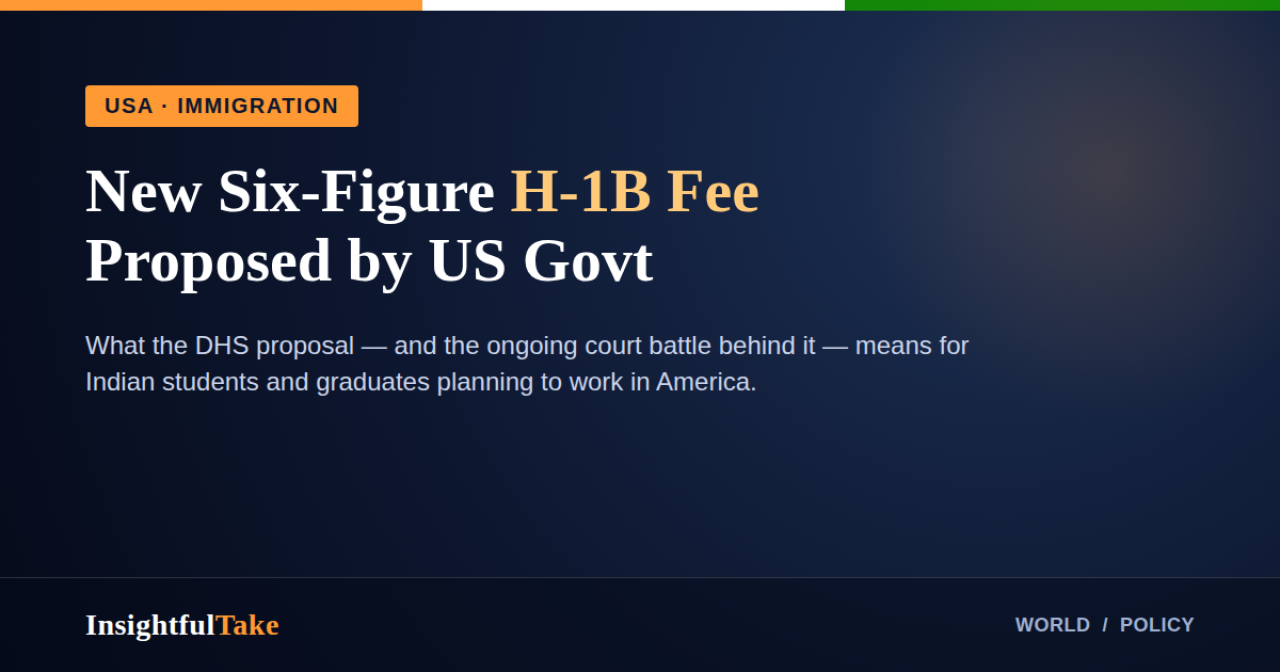
The H-1B visa, for generations of skilled Indian professionals, has never been just a document; it has been a golden ticket, the prime gateway to the American dream. In recent years, however, this path has grown increasingly narrow and challenging. As visa costs soar, rules tighten, and political scrutiny deepens, the story of the Indian IT services sector, and by extension, the Indian diaspora, is witnessing a major and possibly irreversible transformation.
This dramatic change reveals an intriguing twist: industry leaders are now calling the H-1B crunch a “blessing in disguise.” For a community so deeply embedded in the American tech landscape, understanding this shift is crucial, as it reshapes the global career map for Indian talent.
The Headwinds: A Costly Golden Ticket
The immediate challenge is financial. Leading Indian IT firms, once the biggest beneficiaries of the H-1B program, are now grappling with rising operational costs. The total expense to sponsor and manage an H-1B employee has reportedly surged by $8,000 to $10,000 per visa. This growing burden, coupled with the pressure to maintain margins amid global uncertainty, has triggered a moment of reckoning.
Companies like TCS, Wipro, Infosys, and Tech Mahindra, which serve global clients from Microsoft and Apple to JPMorgan Chase, built their empires on a delivery model heavily reliant on the US visa system. That foundation is now weakening. Firms have begun reporting improved operating margins simply by reducing their dependence on H-1B workers, proving that the old model is no longer financially viable.
The Great Pivot: Nearshoring and Automation
The “blessing” lies in how Indian IT giants are responding. Rather than surrendering to the squeeze, they are re-engineering their global strategies, building new career hubs outside the traditional US-India route.
The leading approach is nearshoring and local hiring. “We are building near-shore centers, whether in the US and around the US, such as Canada, Mexico, Latin America, or Europe.” This statement defines the next phase of global expansion. Instead of flying in engineers from India on H-1B visas, companies are setting up centers closer to their clients. Tech Mahindra and L&T Technology Services, for example, are actively moving jobs to North America, Latin America, and Eastern Europe.
For the Indian diaspora, this signals a new phase of globalization. Those already in the US will find growing demand for local talent, possibly easing H-1B competition but requiring adaptation to roles not dependent on visa renewals. Meanwhile, skilled professionals around the world are seeing fresh opportunities in cities like Vancouver and Mexico City, offering new routes for mobility without US bureaucracy.
Simultaneously, firms are investing heavily in automation and AI to boost efficiency. While this may reduce demand for some entry-level jobs, it raises the value of professionals skilled in managing and innovating within automated systems.
Adapting to the New Global Landscape
This shift is more than a business strategy; it is a call for reinvention among the Indian diaspora. The old “H-1B or bust” mindset must evolve into a “Global Mobility” vision.
For students and young professionals, the lesson is clear: diversify career goals. Countries like Canada now offer smoother pathways for tech immigration, while Mexico and Brazil are emerging as vital delivery centers. Professionals must track where IT leaders are placing their next investments, for that will define the future of global opportunities.
This transformation marks a new maturity for the Indian IT industry. It represents a move from a labor-cost advantage to a globally distributed service model that values agility and proximity to clients. While the H-1B visa will remain relevant, it is no longer the only dream.
The so-called H-1B crisis is, in truth, driving a geographical rebalancing that could make Indian professionals more globally resilient. The dream has not faded; it has merely expanded its borders. The next chapter of the Indian global tech story may not be written only in Silicon Valley but also in Toronto, Mexico City, and beyond.
























Leave a Comment