
India’s young population is growing, but for millions of young Indians, the dream of a stable job is growing further out of reach.
India calls itself a young nation. More than half of its population is below the age of 30, and every year millions of young people enter the labour market hoping to build a secure future. Yet for a growing number of them, the journey from education to employment is becoming increasingly difficult.
This is why the phrase “Republic of Unemployment” may sound harsh, but it captures a reality that cannot be dismissed simply by pointing to the overall unemployment rate. The problem is not only the number of people without jobs. It is also the shortage of stable jobs, the long wait for government recruitment, the rise of insecure work and the growing frustration among educated young people.
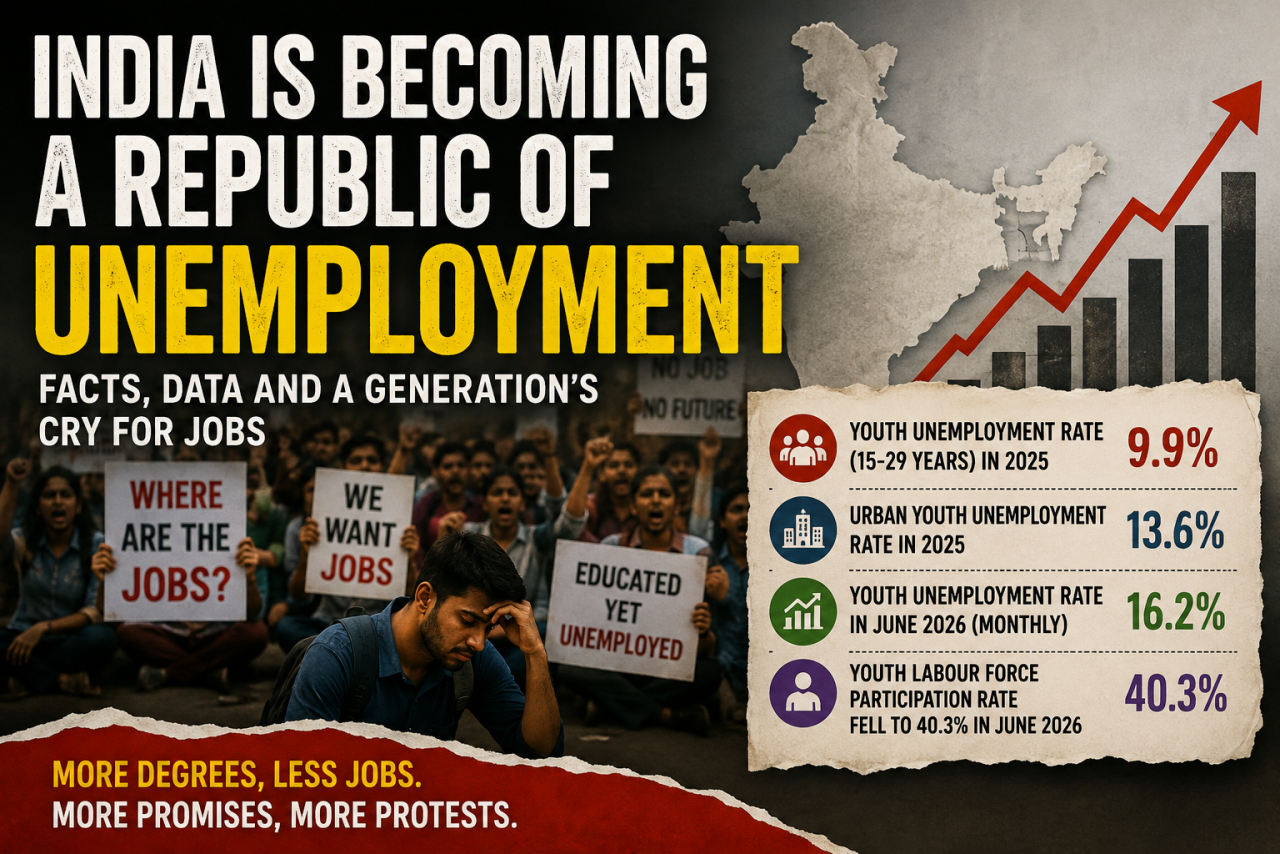
India's own official data shows that the problem is particularly serious among the young. According to the government's Periodic Labour Force Survey, the annual unemployment rate for people aged 15 to 29 was 9.9% in 2025, compared with 10.3% in 2024. Urban youth unemployment was considerably higher at 13.6%.
The monthly figures reveal another worrying picture. In June 2026, youth unemployment for the 15 to 29 age group reached 16.2%, the highest level recorded since the monthly PLFS series began in April 2025. At the same time, the youth labour force participation rate fell from 42.7% in April 2025 to 40.3% in June 2026. This means fewer young people were even looking for work, yet unemployment among those seeking work still increased.
The government has also highlighted positive employment numbers. The latest PLFS annual report shows that youth unemployment on the annual measure declined in 2025. The government has cited other employment estimates as well, including RBI-linked data suggesting that more than 17 crore employment opportunities were created between 2014 and 2024. Such figures are important and should not be ignored. But the question is what kind of employment is being created and whether it matches the aspirations of India's educated population.
A young graduate does not necessarily consider a temporary, poorly paid or unstable job equivalent to the career for which he or she spent years studying. This is where the unemployment debate becomes more complicated.
The anger visible on Indian streets is therefore significant. In 2026, youth and student protests over jobs, examinations and employment opportunities have spread across parts of the country. The protests associated with the Citizens for Justice and Progress, popularly referred to as the Cockroach Janta Party movement, brought unemployment and the future of India's youth into national political discussion. Demonstrations in Delhi and elsewhere reflected a frustration that goes beyond one examination or one recruitment process.
The symbolism of these protests is especially powerful. Young people who have spent years preparing for competitive examinations are increasingly asking a basic question: Where are the jobs?
Government recruitment itself illustrates the pressure. A government job remains highly desirable in India because it offers security, predictable income and social status. But recruitment examinations often attract enormous numbers of applicants for a limited number of positions. Delays, cancelled examinations, paper-leak allegations and lengthy recruitment processes can leave candidates spending several years preparing without knowing when their economic lives will actually begin.
This creates another form of unemployment that a simple unemployment percentage cannot fully capture. A graduate may not be counted as unemployed if he is preparing for an examination, doing occasional work or helping in a family business. Yet he may still have no stable career.
India also faces the problem of educated unemployment. The irony is striking. Education is supposed to improve economic opportunity, but higher education does not guarantee employment. Recent analysis of government labour data has shown that educated young Indians face particularly serious difficulties in entering the labour market.
At the same time, India's economy is producing work in areas such as delivery services, ride-hailing, construction and other forms of informal or platform-based employment. These jobs provide income and should not be dismissed. But many lack the stability, wages and social security associated with formal employment. The government itself is now preparing to capture digital and platform workers more systematically in the 2026 PLFS, recognising how important this part of the labour market has become.
That is why calling India a “Republic of Unemployment” is not a claim that most Indians have no work. It is a description of a growing national anxiety surrounding employment, especially among the young and educated.
A republic is ultimately judged by the opportunities it creates for its citizens. India's demographic advantage can become a demographic burden if millions of young people remain trapped between education and employment.
The government can point to falling annual unemployment and rising employment estimates. Critics can point to youth unemployment, insecure work and angry protests. Both sides need to be heard.
The real test, however, is simple. A young Indian should not have to spend the best years of life merely preparing for the possibility of getting a job.
If India wants to convert its demographic dividend into economic strength, it needs not merely more work, but more productive, stable and dignified employment.
Until that happens, “The Republic of Unemployment” will remain a powerful description of the distance between India's economic ambitions and the everyday reality faced by its job-seeking youth.
India calls itself a young nation. More than half of its population is below the age of 30, and every year millions of young people enter the labour market hoping to build a secure future. Yet for a growing number of them, the journey from education to employment is becoming increasingly difficult.
This is why the phrase “Republic of Unemployment” may sound harsh, but it captures a reality that cannot be dismissed simply by pointing to the overall unemployment rate. The problem is not only the number of people without jobs. It is also the shortage of stable jobs, the long wait for government recruitment, the rise of insecure work and the growing frustration among educated young people.
India's own official data shows that the problem is particularly serious among the young. According to the government's Periodic Labour Force Survey, the annual unemployment rate for people aged 15 to 29 was 9.9% in 2025, compared with 10.3% in 2024. Urban youth unemployment was considerably higher at 13.6%.
The monthly figures reveal another worrying picture. In June 2026, youth unemployment for the 15 to 29 age group reached 16.2%, the highest level recorded since the monthly PLFS series began in April 2025. At the same time, the youth labour force participation rate fell from 42.7% in April 2025 to 40.3% in June 2026. This means fewer young people were even looking for work, yet unemployment among those seeking work still increased.
The government has also highlighted positive employment numbers. The latest PLFS annual report shows that youth unemployment on the annual measure declined in 2025. The government has cited other employment estimates as well, including RBI-linked data suggesting that more than 17 crore employment opportunities were created between 2014 and 2024. Such figures are important and should not be ignored. But the question is what kind of employment is being created and whether it matches the aspirations of India's educated population.
A young graduate does not necessarily consider a temporary, poorly paid or unstable job equivalent to the career for which he or she spent years studying. This is where the unemployment debate becomes more complicated.
The anger visible on Indian streets is therefore significant. In 2026, youth and student protests over jobs, examinations and employment opportunities have spread across parts of the country. The protests associated with the Citizens for Justice and Progress, popularly referred to as the Cockroach Janta Party movement, brought unemployment and the future of India's youth into national political discussion. Demonstrations in Delhi and elsewhere reflected a frustration that goes beyond one examination or one recruitment process.
The symbolism of these protests is especially powerful. Young people who have spent years preparing for competitive examinations are increasingly asking a basic question: Where are the jobs?
Government recruitment itself illustrates the pressure. A government job remains highly desirable in India because it offers security, predictable income and social status. But recruitment examinations often attract enormous numbers of applicants for a limited number of positions. Delays, cancelled examinations, paper-leak allegations and lengthy recruitment processes can leave candidates spending several years preparing without knowing when their economic lives will actually begin.
This creates another form of unemployment that a simple unemployment percentage cannot fully capture. A graduate may not be counted as unemployed if he is preparing for an examination, doing occasional work or helping in a family business. Yet he may still have no stable career.
India also faces the problem of educated unemployment. The irony is striking. Education is supposed to improve economic opportunity, but higher education does not guarantee employment. Recent analysis of government labour data has shown that educated young Indians face particularly serious difficulties in entering the labour market.
At the same time, India's economy is producing work in areas such as delivery services, ride-hailing, construction and other forms of informal or platform-based employment. These jobs provide income and should not be dismissed. But many lack the stability, wages and social security associated with formal employment. The government itself is now preparing to capture digital and platform workers more systematically in the 2026 PLFS, recognising how important this part of the labour market has become.
That is why calling India a “Republic of Unemployment” is not a claim that most Indians have no work. It is a description of a growing national anxiety surrounding employment, especially among the young and educated.
A republic is ultimately judged by the opportunities it creates for its citizens. India's demographic advantage can become a demographic burden if millions of young people remain trapped between education and employment.
The government can point to falling annual unemployment and rising employment estimates. Critics can point to youth unemployment, insecure work and angry protests. Both sides need to be heard.
The real test, however, is simple. A young Indian should not have to spend the best years of life merely preparing for the possibility of getting a job.
If India wants to convert its demographic dividend into economic strength, it needs not merely more work, but more productive, stable and dignified employment.
Until that happens, “The Republic of Unemployment” will remain a powerful description of the distance between India's economic ambitions and the everyday reality faced by its job-seeking youth.






















Leave a Comment