
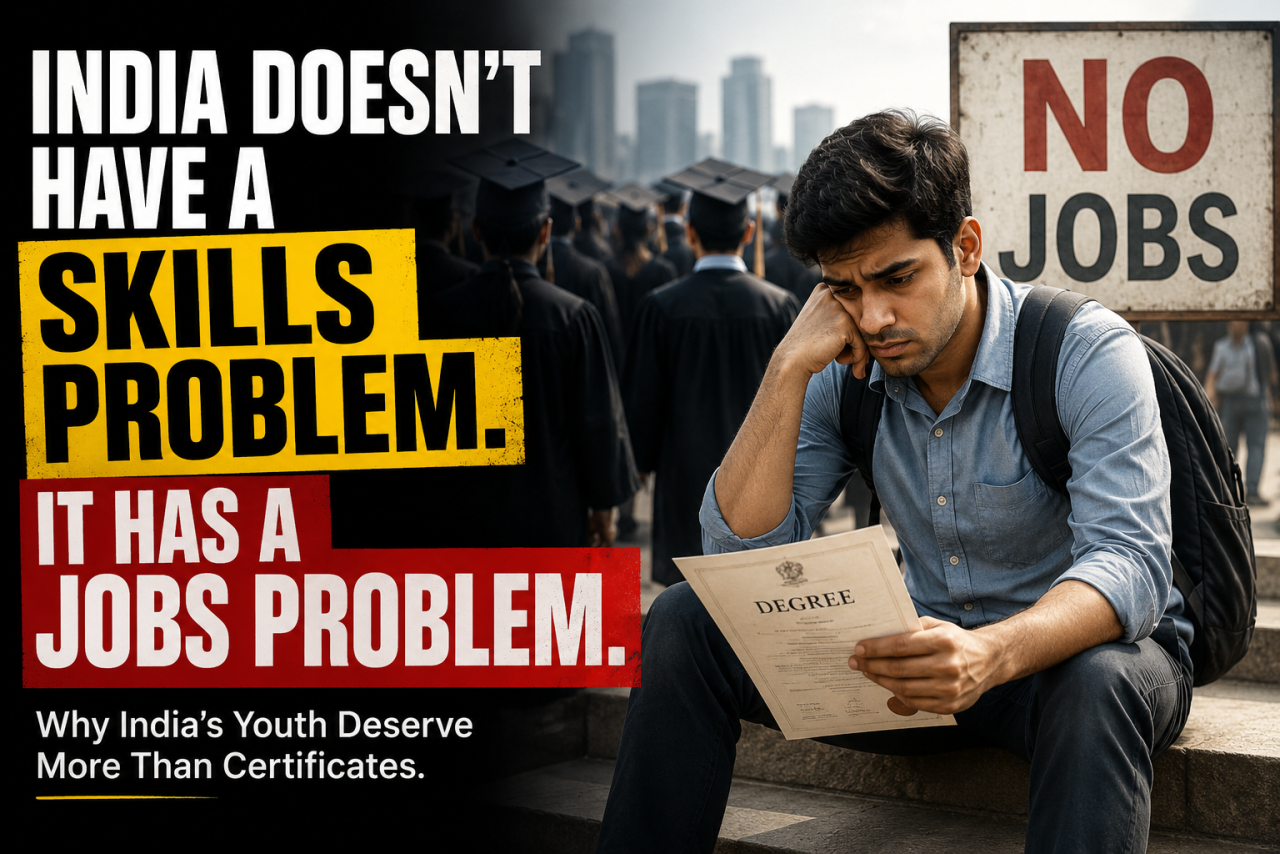
India is producing more graduates and certificates, but not enough good jobs. The real crisis is not whether young Indians are skilled enough. It is whether the economy is creating enough work for them.
Every year, India adds millions of young people to its workforce. Many are college graduates, digitally connected and more educated than the generation before them. Yet a large number remain unemployed for months, and sometimes years, after leaving college.
The usual explanation is familiar. India has a skills gap, we are told. Young people have degrees but lack the practical skills employers need. The solution, therefore, appears straightforward: more training, more certifications, more vocational courses and better employability programmes.
But this explanation misses a much larger problem.
India may not have a shortage of skilled people. It may have a shortage of good jobs.
Recent evidence from India's labour market challenges the idea that unemployment is primarily a skills problem. Educated young people face much higher unemployment than those with little or no formal education. A graduate can find it harder to secure a job than someone who never completed primary school.
That is an uncomfortable finding.
If employability were simply a matter of education and skills, unemployment should generally fall as educational attainment rises. Instead, India's labour market often produces the opposite result. For many young people, a degree has become the beginning of a long wait for suitable employment rather than a reliable path into it.
The Certificate Is Not the Job
For years, skilling has been treated as one of the central answers to India's employment challenge.
Government programmes and private institutions have trained and certified millions of young people in areas ranging from tailoring and electrical work to data entry and digital services. Such programmes have an important role to play. But training someone for a job is not the same as creating that job.
A young person can complete a course, receive a certificate and still remain unemployed.
The problem becomes particularly serious when training programmes are disconnected from the industries and local economies in which people actually live. A certificate has limited value if there is no employer nearby looking for that skill, or if the available jobs pay too little to make relocation worthwhile.
India therefore needs to ask a more basic question.
Where are the jobs for all the people we are training?
Falling Unemployment Does Not Tell the Whole Story
There is another problem with focusing only on the unemployment rate.
A declining unemployment rate can look encouraging. But unemployment statistics do not always capture the difference between having a job and having a decent livelihood.
Someone who gives up searching for formal employment and starts working at a family shop is technically employed. So is a graduate who spends ten hours a day making deliveries because there are no suitable jobs in their field.
The same is true of people working irregular hours, accepting temporary work or helping in family enterprises without a stable income.
This is the quieter side of India's employment crisis: underemployment.
The question is not simply whether people are working. It is whether the economy is creating enough productive, stable and reasonably paid work for the people entering it.
A Generation With Bigger Aspirations
India's employment challenge is also becoming harder to ignore because the country's young population is more educated and more connected than ever before.
A young Indian no longer compares their life only with that of their parents or neighbours. A smartphone can expose them to the lifestyles and opportunities of people across Bengaluru, Mumbai, Delhi, Dubai, Singapore or New York.
That changes expectations.
A graduate who has spent years studying may not consider a low-paid, insecure job a satisfactory outcome. Yet when formal employment is scarce, accepting such work can become the only practical choice.
The result is a growing gap between what young Indians expect from the economy and what the economy is able to offer them.
That gap is not merely economic. Over time, it can become social and political.
The Structural Problem With India's Growth
Part of the problem lies in the structure of India's economic growth.
India has expanded rapidly in sectors that do not always create enough jobs for the number of people entering the workforce. Manufacturing has become increasingly capital-intensive. Technology and automation can raise productivity without necessarily producing large numbers of new workers.
Construction, too, can generate employment but often provides irregular and insecure work.
At the same time, several labour-intensive sectors that could potentially employ millions, including textiles, tourism, food processing, retail and small-scale manufacturing, continue to face problems involving infrastructure, credit, regulation and access to markets.
Small businesses are particularly important here. A small factory, restaurant, retailer or service company that grows from five employees to 50 can make a meaningful difference to local employment.
But businesses cannot hire at scale if expansion itself is difficult.
That is why India's employment problem cannot be solved inside classrooms alone. It has to be addressed in factories, offices, shops, farms, workshops and small businesses across the country.
The Rise of the Gig Economy
India's gig economy has provided an important outlet for workers who might otherwise have remained unemployed.
Ride-hailing, food delivery, logistics and freelance digital work have given millions of people access to income with relatively low barriers to entry.
But calling this simply a jobs success story would be misleading.
Much of this work lacks the protections traditionally associated with formal employment. Workers may not have guaranteed hours, employer-provided health insurance, provident fund contributions or reliable income.
For a young person needing money immediately, a delivery platform can be a lifeline. But a country cannot build its long-term employment strategy around the assumption that millions of workers will remain permanently dependent on insecure work.
India therefore needs a social security system that follows the worker rather than the employer.
Benefits should be portable across jobs and platforms, allowing workers to move between employers without losing access to basic protections.
Skilling Still Matters
None of this means India should abandon skilling.
Better vocational education matters. Colleges need stronger connections with employers. Training programmes should respond to actual local demand rather than simply producing certificates. Employers should have a greater role in designing curricula and assessing whether trainees are genuinely employable.
But these are supporting measures, not the central solution.
You cannot train your way out of a shortage of jobs.
The bigger challenge is to create an economy in which companies have strong reasons to expand, invest and employ more people.
That means making labour-intensive industries more competitive, improving infrastructure, widening access to credit, reducing unnecessary barriers for businesses and encouraging investment beyond India's biggest metropolitan centres.
It also means looking beyond headline GDP growth and asking a harder question: How many decent jobs does each percentage point of growth actually create?
The Demographic Dividend Is Not Automatic
India's demographic dividend has often been described as one of its greatest economic advantages.
But demographics do not create prosperity on their own.
A young population becomes an economic asset only when the economy can provide that population with productive work. Otherwise, a demographic dividend can become a demographic burden.
India has spent years talking about making its youth "job ready".
The conversation now needs to change.
The country does need better skills. But it needs something even more urgently: an economy capable of using those skills.
The success of India's demographic story will not ultimately be measured by how many young people receive certificates.
It will be measured by how many receive paychecks, stable careers and a genuine chance to build a better life.
India does not merely need more skilled workers.
It needs more work worth doing.
Every year, India adds millions of young people to its workforce. Many are college graduates, digitally connected and more educated than the generation before them. Yet a large number remain unemployed for months, and sometimes years, after leaving college.
The usual explanation is familiar. India has a skills gap, we are told. Young people have degrees but lack the practical skills employers need. The solution, therefore, appears straightforward: more training, more certifications, more vocational courses and better employability programmes.
But this explanation misses a much larger problem.
India may not have a shortage of skilled people. It may have a shortage of good jobs.
Recent evidence from India's labour market challenges the idea that unemployment is primarily a skills problem. Educated young people face much higher unemployment than those with little or no formal education. A graduate can find it harder to secure a job than someone who never completed primary school.
That is an uncomfortable finding.
If employability were simply a matter of education and skills, unemployment should generally fall as educational attainment rises. Instead, India's labour market often produces the opposite result. For many young people, a degree has become the beginning of a long wait for suitable employment rather than a reliable path into it.
The Certificate Is Not the Job
For years, skilling has been treated as one of the central answers to India's employment challenge.
Government programmes and private institutions have trained and certified millions of young people in areas ranging from tailoring and electrical work to data entry and digital services. Such programmes have an important role to play. But training someone for a job is not the same as creating that job.
A young person can complete a course, receive a certificate and still remain unemployed.
The problem becomes particularly serious when training programmes are disconnected from the industries and local economies in which people actually live. A certificate has limited value if there is no employer nearby looking for that skill, or if the available jobs pay too little to make relocation worthwhile.
India therefore needs to ask a more basic question.
Where are the jobs for all the people we are training?
Falling Unemployment Does Not Tell the Whole Story
There is another problem with focusing only on the unemployment rate.
A declining unemployment rate can look encouraging. But unemployment statistics do not always capture the difference between having a job and having a decent livelihood.
Someone who gives up searching for formal employment and starts working at a family shop is technically employed. So is a graduate who spends ten hours a day making deliveries because there are no suitable jobs in their field.
The same is true of people working irregular hours, accepting temporary work or helping in family enterprises without a stable income.
This is the quieter side of India's employment crisis: underemployment.
The question is not simply whether people are working. It is whether the economy is creating enough productive, stable and reasonably paid work for the people entering it.
A Generation With Bigger Aspirations
India's employment challenge is also becoming harder to ignore because the country's young population is more educated and more connected than ever before.
A young Indian no longer compares their life only with that of their parents or neighbours. A smartphone can expose them to the lifestyles and opportunities of people across Bengaluru, Mumbai, Delhi, Dubai, Singapore or New York.
That changes expectations.
A graduate who has spent years studying may not consider a low-paid, insecure job a satisfactory outcome. Yet when formal employment is scarce, accepting such work can become the only practical choice.
The result is a growing gap between what young Indians expect from the economy and what the economy is able to offer them.
That gap is not merely economic. Over time, it can become social and political.
The Structural Problem With India's Growth
Part of the problem lies in the structure of India's economic growth.
India has expanded rapidly in sectors that do not always create enough jobs for the number of people entering the workforce. Manufacturing has become increasingly capital-intensive. Technology and automation can raise productivity without necessarily producing large numbers of new workers.
Construction, too, can generate employment but often provides irregular and insecure work.
At the same time, several labour-intensive sectors that could potentially employ millions, including textiles, tourism, food processing, retail and small-scale manufacturing, continue to face problems involving infrastructure, credit, regulation and access to markets.
Small businesses are particularly important here. A small factory, restaurant, retailer or service company that grows from five employees to 50 can make a meaningful difference to local employment.
But businesses cannot hire at scale if expansion itself is difficult.
That is why India's employment problem cannot be solved inside classrooms alone. It has to be addressed in factories, offices, shops, farms, workshops and small businesses across the country.
The Rise of the Gig Economy
India's gig economy has provided an important outlet for workers who might otherwise have remained unemployed.
Ride-hailing, food delivery, logistics and freelance digital work have given millions of people access to income with relatively low barriers to entry.
But calling this simply a jobs success story would be misleading.
Much of this work lacks the protections traditionally associated with formal employment. Workers may not have guaranteed hours, employer-provided health insurance, provident fund contributions or reliable income.
For a young person needing money immediately, a delivery platform can be a lifeline. But a country cannot build its long-term employment strategy around the assumption that millions of workers will remain permanently dependent on insecure work.
India therefore needs a social security system that follows the worker rather than the employer.
Benefits should be portable across jobs and platforms, allowing workers to move between employers without losing access to basic protections.
Skilling Still Matters
None of this means India should abandon skilling.
Better vocational education matters. Colleges need stronger connections with employers. Training programmes should respond to actual local demand rather than simply producing certificates. Employers should have a greater role in designing curricula and assessing whether trainees are genuinely employable.
But these are supporting measures, not the central solution.
You cannot train your way out of a shortage of jobs.
The bigger challenge is to create an economy in which companies have strong reasons to expand, invest and employ more people.
That means making labour-intensive industries more competitive, improving infrastructure, widening access to credit, reducing unnecessary barriers for businesses and encouraging investment beyond India's biggest metropolitan centres.
It also means looking beyond headline GDP growth and asking a harder question: How many decent jobs does each percentage point of growth actually create?
The Demographic Dividend Is Not Automatic
India's demographic dividend has often been described as one of its greatest economic advantages.
But demographics do not create prosperity on their own.
A young population becomes an economic asset only when the economy can provide that population with productive work. Otherwise, a demographic dividend can become a demographic burden.
India has spent years talking about making its youth "job ready".
The conversation now needs to change.
The country does need better skills. But it needs something even more urgently: an economy capable of using those skills.
The success of India's demographic story will not ultimately be measured by how many young people receive certificates.
It will be measured by how many receive paychecks, stable careers and a genuine chance to build a better life.
India does not merely need more skilled workers.
It needs more work worth doing.
























Leave a Comment