
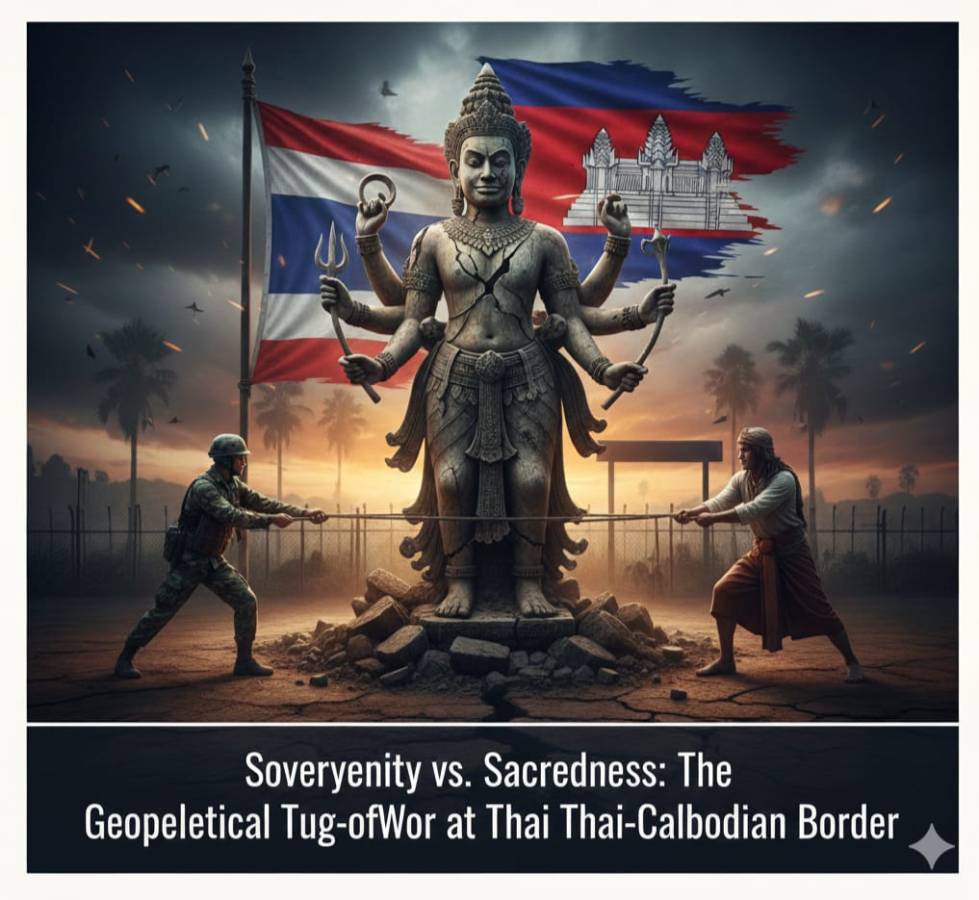
The recent demolition of a statue of the Hindu deity Vishnu by the Thai military has reignited a long-standing and volatile debate regarding the intersection of national sovereignty and religious sentiment. Situated along the contentious border between Thailand and Cambodia, the incident serves as a stark reminder of how cultural artifacts can quickly become weaponized in territorial disputes, often leaving international observers and religious communities caught in the crossfire.
A Conflict of Perspectives
At the heart of the matter is a fundamental disagreement over the nature of the statue itself and the land upon which it stood. The Thai government has been firm in its stance, categorizing the removal not as an act of religious intolerance, but as a strategic necessity. According to officials in Bangkok, the structure was a "decorative piece" rather than a consecrated religious site. By dismantling it, Thailand intended to assert "effective control" over a disputed frontier area that has seen periodic military skirmishes for years.
In contrast, Cambodian officials and the provincial leadership of Preah Vihear have expressed deep indignation. They argue that the statue, erected in 2014, was a significant cultural marker located on Cambodian soil. To them, the demolition is not merely an administrative move but a provocative act of aggression and a violation of their territorial integrity.
The Ripple Effect: Beyond Borders
The controversy has not remained localized. India’s Ministry of External Affairs has weighed in, reflecting the global reach of Hindu sentiment. Indian officials characterized the demolition as a "disrespectful act" that has caused pain to followers of the faith worldwide. This intervention highlights a growing trend in modern diplomacy: the "soft power" of religion. When a state takes action against a religious symbol—even one categorized as "decorative" by the acting party—it risks alienating global stakeholders and triggering diplomatic friction that transcends the immediate geographic dispute.
The Thai government's defense—that the site was not "officially recognized"—is a technicality that often fails to resonate with the public. For many, the imagery of a deity being "knocked down" carries a weight that cannot be dismissed by administrative jargon. It raises a difficult question: Does a state’s right to secure its borders override the perceived sanctity of a monument?
The Geography of Disruption
The Thailand-Cambodia border has historically been a flashpoint, most notably around the Preah Vihear Temple, a UNESCO World Heritage site. In such high-tension zones, every brick, pillar, or statue is viewed through a lens of "ownership." When one country builds a monument, the other often views it as a "flag-planting" exercise—a way to claim territory through cultural presence.
The demolition of the Vishnu statue is a classic example of this zero-sum game. By removing the statue, Thailand sought to erase a physical claim to the land; however, in doing so, they created a symbolic wound that may be harder to heal than any border fence.
Final Take
As both nations move forward, the challenge lies in balancing security concerns with cultural sensitivity. While Thailand emphasizes "area administration," the international reaction suggests that the world expects a higher degree of reverence for religious icons, regardless of their legal status. Until a permanent resolution to the border demarcation is reached, symbols will continue to be targets, and the line between a decorative structure and a sacred idol will remain a dangerous point of contention.
.jpeg)





















Leave a Comment