
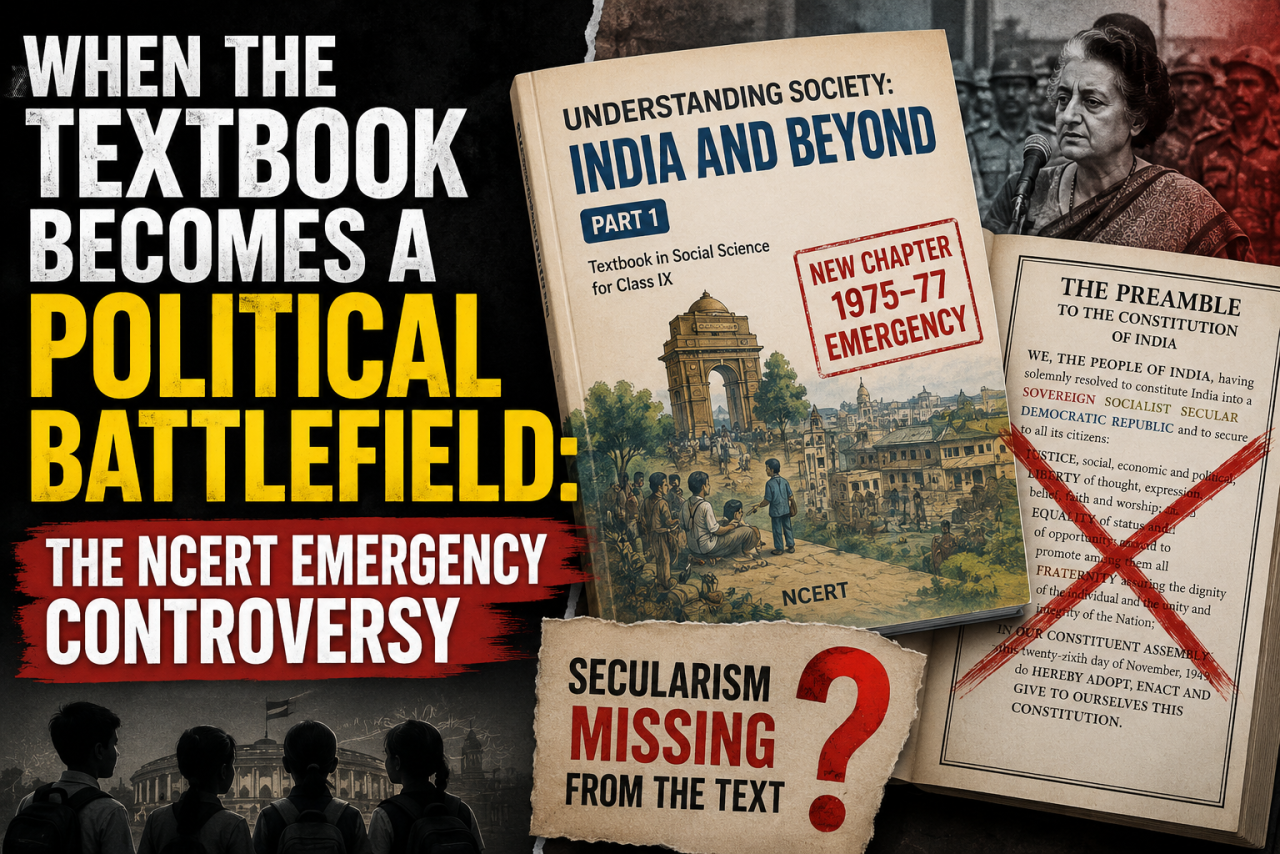
NCERT's revised Class 9 textbook adds a chapter on the Emergency but drops the Constitution's Preamble, sparking fresh debate over history, constitutional values, and the politics of education.
There is something revealing about what a government chooses to teach children. Equally revealing is what it chooses to leave out. The latest revision of the NCERT Class 9 Social Science textbook does both. It introduces a long-overdue chapter on the Emergency while quietly dropping the Preamble to the Constitution from the same volume. That combination deserves closer attention.
Released on June 25, 2026, the 51st anniversary of the declaration of the Emergency, the new textbook, Understanding Society: India and Beyond – Part 1, includes a dedicated section on the 1975–77 Emergency for the first time in the Class 9 curriculum. On its own, this is a welcome change.
The Emergency remains one of the defining moments in independent India's history. For 21 months, constitutional freedoms were suspended, political opponents were jailed, the press was censored and democratic institutions came under unprecedented pressure. Yet generations of students completed school without receiving a structured introduction to this period. Filling that gap strengthens civic education.
The controversy begins elsewhere.
What the New Textbook Teaches
The revised Social Science textbook replaces the earlier separate books on History, Geography, Political Science and Economics with a single integrated volume. One chapter, Challenges to Democratic Practices in India, deals with the Emergency.
Its account is broadly factual. It explains that Fundamental Rights were suspended, newspapers were censored, political leaders and activists were imprisoned, and democratic institutions faced severe strain. It also highlights the mass movement led by Jayaprakash Narayan, describing how students, farmers and ordinary citizens mobilised across Bihar and Gujarat against authoritarian rule. The chapter concludes with the 1977 general election, presenting it as evidence of the resilience of Indian democracy.
There is little to object to here. These events deserve a place in every school curriculum. Students should understand why the Emergency remains one of the darkest chapters in India's democratic journey. It was not merely a political crisis for one party. It challenged the independence of the judiciary, weakened the free press and curtailed citizens' right to dissent.
A democracy that does not teach this history risks repeating it.
What the Textbook Leaves Out
The larger debate is not about the Emergency chapter. It is about what has disappeared alongside it.
Earlier editions of the Class 9 Political Science textbook introduced students to the Preamble to the Constitution. They explained the meaning of terms such as Sovereign, Socialist, Secular, Democratic and Republic before moving into broader discussions on constitutional values.
Those sections no longer appear in the revised textbook.
The words secular and secularism are absent from the new volume. The book discusses ideas such as liberty, equality, justice and fraternity, but it does not explain the constitutional framework that binds these principles together. Nor does it introduce students to the Preamble, which has traditionally served as their first encounter with the philosophy of the Constitution.
That omission changes the nature of the debate. It is no longer only about what has been added to the curriculum. It is also about what has been removed.
A Question of Balance
The BJP has welcomed the inclusion of the Emergency chapter. Union Education Minister Dharmendra Pradhan has said future generations must understand the "dark deeds" of that period. BJP spokesperson Shehzad Poonawalla has argued that the Congress imposed the Emergency out of a "lust for power" and that students should learn from this chapter of history.
Few would dispute that the Emergency deserves to be taught honestly.
The question is whether the same standard should apply to the constitutional principles that the Emergency undermined.
If students are taught how civil liberties were suspended, they should also learn where those liberties come from. If they are told that democratic institutions came under attack, they should also understand the constitutional vision those institutions were designed to protect.
The Preamble is not a ceremonial page at the beginning of the Constitution. It sets out the values that guide the Republic. Teaching about the Emergency without introducing the Preamble risks separating one of India's greatest constitutional crises from the constitutional ideals it threatened.
Politics on Both Sides
The Congress and other opposition parties have accused the government of reshaping history to fit its political narrative. Congress leader Sachin Pilot has argued that education is increasingly being viewed through an ideological lens. Shiv Sena (UBT) leader Sanjay Raut has said the Emergency should be taught within its full constitutional context.
These criticisms deserve consideration. At the same time, they also come from the political party that imposed the Emergency in 1975. That history cannot simply be ignored.
Both the BJP and the Congress invoke democratic values when it suits their political arguments. That reality should encourage readers to look beyond partisan exchanges and focus on the curriculum itself.
The real question is not which party benefits politically. It is whether students are receiving a complete understanding of India's constitutional democracy.
There is something revealing about what a government chooses to teach children. Equally revealing is what it chooses to leave out. The latest revision of the NCERT Class 9 Social Science textbook does both. It introduces a long-overdue chapter on the Emergency while quietly dropping the Preamble to the Constitution from the same volume. That combination deserves closer attention.
Released on June 25, 2026, the 51st anniversary of the declaration of the Emergency, the new textbook, Understanding Society: India and Beyond – Part 1, includes a dedicated section on the 1975–77 Emergency for the first time in the Class 9 curriculum. On its own, this is a welcome change.
The Emergency remains one of the defining moments in independent India's history. For 21 months, constitutional freedoms were suspended, political opponents were jailed, the press was censored and democratic institutions came under unprecedented pressure. Yet generations of students completed school without receiving a structured introduction to this period. Filling that gap strengthens civic education.
The controversy begins elsewhere.
What the New Textbook Teaches
The revised Social Science textbook replaces the earlier separate books on History, Geography, Political Science and Economics with a single integrated volume. One chapter, Challenges to Democratic Practices in India, deals with the Emergency.
Its account is broadly factual. It explains that Fundamental Rights were suspended, newspapers were censored, political leaders and activists were imprisoned, and democratic institutions faced severe strain. It also highlights the mass movement led by Jayaprakash Narayan, describing how students, farmers and ordinary citizens mobilised across Bihar and Gujarat against authoritarian rule. The chapter concludes with the 1977 general election, presenting it as evidence of the resilience of Indian democracy.
There is little to object to here. These events deserve a place in every school curriculum. Students should understand why the Emergency remains one of the darkest chapters in India's democratic journey. It was not merely a political crisis for one party. It challenged the independence of the judiciary, weakened the free press and curtailed citizens' right to dissent.
A democracy that does not teach this history risks repeating it.
What the Textbook Leaves Out
The larger debate is not about the Emergency chapter. It is about what has disappeared alongside it.
Earlier editions of the Class 9 Political Science textbook introduced students to the Preamble to the Constitution. They explained the meaning of terms such as Sovereign, Socialist, Secular, Democratic and Republic before moving into broader discussions on constitutional values.
Those sections no longer appear in the revised textbook.
The words secular and secularism are absent from the new volume. The book discusses ideas such as liberty, equality, justice and fraternity, but it does not explain the constitutional framework that binds these principles together. Nor does it introduce students to the Preamble, which has traditionally served as their first encounter with the philosophy of the Constitution.
That omission changes the nature of the debate. It is no longer only about what has been added to the curriculum. It is also about what has been removed.
A Question of Balance
The BJP has welcomed the inclusion of the Emergency chapter. Union Education Minister Dharmendra Pradhan has said future generations must understand the "dark deeds" of that period. BJP spokesperson Shehzad Poonawalla has argued that the Congress imposed the Emergency out of a "lust for power" and that students should learn from this chapter of history.
Few would dispute that the Emergency deserves to be taught honestly.
The question is whether the same standard should apply to the constitutional principles that the Emergency undermined.
If students are taught how civil liberties were suspended, they should also learn where those liberties come from. If they are told that democratic institutions came under attack, they should also understand the constitutional vision those institutions were designed to protect.
The Preamble is not a ceremonial page at the beginning of the Constitution. It sets out the values that guide the Republic. Teaching about the Emergency without introducing the Preamble risks separating one of India's greatest constitutional crises from the constitutional ideals it threatened.
Politics on Both Sides
The Congress and other opposition parties have accused the government of reshaping history to fit its political narrative. Congress leader Sachin Pilot has argued that education is increasingly being viewed through an ideological lens. Shiv Sena (UBT) leader Sanjay Raut has said the Emergency should be taught within its full constitutional context.
These criticisms deserve consideration. At the same time, they also come from the political party that imposed the Emergency in 1975. That history cannot simply be ignored.
Both the BJP and the Congress invoke democratic values when it suits their political arguments. That reality should encourage readers to look beyond partisan exchanges and focus on the curriculum itself.
The real question is not which party benefits politically. It is whether students are receiving a complete understanding of India's constitutional democracy.


















Leave a Comment