
India’s rainfall numbers may be improving, but the fields tell a different story.
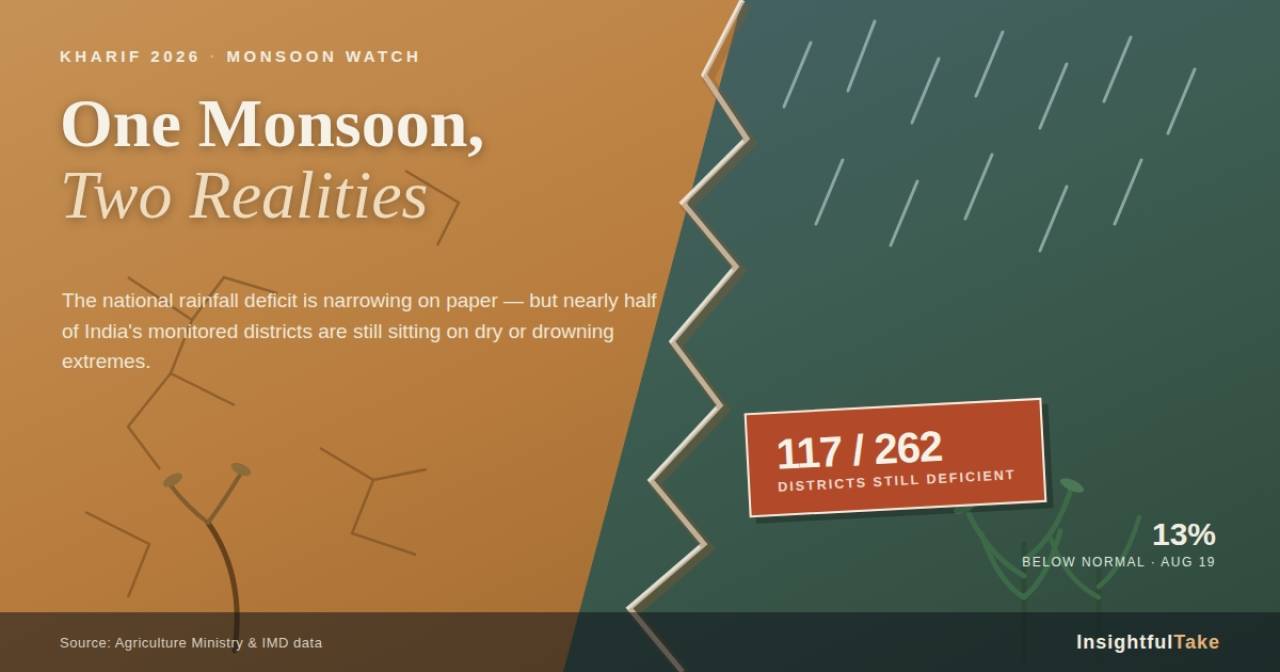
India’s monsoon season tells two different stories depending on where one looks. At the national level, the all-India rainfall deficit has narrowed sharply after a weak July, giving the impression that the worst is behind farmers. But a district-level analysis by the Union Agriculture Ministry paints a far more troubling picture. As many as 262 districts across the country have been flagged for deficient or large deficient rainfall at some point during this year’s kharif season, and 117 of them remain in one of these categories.
The finding, based on India Meteorological Department (IMD) data, exposes a familiar problem in Indian agriculture. A healthy national average can mask severe distress in specific pockets. A district is classified as “large deficient” when rainfall is 60 to 99 percent below its long-term average, and “deficient” when the shortfall is between 20 and 59 percent below normal. Of the 262 districts identified, 117 are currently in one of these two categories, while the remaining districts have received normal or better rainfall after an earlier dry spell.
The national numbers help explain how this contradiction arises. As of August 19, the all-India rainfall deficit stood at 13 percent below the long-period average, a significant improvement from the 40 percent deficit recorded at the end of July. The season’s low point came after a very weak June, when the deficit stood at 13 percent, followed by a further deterioration through July. August has brought a recovery, narrowing the gap to around 11 percent by some estimates.
Yet this improvement in the headline number does not mean rainfall has been evenly distributed. A district can experience a prolonged dry spell in the middle of the season even if its cumulative seasonal rainfall eventually appears close to normal.
That distinction matters enormously for agriculture because crops are most vulnerable to water stress during specific growth windows, not necessarily across the season as a whole. For paddy, moisture-sensitive stages include transplanting, tillering, panicle formation and flowering. A dry spell during any of these stages can affect yields even if rainfall returns later.
Oilseeds and pulses face similar risks tied to their own critical growth periods. A district can therefore report satisfactory cumulative rainfall by the end of the season while having suffered real crop damage from a dry spell that struck at the wrong time.
This is why prolonged dry spells during moisture-sensitive periods are particularly important to track, rather than relying solely on the final seasonal rainfall total.
It is also important to note that the ministry’s district classification is not a forecasting tool. It does not predict which areas will end the season with deficient rainfall. The assessment uses rainfall data alongside factors such as irrigation coverage and cropped area, rather than relying purely on meteorological forecasting.
That makes irrigation infrastructure a crucial factor in determining how severely a dry spell affects a region. Areas with stronger irrigation coverage can cushion the impact of poor or delayed rainfall, while regions heavily dependent on rain remain directly exposed to the kind of mid-season volatility now being recorded.
Private forecasters have also revised their outlook during the season. Skymet, for instance, altered its seasonal forecast more than once, moving its probability of below-normal rainfall from 70 percent to 85 percent in its Monday update while lowering the probability of a drought-like scenario for the season. The IMD had earlier revised its expectations from 92 percent of the long-period average in its April forecast to 90 percent in June, before conditions began improving through August.
For farmers, the practical takeaway remains unsettling regardless of where the season’s cumulative numbers eventually settle. A district that ends the season with rainfall close to normal can still suffer real agricultural losses if a dry spell arrives during transplanting, flowering or another moisture-sensitive stage.
The Centre’s district-level monitoring, in that sense, is an acknowledgement that national and even state-level rainfall averages can be unreliable indicators of what is actually happening on the ground.
India’s monsoon cannot be understood through a single national number. As irrigation coverage varies widely across farming regions, the same monsoon can be experienced as adequate in one district and a serious threat to livelihoods in the next, even within the same state.
The monsoon may be recovering on paper. For many farmers, the real test is whether the rain arrived when their crops needed it most.
India’s monsoon season tells two different stories depending on where one looks. At the national level, the all-India rainfall deficit has narrowed sharply after a weak July, giving the impression that the worst is behind farmers. But a district-level analysis by the Union Agriculture Ministry paints a far more troubling picture. As many as 262 districts across the country have been flagged for deficient or large deficient rainfall at some point during this year’s kharif season, and 117 of them remain in one of these categories.
The finding, based on India Meteorological Department (IMD) data, exposes a familiar problem in Indian agriculture. A healthy national average can mask severe distress in specific pockets. A district is classified as “large deficient” when rainfall is 60 to 99 percent below its long-term average, and “deficient” when the shortfall is between 20 and 59 percent below normal. Of the 262 districts identified, 117 are currently in one of these two categories, while the remaining districts have received normal or better rainfall after an earlier dry spell.
The national numbers help explain how this contradiction arises. As of August 19, the all-India rainfall deficit stood at 13 percent below the long-period average, a significant improvement from the 40 percent deficit recorded at the end of July. The season’s low point came after a very weak June, when the deficit stood at 13 percent, followed by a further deterioration through July. August has brought a recovery, narrowing the gap to around 11 percent by some estimates.
Yet this improvement in the headline number does not mean rainfall has been evenly distributed. A district can experience a prolonged dry spell in the middle of the season even if its cumulative seasonal rainfall eventually appears close to normal.
That distinction matters enormously for agriculture because crops are most vulnerable to water stress during specific growth windows, not necessarily across the season as a whole. For paddy, moisture-sensitive stages include transplanting, tillering, panicle formation and flowering. A dry spell during any of these stages can affect yields even if rainfall returns later.
Oilseeds and pulses face similar risks tied to their own critical growth periods. A district can therefore report satisfactory cumulative rainfall by the end of the season while having suffered real crop damage from a dry spell that struck at the wrong time.
This is why prolonged dry spells during moisture-sensitive periods are particularly important to track, rather than relying solely on the final seasonal rainfall total.
It is also important to note that the ministry’s district classification is not a forecasting tool. It does not predict which areas will end the season with deficient rainfall. The assessment uses rainfall data alongside factors such as irrigation coverage and cropped area, rather than relying purely on meteorological forecasting.
That makes irrigation infrastructure a crucial factor in determining how severely a dry spell affects a region. Areas with stronger irrigation coverage can cushion the impact of poor or delayed rainfall, while regions heavily dependent on rain remain directly exposed to the kind of mid-season volatility now being recorded.
Private forecasters have also revised their outlook during the season. Skymet, for instance, altered its seasonal forecast more than once, moving its probability of below-normal rainfall from 70 percent to 85 percent in its Monday update while lowering the probability of a drought-like scenario for the season. The IMD had earlier revised its expectations from 92 percent of the long-period average in its April forecast to 90 percent in June, before conditions began improving through August.
For farmers, the practical takeaway remains unsettling regardless of where the season’s cumulative numbers eventually settle. A district that ends the season with rainfall close to normal can still suffer real agricultural losses if a dry spell arrives during transplanting, flowering or another moisture-sensitive stage.
The Centre’s district-level monitoring, in that sense, is an acknowledgement that national and even state-level rainfall averages can be unreliable indicators of what is actually happening on the ground.
India’s monsoon cannot be understood through a single national number. As irrigation coverage varies widely across farming regions, the same monsoon can be experienced as adequate in one district and a serious threat to livelihoods in the next, even within the same state.
The monsoon may be recovering on paper. For many farmers, the real test is whether the rain arrived when their crops needed it most.


























Leave a Comment