
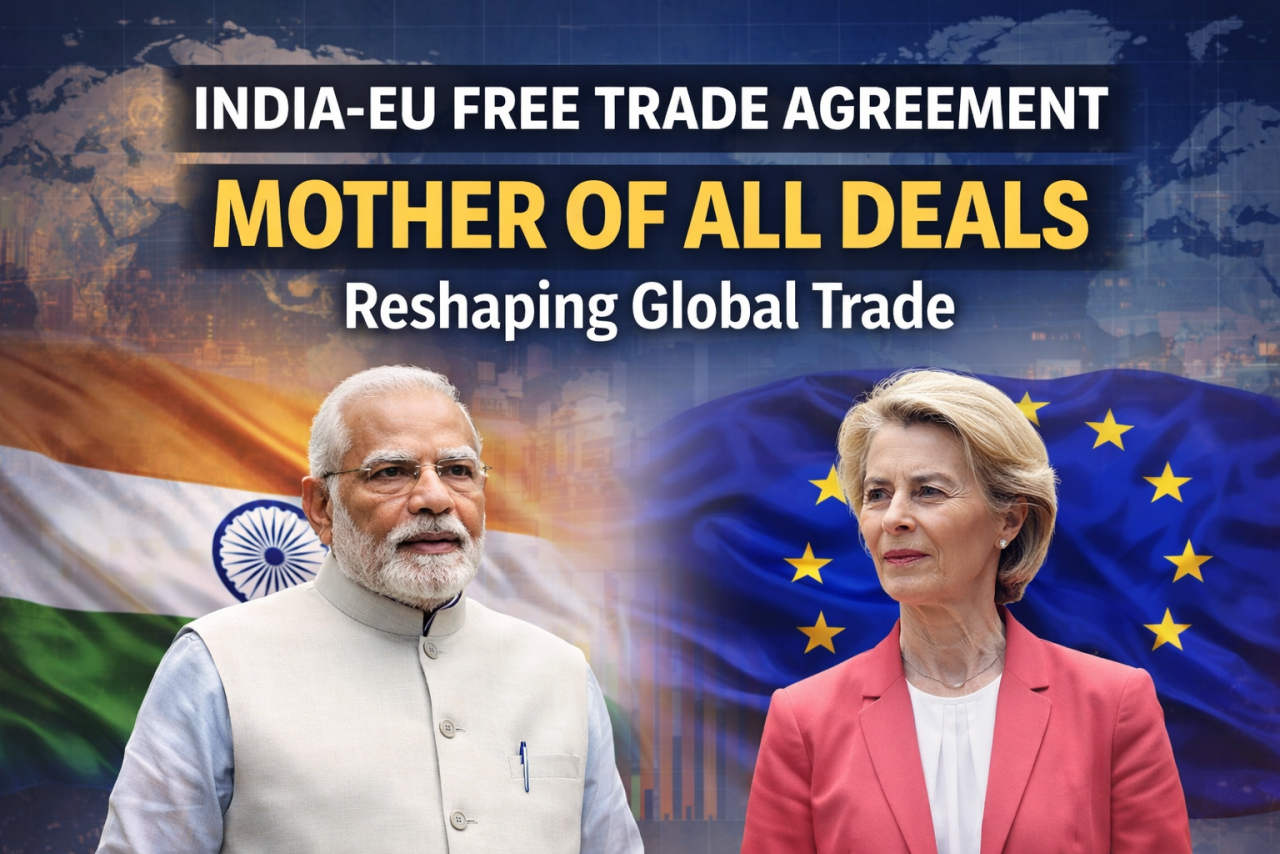
The proposed India-EU free trade agreement links nearly two billion consumers and aims to reshape global trade through wide tariff cuts, services access, and long-term economic cooperation.
The proposed India-European Union free trade agreement has become a major topic of discussion in 2026. The deal is trending on social media and policy platforms. Many leaders and experts are calling it the “mother of all deals.” This description is based on its size, coverage, and expected economic impact. Reports from newspapers and television debates highlight strong facts and logic behind this claim.
India and the European Union together form one of the largest economic spaces in the world. The European Union has 27 member countries and a population of about 450 million. India has a population of more than 1.4 billion. The agreement connects nearly two billion consumers. Very few trade deals in history have covered such a large population base.
The economic scale of the deal is equally important. The European Union is one of the largest trading blocs in the world. India is one of the fastest growing major economies. Together, they account for a large share of global production and trade. This gives the agreement global significance and long-term influence.
Trade between India and the EU is already strong. In recent years, annual goods trade has crossed 130 billion dollars. Services trade has also expanded steadily. It includes information technology, finance, consulting, and professional services. The new agreement aims to deepen this relationship by removing barriers that slow trade and investment.
A key reason the deal is described as historic is tariff reduction. The EU has agreed to reduce or remove duties on most goods imported from India. This includes textiles, garments, leather goods, pharmaceuticals, engineering products, and marine items. These sectors employ millions of workers in India. Better access to the EU market can support exports and jobs.
India has also agreed to lower tariffs on many goods imported from the EU. These include machinery, industrial equipment, chemicals, and selected consumer products. Import duties on European cars and wine will be reduced gradually. This phased approach allows Indian manufacturers time to adjust. It also avoids sudden pressure on domestic industries.
The agreement goes beyond goods trade. It includes provisions on services. Indian professionals in information technology, healthcare, and business services may gain improved access to European markets. This is important for India, where services contribute a large share of economic output and exports.
Investment protection is another major feature. Clear rules can increase investor confidence. European firms may expand investment in Indian manufacturing, clean energy, infrastructure, and digital sectors. Indian companies may also find new opportunities in Europe.
The timing of the agreement adds to its importance. Global trade faces uncertainty due to geopolitical tensions and supply chain disruptions. Many countries are seeking to diversify trade partners. India and the EU are both trying to reduce overdependence on limited markets. The agreement helps achieve this goal.
The deal also signals a change in India’s trade approach. In the past, India was cautious about large trade agreements. In recent years, India has signed trade pacts with several countries. The EU agreement is the largest and most complex among them. It reflects India’s growing confidence in engaging with global markets.
For the European Union, the deal opens access to a rapidly growing consumer market. India’s middle class is expanding. Demand for technology, quality goods, and services is rising. European companies see long-term opportunities in India’s growth story.
Consumers in both regions may benefit over time. Lower tariffs can reduce the cost of imported goods. Increased competition can improve quality and choice. Indian exporters may gain stable demand in Europe. European buyers may gain reliable supply chains from India.
The agreement also includes cooperation on standards and regulations. This can help Indian products meet strict European norms. It can encourage cleaner and more efficient production practices. Over time, this may raise industrial standards and competitiveness.
The trade deal still requires formal approval. It must pass legal and political processes in India and across EU member states. This process may take several months. Trade experts believe the core framework is strong.
The label “mother of all deals” is based on clear factors. The population covered is vast. The economic value is high. The sector coverage is wide. The timing is strategic. The long-term impact on trade, investment, and jobs could be significant.
If implemented effectively, the India-EU free trade agreement may reshape India’s global trade position. It may also strengthen economic ties between two major democratic regions. This explains why the deal is being seen as one of the most important trade agreements of this decade.















Leave a Comment