
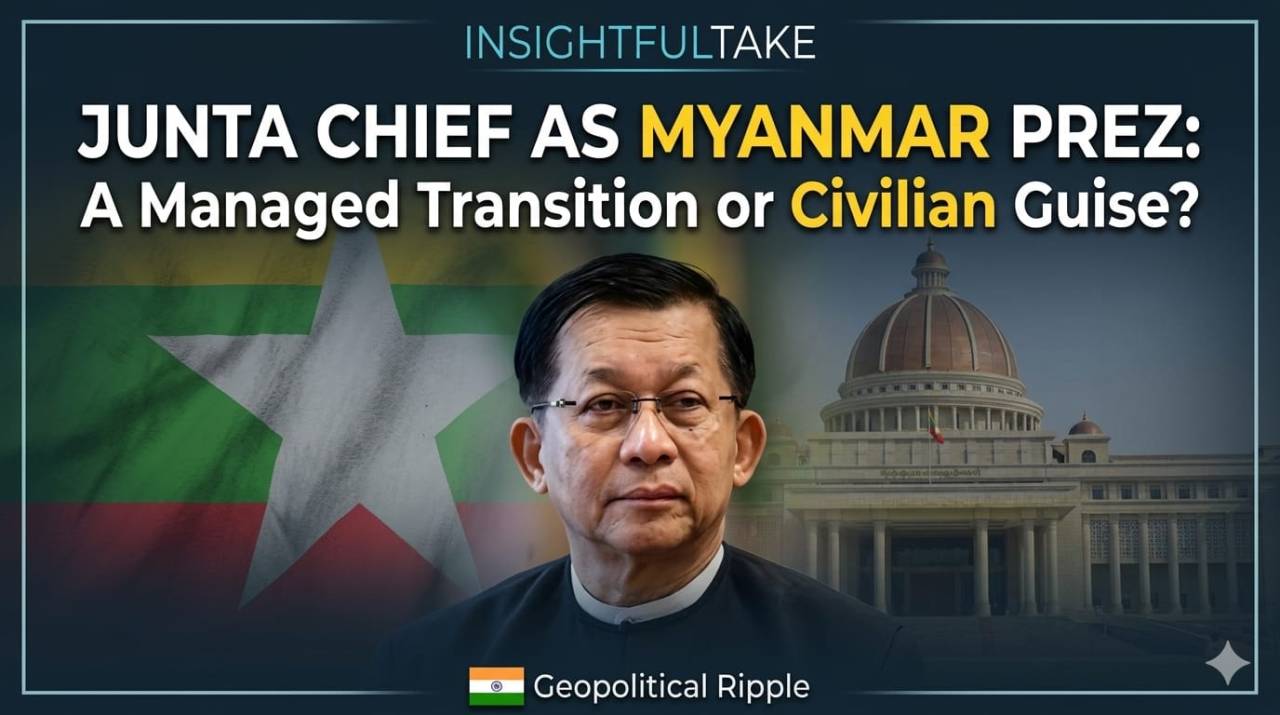
He traded his military uniform for a civilian title—but not his power. As Min Aung Hlaing becomes Myanmar’s President, the move raises a bigger question: is this a democratic transition, or just a strategic rebranding—and why does it matter deeply for India?
On April 3, 2026, Senior General Min Aung Hlaing completed a long-orchestrated transition from military dictator to formal head of state. Elected as President by a parliament dominated by the military-backed Union Solidarity and Development Party (USDP) and unelected soldier-legislators, the move marks a definitive, albeit widely criticized, attempt to trade a combat uniform for a civilian suit.
While the junta presents this as a "return to democracy," the reality on the ground and the international response suggest a mere rebranding of the iron-fisted rule that has defined Myanmar since the Myanmar coup 2021. For India, a neighbor sharing a 1,643-kilometer border, this formalization of power presents a complex geopolitical and security calculus.
A Managed Transition
The "election" was the culmination of a three-phased polling process held in December 2025 and January 2026. With the popular National League for Democracy (NLD) dissolved and Nobel laureate Aung San Suu Kyi remaining in detention, the path was cleared for Min Aung Hlaing. To satisfy the military-drafted 2008 Constitution—which prohibits the President from holding the top military post—the 69-year-old general stepped down as Commander-in-Chief just days prior, handing the baton to his loyal intelligence chief, Gen. Ye Win Oo.
By securing 429 out of 584 votes in the Naypyidaw parliament, Min Aung Hlaing has achieved a long-held personal ambition. However, this "civilian window dressing" does little to address the ongoing civil war that has displaced millions and decimated the nation’s economy. To the domestic resistance and the Western world, the presidency is a hollow title born of a "fake election." Conversely, to regional powers like China, it provides a formal diplomatic channel to resume large-scale infrastructure projects under the Belt and Road Initiative.
The Strategic Dilemma for New Delhi
For India, the formalization of Min Aung Hlaing’s presidency creates a "fait accompli" that necessitates a delicate balancing act. Unlike Western nations that can afford to isolate Myanmar through sanctions, India’s proximity forces a more pragmatic engagement.
1. Security and the Insurgency Challenge
The most immediate concern for India is the stability of its four northeastern states: Mizoram, Manipur, Nagaland, and Arunachal Pradesh. The ongoing conflict between the Myanmar military (Tatmadaw) and various ethnic armed organizations (EAOs) has led to a spillover of violence and a massive influx of refugees. Furthermore, Indian insurgent groups have historically used the dense jungles of Myanmar as safe havens. A formalized government in Naypyidaw, regardless of its perceived legitimacy, is a partner India must deal with to maintain border security and coordinate counter-insurgency operations.
2. The China Factor
China’s immediate congratulatory message to the new President underscores the high stakes. Beijing is eager to push forward the China-Myanmar Economic Corridor (CMEC) to gain direct access to the Indian Ocean. If India pivots too far toward the West's policy of isolation, it risks pushing Myanmar deeper into Beijing’s orbit. India’s "Act East" policy relies on Myanmar as a land bridge to Southeast Asia. Connectivity projects like the Kaladan Multi-Modal Transit Transport Project and the India-Myanmar-Thailand Trilateral Highway are essential for the development of India’s Northeast, and their completion requires a functional relationship with the administration in power.
3. The Humanitarian and Democratic Balance
India has traditionally advocated for a "return to democracy" in Myanmar. However, the 2026 election presents a "grey-zone" democracy. New Delhi is likely to adopt a "wait-and-watch" approach—engaging with the new presidential administration for the sake of security and connectivity, while quietly maintaining informal channels with other stakeholders. This "dual-track" diplomacy is necessary to ensure that India is not caught off guard if the internal resistance eventually shifts the balance of power.
Final Take
Min Aung Hlaing’s presidency is unlikely to bring an end to Myanmar’s internal strife. If anything, the exclusion of the democratic opposition ensures that the civil war will continue to simmer. For the international community, he remains the general who ousted a civilian government; for China, he is a strategic partner; but for India, he is now the official head of a neighboring state whose stability—or lack thereof—directly impacts Indian soil.
As the new President prepares his cabinet, New Delhi finds itself at a crossroads: it must weigh its democratic values against the cold, hard realities of border security and regional competition. In the coming months, India’s engagement with "President" Min Aung Hlaing will be a litmus test for its "Neighbourhood First" policy in an increasingly fragmented Indo-Pacific.















Leave a Comment