
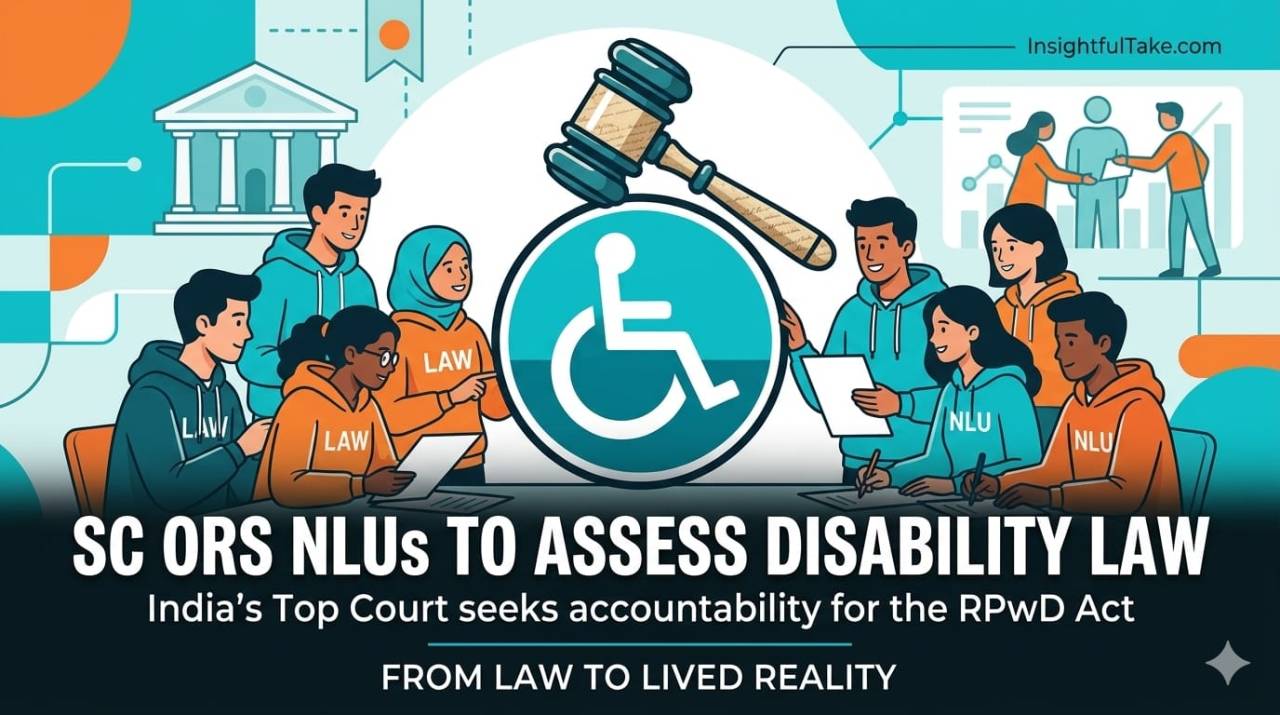
The Supreme Court has directed eight National Law Universities to audit the implementation of the RPwD Act, 2016, highlighting growing concerns over accessibility and disability rights enforcement in India.
The Supreme Court of India has taken a decisive step toward ensuring that the Rights of Persons with Disabilities (RPwD) Act, 2016 is more than just a law on paper. In a recent directive, the apex court tasked eight National Law Universities (NLUs) with conducting a “substantive evaluation” of how disability laws are being implemented across states and Union Territories.
The move signals a shift from surface-level compliance checks to a rigorous academic and practical audit of accessibility and inclusion across India.
Moving Beyond Surface-Level Audits
For years, the implementation of the RPwD Act has been described by courts as “minimal” and “uneven.” While the legislation was designed to safeguard the rights and dignity of persons with disabilities, the reality on the ground often reflects inaccessible infrastructure, weak institutional support, and inadequate funding.
A bench comprising Justice Vikram Nath and Justice Sandeep Mehta stressed that the new exercise must go far beyond ticking boxes on a checklist.
Instead of merely verifying whether rules exist, the NLUs have been asked to carry out a substantive evaluation of compliance, including:
- Creation of mandatory institutional mechanisms
- Actual enforcement of disability rights in everyday life
- Effectiveness of accessibility measures in public and private spaces
The Role of National Law Universities
By involving the NLUs, the Supreme Court is relying on the analytical and legal expertise of India’s premier law institutions to identify gaps where the law is failing in practice.
This initiative follows the earlier “Project Ability Empowerment”, which focused on institutions housing persons with cognitive disabilities. However, the current mandate is significantly broader in scope.
The universities are expected to assess the “lived reality” of persons with disabilities by examining not only physical infrastructure such as ramps and elevators, but also the functioning of state-run and private care institutions.
Why Progress Has Been Slow
The Supreme Court also expressed “serious displeasure” over the slow pace of implementation. Despite the RPwD Act being in force for nearly eight years, the court observed that full and effective compliance remains elusive.
Among the major concerns highlighted by the court were:
1. Missing Nodal Officers
Several states had failed to appoint nodal officers responsible for coordinating disability rights initiatives until the court warned of personal appearances by Chief Secretaries.
2. Lack of State Funds
Many jurisdictions have still not established mandatory state funds dedicated to the welfare and empowerment of persons with disabilities.
3. Fragmented Accountability
The absence of a centralized coordination mechanism resulted in inconsistent implementation across states and Union Territories.
A New Framework for Accountability
The court noted some recent progress, particularly the appointment of nodal officers in most states. This development creates a framework for a time-bound assessment of the RPwD Act, 2016.
The Supreme Court has directed all state authorities to extend complete cooperation to the NLUs to ensure:
- Accurate data collection
- Identification of systemic deficiencies
- Formulation of corrective measures for immediate implementation
What Lies Ahead?
The findings prepared by the eight law universities will form the basis of a comprehensive status report scheduled for review by the Supreme Court in September 2026.
The report could influence the next phase of judicial directions, potentially resulting in stricter enforcement mechanisms and fresh mandates for state governments.
Final Take
The Supreme Court’s intervention adds significant legal momentum to the cause of disability rights in India. By assigning the task to National Law Universities, the court is ensuring that the review process combines legal scrutiny with social realities.
For millions of Indians living with disabilities, this audit could become a major step toward building a more inclusive and accessible society where rights are not merely promised in legislation, but experienced in daily life.
The Supreme Court of India has taken a decisive step toward ensuring that the Rights of Persons with Disabilities (RPwD) Act, 2016 is more than just a law on paper. In a recent directive, the apex court tasked eight National Law Universities (NLUs) with conducting a “substantive evaluation” of how disability laws are being implemented across states and Union Territories.
The move signals a shift from surface-level compliance checks to a rigorous academic and practical audit of accessibility and inclusion across India.
Moving Beyond Surface-Level Audits
For years, the implementation of the RPwD Act has been described by courts as “minimal” and “uneven.” While the legislation was designed to safeguard the rights and dignity of persons with disabilities, the reality on the ground often reflects inaccessible infrastructure, weak institutional support, and inadequate funding.
A bench comprising Justice Vikram Nath and Justice Sandeep Mehta stressed that the new exercise must go far beyond ticking boxes on a checklist.
Instead of merely verifying whether rules exist, the NLUs have been asked to carry out a substantive evaluation of compliance, including:
- Creation of mandatory institutional mechanisms
- Actual enforcement of disability rights in everyday life
- Effectiveness of accessibility measures in public and private spaces
The Role of National Law Universities
By involving the NLUs, the Supreme Court is relying on the analytical and legal expertise of India’s premier law institutions to identify gaps where the law is failing in practice.
This initiative follows the earlier “Project Ability Empowerment”, which focused on institutions housing persons with cognitive disabilities. However, the current mandate is significantly broader in scope.
The universities are expected to assess the “lived reality” of persons with disabilities by examining not only physical infrastructure such as ramps and elevators, but also the functioning of state-run and private care institutions.
Why Progress Has Been Slow
The Supreme Court also expressed “serious displeasure” over the slow pace of implementation. Despite the RPwD Act being in force for nearly eight years, the court observed that full and effective compliance remains elusive.
Among the major concerns highlighted by the court were:
1. Missing Nodal Officers
Several states had failed to appoint nodal officers responsible for coordinating disability rights initiatives until the court warned of personal appearances by Chief Secretaries.
2. Lack of State Funds
Many jurisdictions have still not established mandatory state funds dedicated to the welfare and empowerment of persons with disabilities.
3. Fragmented Accountability
The absence of a centralized coordination mechanism resulted in inconsistent implementation across states and Union Territories.
A New Framework for Accountability
The court noted some recent progress, particularly the appointment of nodal officers in most states. This development creates a framework for a time-bound assessment of the RPwD Act, 2016.
The Supreme Court has directed all state authorities to extend complete cooperation to the NLUs to ensure:
- Accurate data collection
- Identification of systemic deficiencies
- Formulation of corrective measures for immediate implementation
What Lies Ahead?
The findings prepared by the eight law universities will form the basis of a comprehensive status report scheduled for review by the Supreme Court in September 2026.
The report could influence the next phase of judicial directions, potentially resulting in stricter enforcement mechanisms and fresh mandates for state governments.
Final Take
The Supreme Court’s intervention adds significant legal momentum to the cause of disability rights in India. By assigning the task to National Law Universities, the court is ensuring that the review process combines legal scrutiny with social realities.
For millions of Indians living with disabilities, this audit could become a major step toward building a more inclusive and accessible society where rights are not merely promised in legislation, but experienced in daily life.
























Leave a Comment