
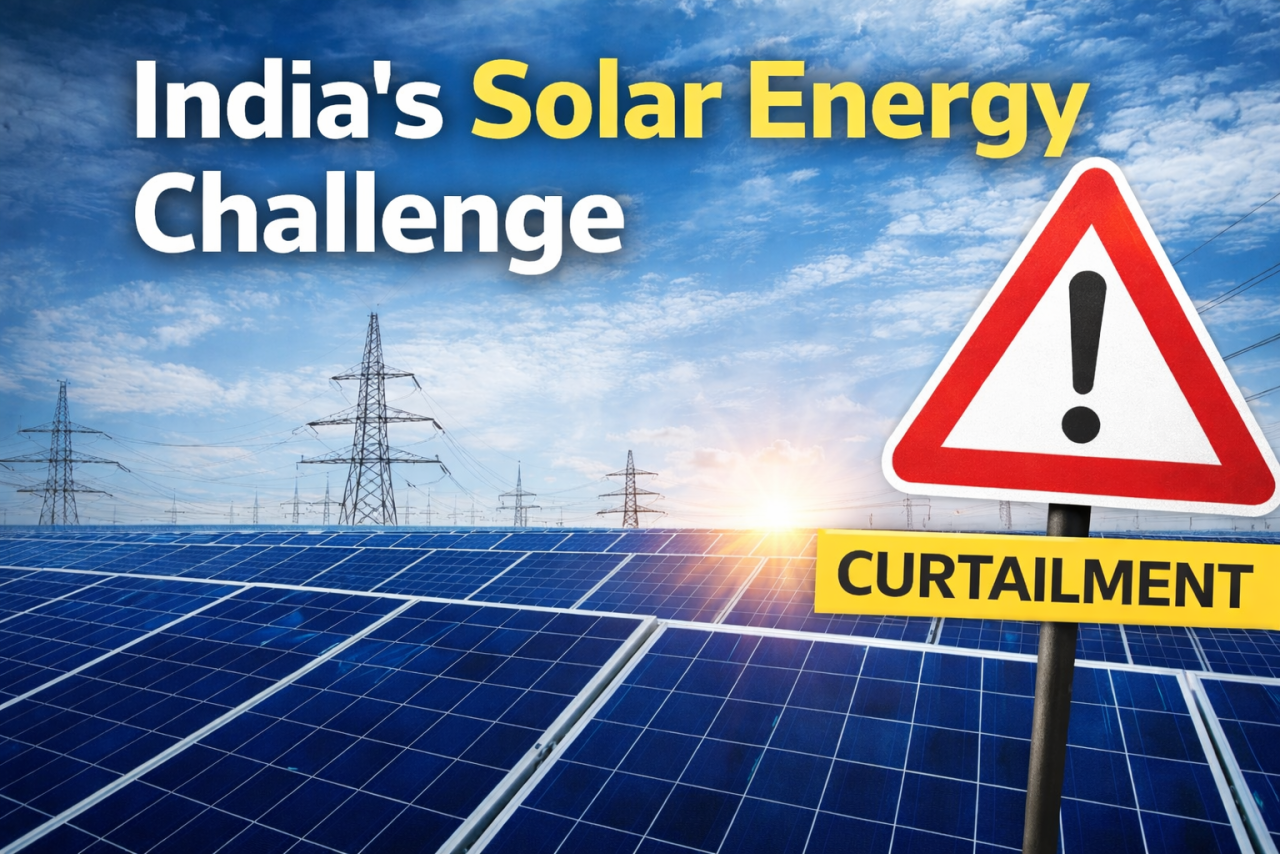
India added record solar capacity, but in 2025 the country was forced to switch off the sun—revealing a growing gap between renewable ambition and grid reality.
India has spent the last five years aggressively pushing solar energy as a central pillar of its clean energy transition. From large solar parks to rooftop installations, solar power has been projected as the answer to rising energy demand, climate commitments, and reduced dependence on fossil fuels. Against this background, the Ember report shows a gap between ambition and ground-level execution.
According to the report, India had to curtail about 2.3 terawatt hours of solar power between late May and December 2025. This means that even though solar electricity was available, it could not be used and had to be reduced deliberately to keep the power grid stable. This happened despite 2025 being a year when India added a massive 38 gigawatts of new solar capacity. In simple terms, the country produced more solar power than the system could safely absorb at certain times of the day.
The main reason for this curtailment was grid limitation. Solar power peaks during midday, but electricity demand does not always rise at the same time. In 2025, demand was often lower than expected, partly due to milder temperatures. At the same time, other power sources such as coal plants could not be turned down quickly enough. This left grid operators with no option but to cut back solar generation to prevent instability.
The report also points to deeper structural issues. India’s power grid was not designed for such high levels of variable renewable energy. Transmission constraints, lack of storage, and limited flexibility in conventional power plants made it difficult to manage sudden surges of solar power. While curtailment was described as an emergency measure, it became frequent enough to raise serious concerns about planning and coordination in the power sector.
There is also a financial and environmental cost to this curtailment. Solar power producers had to be compensated for electricity they generated but could not supply. Environmentally, the report estimates that the curtailed solar energy could have avoided around 2.1 million tonnes of carbon dioxide emissions if it had replaced coal-based power. That is roughly equal to the annual emissions of about 400,000 Indian households, showing that the impact goes beyond technical inconvenience.
At the same time, the report does not suggest that solar expansion is a mistake. Instead, it treats 2025 as a stress test for India’s clean energy future. It highlights a basic truth: adding renewable capacity alone is not enough. Without investment in grid flexibility, energy storage, better forecasting, and smarter demand management, clean energy cannot scale efficiently.
This situation is particularly relevant because the Indian government has repeatedly projected solar energy as a success story and a symbol of global leadership on climate action. The curtailment figures show that policy focus now needs to move beyond capacity addition. Greater attention is required on strengthening transmission networks, integrating battery storage, and reforming power markets so that renewable energy can be absorbed smoothly.
Over the last five years, solar energy has been presented as both an economic and environmental solution. When such a flagship programme runs into systemic issues, it deserves close attention and clear explanation. This report aims to translate technical findings into simple language so that policymakers, industry players, and ordinary readers can understand what is going wrong and why it matters. Solar energy remains central to India’s future, but this episode shows that ambition must be matched with planning, flexibility, and realistic assessment of infrastructure limits.





























Leave a Comment