
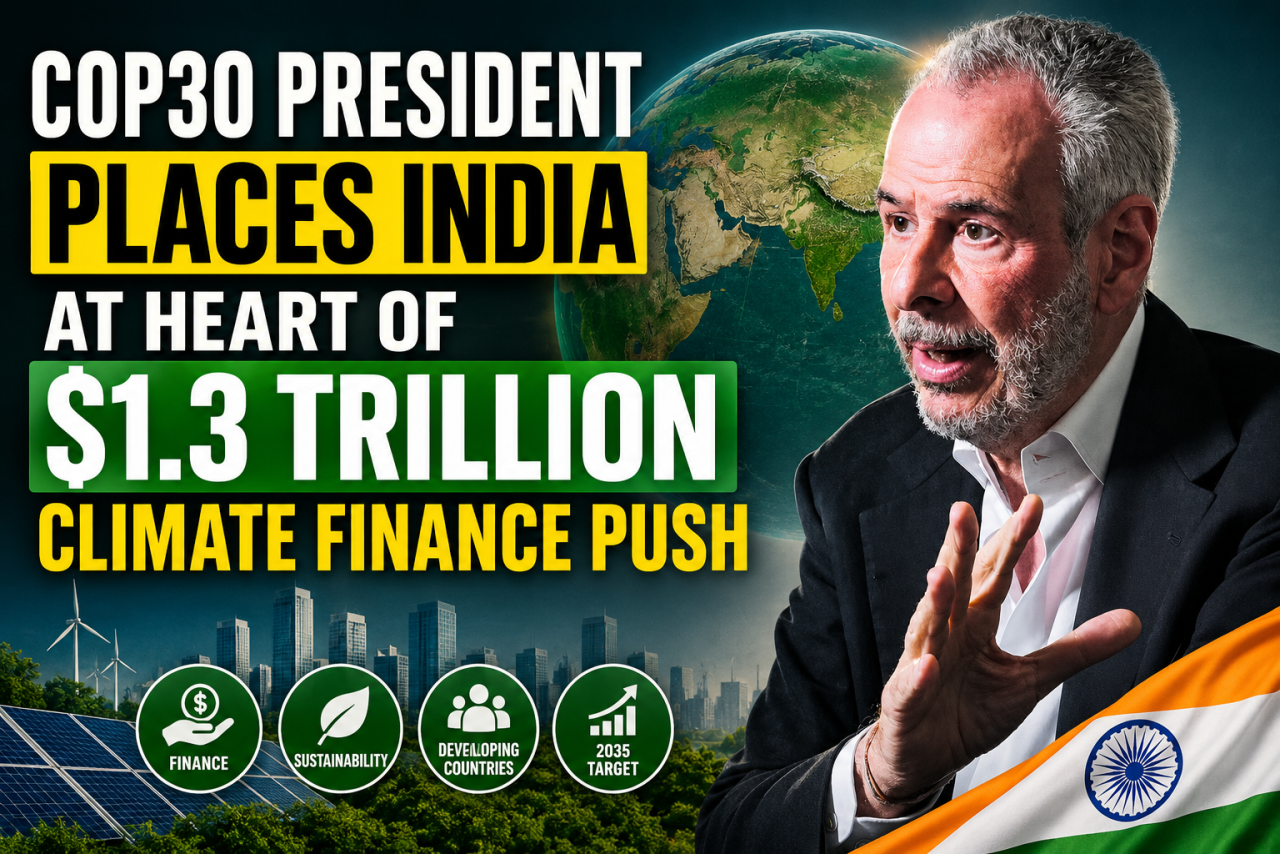
India has emerged as the focal point of a proposed $1.3 trillion global climate finance plan, with COP30 leaders calling its role indispensable to the world's green transition.
André Corrêa do Lago, president of the COP30 climate summit, said on Friday that three implementation roadmaps under the proposed $1.3 trillion global climate finance plan will be released before November, stressing that India's participation will be critical to their success.
Speaking at a panel discussion in the capital, Corrêa do Lago chaired a session with key board members overseeing the global green transition process.
The $1.3 trillion target was first outlined in the Baku to Belém Roadmap, a framework jointly launched by the COP29 presidency of Azerbaijan and the COP30 presidency of Brazil. The initiative aims to mobilise at least $1.3 trillion annually for developing countries by 2035, built around five priority areas—known as the 5Rs: replenishing concessional finance, rebalancing fiscal space, rechannelling private capital, revamping institutional capacity, and reshaping global financial systems to improve equitable access to climate finance.
Corrêa do Lago said India embodies two of the roadmap's most significant implementation challenges: reducing dependence on fossil fuels while simultaneously halting deforestation by 2030. Both issues are among the implementation roadmaps expected to be finalised ahead of COP31.
He also highlighted structural barriers facing developing economies. According to Corrêa do Lago, international credit rating agencies continue to assign disproportionately high risk to climate investments in emerging markets, raising borrowing costs and limiting access to affordable finance. He identified power storage and electricity transmission infrastructure as major constraints that could slow India's clean energy transition if not addressed.
The discussion coincided with the inaugural meeting of the High-Level Empowered Board on Green Transition, launched during India's Raisina Dialogue 2026 and chaired by economist N.K. Singh, former chairman of the Fifteenth Finance Commission. The board has been tasked with developing market-based pathways for climate finance and helping shape India's negotiating strategy under the United Nations Framework Convention on Climate Change (UNFCCC).
Among the keynote speakers was Lord Nicholas Stern, chair of the London School of Economics' Grantham Research Institute. Stern warned of a widening disconnect between the scientific consensus on climate change and the political debate surrounding it, arguing that the gap risks leaving countries such as India underprepared for increasingly severe climate impacts. He has also led the Independent High-Level Expert Group on Climate Finance, which has concluded that mobilising $1.3 trillion annually is achievable if conventional public finance is complemented by innovative financial instruments and greater private-sector participation.
Rachel Kyte, the United Kingdom's Special Representative for Climate Change, offered an international comparison, arguing that climate finance strategies must reflect local energy systems rather than follow a single global model. She noted that Pakistan now generates roughly one-quarter of its electricity from solar power—a level South Korea has also approached—although each country reached that point through distinct policy and financing pathways shaped by its own economic and political circumstances.
The meeting also addressed mechanisms for monitoring progress toward the financing target. Officials said quarterly implementation updates will continue through March 2027, providing governments with a structured framework to assess whether financial commitments are translating into actual disbursements. Corrêa do Lago described the current stage of climate diplomacy as moving beyond negotiations toward implementation, arguing that while consensus remains essential for international agreements, it is no longer a prerequisite for delivering on commitments that have already been made.
For India, the implications extend well beyond climate negotiations. As one of the world's largest emerging economies balancing energy security, industrial expansion, and decarbonisation, its ability to attract, absorb, and deploy climate finance effectively could become a model—or a cautionary tale—for other developing nations pursuing the shared 2035 climate finance agenda.
André Corrêa do Lago, president of the COP30 climate summit, said on Friday that three implementation roadmaps under the proposed $1.3 trillion global climate finance plan will be released before November, stressing that India's participation will be critical to their success.
Speaking at a panel discussion in the capital, Corrêa do Lago chaired a session with key board members overseeing the global green transition process.
The $1.3 trillion target was first outlined in the Baku to Belém Roadmap, a framework jointly launched by the COP29 presidency of Azerbaijan and the COP30 presidency of Brazil. The initiative aims to mobilise at least $1.3 trillion annually for developing countries by 2035, built around five priority areas—known as the 5Rs: replenishing concessional finance, rebalancing fiscal space, rechannelling private capital, revamping institutional capacity, and reshaping global financial systems to improve equitable access to climate finance.
Corrêa do Lago said India embodies two of the roadmap's most significant implementation challenges: reducing dependence on fossil fuels while simultaneously halting deforestation by 2030. Both issues are among the implementation roadmaps expected to be finalised ahead of COP31.
He also highlighted structural barriers facing developing economies. According to Corrêa do Lago, international credit rating agencies continue to assign disproportionately high risk to climate investments in emerging markets, raising borrowing costs and limiting access to affordable finance. He identified power storage and electricity transmission infrastructure as major constraints that could slow India's clean energy transition if not addressed.
The discussion coincided with the inaugural meeting of the High-Level Empowered Board on Green Transition, launched during India's Raisina Dialogue 2026 and chaired by economist N.K. Singh, former chairman of the Fifteenth Finance Commission. The board has been tasked with developing market-based pathways for climate finance and helping shape India's negotiating strategy under the United Nations Framework Convention on Climate Change (UNFCCC).
Among the keynote speakers was Lord Nicholas Stern, chair of the London School of Economics' Grantham Research Institute. Stern warned of a widening disconnect between the scientific consensus on climate change and the political debate surrounding it, arguing that the gap risks leaving countries such as India underprepared for increasingly severe climate impacts. He has also led the Independent High-Level Expert Group on Climate Finance, which has concluded that mobilising $1.3 trillion annually is achievable if conventional public finance is complemented by innovative financial instruments and greater private-sector participation.
Rachel Kyte, the United Kingdom's Special Representative for Climate Change, offered an international comparison, arguing that climate finance strategies must reflect local energy systems rather than follow a single global model. She noted that Pakistan now generates roughly one-quarter of its electricity from solar power—a level South Korea has also approached—although each country reached that point through distinct policy and financing pathways shaped by its own economic and political circumstances.
The meeting also addressed mechanisms for monitoring progress toward the financing target. Officials said quarterly implementation updates will continue through March 2027, providing governments with a structured framework to assess whether financial commitments are translating into actual disbursements. Corrêa do Lago described the current stage of climate diplomacy as moving beyond negotiations toward implementation, arguing that while consensus remains essential for international agreements, it is no longer a prerequisite for delivering on commitments that have already been made.
For India, the implications extend well beyond climate negotiations. As one of the world's largest emerging economies balancing energy security, industrial expansion, and decarbonisation, its ability to attract, absorb, and deploy climate finance effectively could become a model—or a cautionary tale—for other developing nations pursuing the shared 2035 climate finance agenda.



























Leave a Comment