
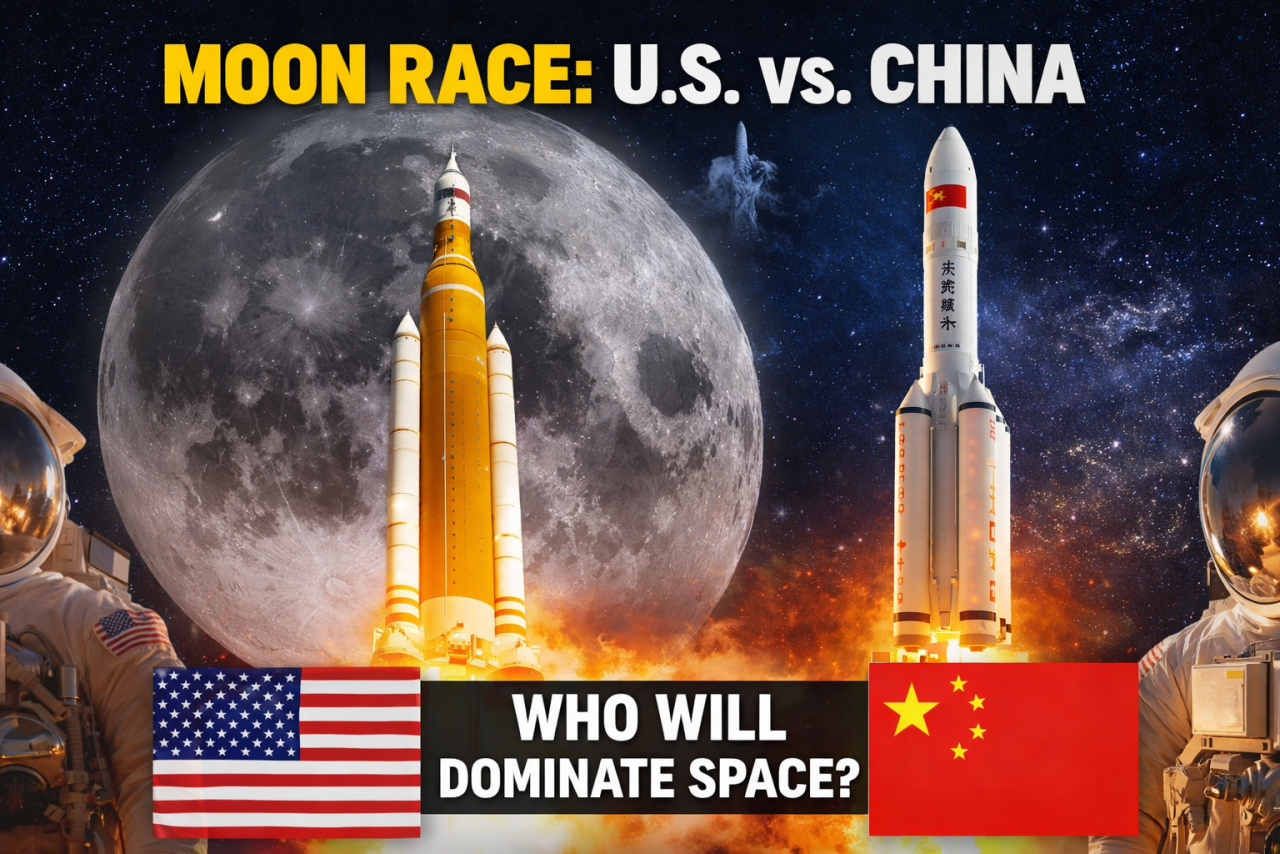
The Moon is no longer a quiet symbol of scientific wonder. It is becoming a proving ground for national ambition, technological depth, and geopolitical influence. As NASA prepares its Artemis missions and China accelerates its own lunar timetable, a 21st-century Moon race is taking shape—subtle in tone, but sharp in intent.
Last week’s images from Florida, showing NASA’s towering Space Launch System (SLS) being rolled out inside the Kennedy Space Center, were not just about engineering. They were about message-making. The United States wants the world to see that it is serious about returning humans to the Moon—and staying there. China, watching closely, is sending its own signals from the other side of the globe.
America’s Long Road Back
NASA’s Artemis program is the backbone of the U.S. lunar push. Artemis I, an uncrewed test flight in 2022, successfully orbited the Moon and returned to Earth, proving that the SLS rocket and Orion capsule could survive deep-space conditions. Artemis II, now in advanced preparation, aims to send four astronauts around the Moon on a crewed mission, likely no later than April this year. Artemis III, planned for 2027, is intended to land humans— including the first woman—on the lunar surface for the first time since 1972.
But the American comeback has been anything but smooth. The SLS rocket has been criticised for cost overruns and delays. Each launch is estimated to cost over $4 billion, making it one of the most expensive rockets ever built. Political pressure has been constant, with lawmakers debating whether such a costly, government-led system makes sense in an era when private players like SpaceX are rapidly advancing.
Still, the U.S. strategy is clear that this is not about a symbolic flag-planting exercise. Artemis is designed to build infrastructure—lunar orbiting stations, surface habitats, and long-term logistics—that can support a sustained presence. The Moon is being framed as a stepping stone to Mars and as a laboratory for deep-space operations.
China’s Quiet but Relentless Advance
China, meanwhile, is playing a different game. It has avoided dramatic headlines but made consistent, methodical progress. Through its Chang’e missions, China has already achieved milestones the U.S. took decades to attempt—soft landings on the Moon’s far side, robotic sample returns, and long-duration lunar operations.
Beijing has announced plans to land astronauts on the Moon by 2030. Unlike the U.S., China is not relying heavily on commercial partners. Its program is tightly state-controlled, with a focus on reliability, incremental testing, and strategic secrecy. Chinese officials rarely engage in public timelines filled with lofty rhetoric, but when milestones are announced, they are often met.
China is also working with Russia and other partners on plans for an International Lunar Research Station, positioned as an alternative to the U.S.-led Artemis Accords. This is not accidental. Lunar cooperation is becoming a proxy for broader global alignment—who works with whom, under what rules, and with whose technology.
Two Visions, One Destination
At its core, the Moon race reflects two competing visions of leadership. The U.S. approach is open, coalition-based, and commercially integrated. It invites allies like Europe, Japan, and India to participate, while encouraging private companies to innovate. The downside is complexity: coordination challenges, political scrutiny, and ballooning costs.
China’s model is centralized and strategic. Decisions are faster, messaging is controlled, and long-term planning is insulated from electoral cycles. But this also limits transparency and international trust, especially among countries wary of becoming dependent on Chinese space infrastructure.
Both nations understand the Moon’s value goes beyond science. Lunar ice can be converted into water, oxygen, and rocket fuel. Strategic locations near the Moon’s south pole could offer long-term advantages for communication, energy generation, and space traffic control. In space, first movers shape the rules.
Why This Race Matters on Earth
Unlike the Cold War-era space race, this competition is not about ideological spectacle. It is about capability. Whoever masters sustained lunar operations gains leverage in satellite servicing, deep-space navigation, and even military space awareness.
For smaller spacefaring nations, the Moon race presents both opportunity and pressure. Aligning with the U.S. or China may determine access to future space resources and technologies. Neutrality will be difficult as lunar governance frameworks solidify.
The return to the Moon also reflects a deeper shift in global power. Space is no longer an isolated scientific domain; it is an extension of economic strength and strategic confidence. The rockets rolling out in Florida and the quiet launches from China’s deserts tell the same story: the Moon is back, and it is contested.
This time, however, the finish line is not a single landing. It is permanence. And in that long game, patience, consistency, and credibility may matter more than who arrives first.

























Leave a Comment