
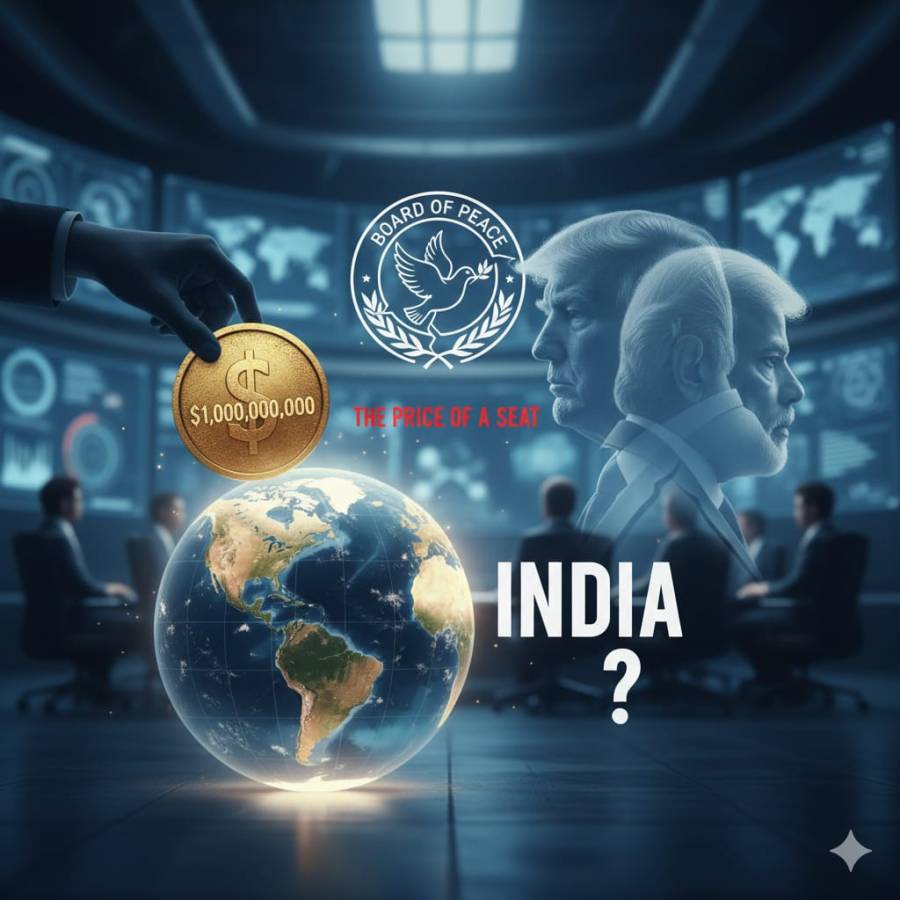
In January 2026, the international diplomatic landscape was shaken by the introduction of the “Board of Peace” (BoP). Unveiled by U.S. President Donald Trump at the World Economic Forum, this new entity is framed as a solution to the gridlock of traditional international organizations. While its immediate goal is the reconstruction of post-war Gaza, its underlying structure suggests a radical departure from how global politics has operated for the last eighty years. For the common reader in India, understanding this isn’t just about foreign news; it is about how India’s sovereignty and money are being weighed on the global stage.
The Board of Peace is fundamentally different from the United Nations. Where the UN is a collective of nearly 200 nations with established—if sometimes slow—processes, the BoP is a centralized body. It is chaired personally by Donald Trump, who holds the power to cast tie-breaking votes and even dissolve subsidiary groups. This creates a “CEO-style” approach to global peace. Perhaps the most striking feature is the entry fee: while temporary memberships are available, a permanent seat on this board reportedly requires a “contribution” of $1 billion. This turns global diplomacy into something resembling a high-stakes club where influence can be purchased.
For the Indian government, this presents a significant “strategic dilemma.” Prime Minister Narendra Modi’s administration has spent years elevating India’s status as a “Vishwa Bandhu” (a friend to the world). However, New Delhi has notably hesitated to join the BoP, choosing to skip the initial signing ceremony. This hesitation isn’t just about the $1 billion price tag; it is about deep-seated principles of Indian foreign policy.
One of the primary reasons for India’s caution is the concept of Strategic Autonomy. India has long prided itself on making independent decisions. Whether it’s navigating relationships during the Ukraine crisis or managing trade tensions with the U.S. regarding high tariffs, India refuses to be a “junior partner” in any alliance. Joining a board where a single foreign leader holds ultimate veto power contradicts India’s vision of a “multipolar world”—a world where many nations share power rather than just one.
Furthermore, there is the sensitive issue of regional security. In May 2025, India demonstrated its military capability through Operation Sindoor, a decisive response to cross-border threats that asserted Indian dominance in the region. India has always maintained that its issues with its neighbors are strictly bilateral—meaning they should be solved between the two countries involved without outside interference. The BoP charter suggests that this board could eventually “intervene” in global conflicts. For India, joining a board that includes rivals like Pakistan and Turkey could open the door for unwanted international meddling in India’s internal security matters.
There is also the matter of the United Nations. India has campaigned for decades for a permanent seat on the UN Security Council, arguing that as the world’s most populous democracy, it has earned a place at the top through contribution and merit. To pivot now and “buy” a seat on a new, unproven board would undermine India’s long-standing demand for a fairer, law-based international system. It would signal that global leadership is for sale to the highest bidder, rather than being earned through diplomatic responsibility.
Despite the pressure, India’s current stance is one of “principled distance.” India remains committed to the humanitarian cause in Gaza and continues to be a major voice for the Global South. However, it is making it clear that it will not be rushed into a deal that compromises its independence. For the average person, this can be seen as India standing its ground: it wants to help build peace, but it won’t pay a billion-dollar “subscription fee” to a club where it doesn’t get to help write the rules.
As the BoP begins its operations in 2026, the world is watching to see if this new model of “transactional diplomacy” will succeed or if nations like India will lead a movement back toward a more balanced, collective form of global governance. For now, New Delhi is choosing to wait and watch, prioritizing its national interest and its dignity over an expensive seat at a volatile table.














Leave a Comment