
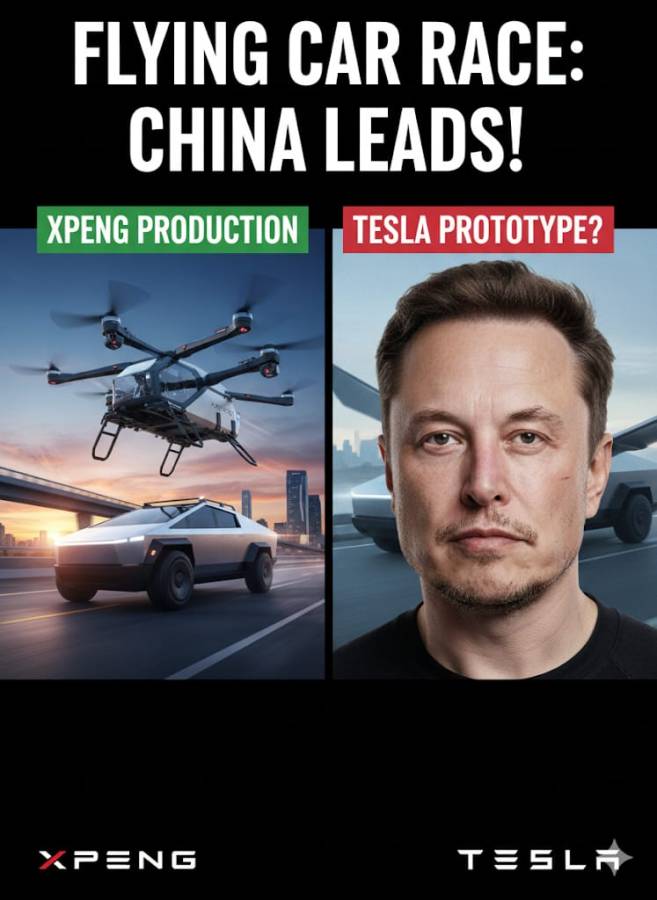
The race to commercialize flying cars has just shifted gears, with a Chinese firm taking a decisive lead. Xpeng Aeroht, a subsidiary of the electric vehicle maker Xpeng Inc., announced this week that it has officially begun trial production of its next-generation modular flying car. This move firmly places the Chinese manufacturer at the forefront of the urban air mobility market, even as tech giant Tesla and its CEO, Elon Musk, continue to pursue their own ambitions in the sector.
The Aircraft Carrier on the Road
The firm's innovative vehicle, dubbed the "Land Aircraft Carrier" by Xinhua news agency, represents a bold vision for future transportation. It's a six-wheel-drive ground module that functions as the "mother ship" for a detachable, two-seat electric vertical take-off and landing (eVTOL) aircraft. This modular design addresses one of the key challenges of flying cars: dual functionality. The ground module is designed to be driven on public roads and will reportedly require a standard driver's license, offering the familiarity and convenience of a conventional vehicle.
The detachable aircraft component is the star of the show. It offers both automatic and manual flight modes, complete with smart flight planning, as well as the inherent capability for one-touch take-off and landing. This eVTOL is reportedly scheduled for mass production and delivery in 2026.
The market response has been overwhelmingly positive. Xpeng Aeroht has already secured orders for more than 5,000 flying cars since the product's release, signaling robust commercial confidence in their groundbreaking design and production timeline.
A Race Beyond Ground Vehicles
This latest development from Xpeng Aeroht highlights a critical pivot point in the global tech landscape. For years, Tesla has dominated the conversation around future mobility, particularly with its advancements in electric ground vehicles and autonomous driving. However, the move into urban air mobility (UAM) is proving to be a different kind of challenge, where numerous startups and established aerospace firms are vying for dominance.
Tesla CEO Elon Musk has made it clear that a flying car is on his company's agenda. Just this Monday on November 03, 2025, Musk reportedly stated, "We're getting closer to building a flying car. We're getting close to demonstrating the prototype."
While this statement signals active development, the commencement of trial production by Xpeng Aeroht represents a tangible, manufacturing-level commitment that arguably leapfrogs Tesla’s current public progress. Trial production is a crucial step that validates the manufacturing process, supply chain, and quality control ahead of full-scale mass production. By rolling the first electric aircraft of its modular flying car off the line, Xpeng Aeroht is demonstrating that their product is moving from the drawing board to the factory floor.
Regulatory and Infrastructure Hurdles
Despite the technological breakthroughs, the widespread adoption of flying cars still faces significant hurdles. Regulation is arguably the biggest challenge. Aviation authorities worldwide are scrambling to develop new frameworks for air traffic control, safety standards, and pilot licensing for these unique vehicles. The concept of personal eVTOLs operating in crowded urban airspace demands entirely new rules.
Furthermore, infrastructure must evolve. Unlike helicopters, which require dedicated helipads, eVTOLs rely on vertiports—specialized hubs for take-off, landing, charging, and maintenance. The successful deployment of 5,000-plus flying cars will necessitate the rapid development of this supportive infrastructure across cities.
Xpeng Aeroht’s modular approach, which allows the ground unit to utilize existing road networks and parking spaces, offers a clever way to bridge the gap between traditional and aerial transit. But ultimately, the success of the eVTOL component hinges on regulatory approval and public acceptance of low-altitude air travel.
As Xpeng Aeroht steams ahead toward its 2026 delivery goal, the world watches to see if their "Land Aircraft Carrier" will be the machine that finally makes the decades-old dream of personal flying cars a reality. The pressure is now squarely on Western competitors like Tesla to close the gap.























Leave a Comment