
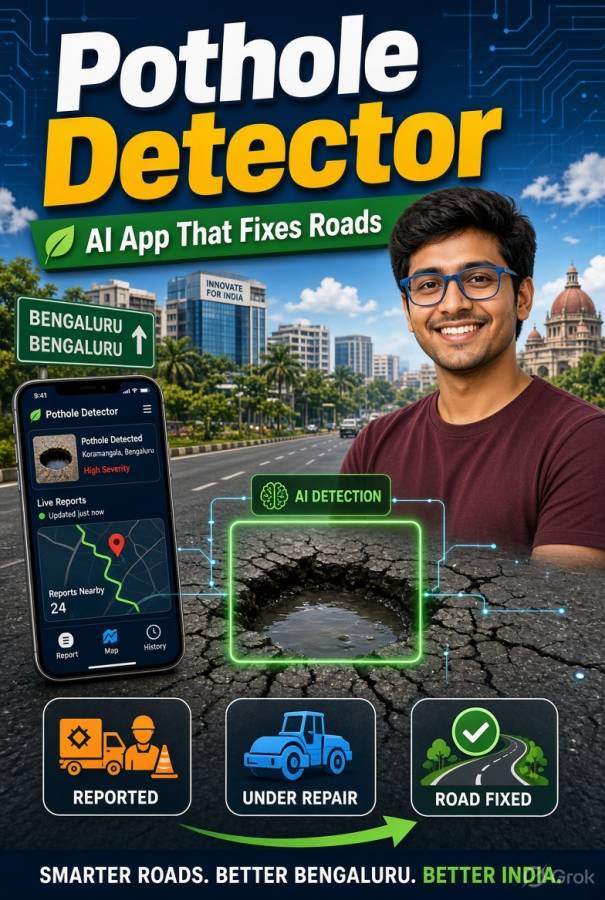
In Bengaluru, one engineer's AI-powered app is turning road damage into traceable evidence by connecting potholes with contractors, contracts and warranty obligations.
A road accident triggered by a pothole is what most people would call bad luck. For Gaurav Sen, a 33-year-old engineer in Bengaluru, it became the starting point for a three-year project that has quietly done something Indian civic administration has struggled with for decades: create an auditable, tamper-resistant record of what is wrong with the country's roads, and who is responsible for fixing them.
Sen's application, Pothole Detector, has been widely reported as a clever use of artificial intelligence, a dashcam-style tool that spots potholes automatically as a person drives. That framing is accurate but incomplete. The more significant story is not the AI model. It is what the app represents: a citizen-built accountability layer sitting on top of a government contracting system that has historically resisted exactly this kind of scrutiny.
The Problem Was Never Detection
Potholes are not a mystery in Indian cities. Commuters know where they are. Local corporators know where they are. Even municipal engineers, in most cases, know where they are. The failure has rarely been about identifying damaged roads. It has been about connecting that damage to a specific contractor, a specific tender, and a specific warranty period, and then making that link visible enough that inaction carries a cost.
This is the gap Sen's app closes. As the app is driven along a route, it automatically geo-tags and photographs road damage, then cross-references the location against municipal contract records to identify which contractor is responsible and whether the road is still under warranty. What used to be a monthslong manual exercise, cross-checking one dataset of road contracts against another of complaint records, is now resolved in the time it takes to drive past the damage.
That distinction matters because it shifts the app from being a complaint tool to being an evidence tool. A complaint can be ignored. A dated, geo-tagged photograph linked to a named contractor and an active warranty clause is much harder to explain away.
Built From Frustration, Not a Business Plan
Sen's own account of the project's origins is telling. He has described how commuters riding two-wheelers were being injured on the same stretches of road repeatedly, and how his own family had experienced the anger and helplessness of dealing with government complaint systems that led nowhere. The project did not begin as a startup pitch. It began as a workbench experiment, built during off-hours, that took roughly three months of painstaking manual data matching before artificial intelligence tools compressed that process into a matter of days.
That evolution, from a slow, manual civic-tech hobby project to something that scales, mirrors a pattern seen elsewhere in India, where individuals with technical skills have stepped in to build tools that public institutions were either unwilling or unable to build themselves. What makes Sen's case notable is that the tool did not stay a personal grievance outlet. It has already been used to flag issues to Bengaluru's civic authorities and has drawn interest from a state government in Andhra Pradesh, suggesting a path toward institutional adoption rather than remaining a one-city curiosity.
Why Scaling Civic Tech Is Harder Than Building It
The more difficult questions lie ahead. Sen has spoken about wanting the tool to expand into other metro cities, including Delhi, and to support the kind of data collection that smaller cities and states typically cannot afford on their own. That ambition runs into a familiar obstacle in Indian governance: technology adoption inside municipal bodies is rarely limited by the absence of good tools. It is limited by procurement inertia, data ownership disputes, and the reluctance of contractors and local officials to accept a system that makes lapses easier to prove.
An AI model that flags a pothole and names a contractor is only useful if a municipal body is willing to act on that finding, and willing to expose its own contract and warranty data to public or semi-public scrutiny in the process. That is a governance choice, not a technical one. Several Indian cities have piloted pothole-reporting apps in the past, some run by municipal corporations themselves, only to see them fade after the initial media cycle because there was no institutional will to enforce contractor penalties once damage was documented.
Sen's stated intention to offer the tool free to individuals while working through paid tie-ups with contractors and departments is one way to sidestep that problem, since it creates a financial incentive for institutions to opt in rather than merely tolerate the tool. Whether that model holds up at the scale of a state government's road network, with thousands of contracts and shifting political incentives, remains untested.
A Wider Signal, Not Just a Local Fix
What Pothole Detector ultimately represents is a broader trend worth watching: engineers and technologists building narrow, well-scoped accountability tools that route around slow-moving public systems rather than waiting for those systems to modernise themselves. It joins a growing category of citizen-built infrastructure, from air quality trackers to flood-reporting tools, that quietly does the data work Indian civic bodies were meant to do but often haven't.
The lasting value of Sen's project may not be the number of potholes it detects, but whether it forces municipal contracting to become more transparent by default. If that happens even in a handful of cities, an app born out of one engineer's frustration on a Bengaluru road could end up reshaping how road accountability works across urban India.
A road accident triggered by a pothole is what most people would call bad luck. For Gaurav Sen, a 33-year-old engineer in Bengaluru, it became the starting point for a three-year project that has quietly done something Indian civic administration has struggled with for decades: create an auditable, tamper-resistant record of what is wrong with the country's roads, and who is responsible for fixing them.
Sen's application, Pothole Detector, has been widely reported as a clever use of artificial intelligence, a dashcam-style tool that spots potholes automatically as a person drives. That framing is accurate but incomplete. The more significant story is not the AI model. It is what the app represents: a citizen-built accountability layer sitting on top of a government contracting system that has historically resisted exactly this kind of scrutiny.
The Problem Was Never Detection
Potholes are not a mystery in Indian cities. Commuters know where they are. Local corporators know where they are. Even municipal engineers, in most cases, know where they are. The failure has rarely been about identifying damaged roads. It has been about connecting that damage to a specific contractor, a specific tender, and a specific warranty period, and then making that link visible enough that inaction carries a cost.
This is the gap Sen's app closes. As the app is driven along a route, it automatically geo-tags and photographs road damage, then cross-references the location against municipal contract records to identify which contractor is responsible and whether the road is still under warranty. What used to be a monthslong manual exercise, cross-checking one dataset of road contracts against another of complaint records, is now resolved in the time it takes to drive past the damage.
That distinction matters because it shifts the app from being a complaint tool to being an evidence tool. A complaint can be ignored. A dated, geo-tagged photograph linked to a named contractor and an active warranty clause is much harder to explain away.
Built From Frustration, Not a Business Plan
Sen's own account of the project's origins is telling. He has described how commuters riding two-wheelers were being injured on the same stretches of road repeatedly, and how his own family had experienced the anger and helplessness of dealing with government complaint systems that led nowhere. The project did not begin as a startup pitch. It began as a workbench experiment, built during off-hours, that took roughly three months of painstaking manual data matching before artificial intelligence tools compressed that process into a matter of days.
That evolution, from a slow, manual civic-tech hobby project to something that scales, mirrors a pattern seen elsewhere in India, where individuals with technical skills have stepped in to build tools that public institutions were either unwilling or unable to build themselves. What makes Sen's case notable is that the tool did not stay a personal grievance outlet. It has already been used to flag issues to Bengaluru's civic authorities and has drawn interest from a state government in Andhra Pradesh, suggesting a path toward institutional adoption rather than remaining a one-city curiosity.
Why Scaling Civic Tech Is Harder Than Building It
The more difficult questions lie ahead. Sen has spoken about wanting the tool to expand into other metro cities, including Delhi, and to support the kind of data collection that smaller cities and states typically cannot afford on their own. That ambition runs into a familiar obstacle in Indian governance: technology adoption inside municipal bodies is rarely limited by the absence of good tools. It is limited by procurement inertia, data ownership disputes, and the reluctance of contractors and local officials to accept a system that makes lapses easier to prove.
An AI model that flags a pothole and names a contractor is only useful if a municipal body is willing to act on that finding, and willing to expose its own contract and warranty data to public or semi-public scrutiny in the process. That is a governance choice, not a technical one. Several Indian cities have piloted pothole-reporting apps in the past, some run by municipal corporations themselves, only to see them fade after the initial media cycle because there was no institutional will to enforce contractor penalties once damage was documented.
Sen's stated intention to offer the tool free to individuals while working through paid tie-ups with contractors and departments is one way to sidestep that problem, since it creates a financial incentive for institutions to opt in rather than merely tolerate the tool. Whether that model holds up at the scale of a state government's road network, with thousands of contracts and shifting political incentives, remains untested.
A Wider Signal, Not Just a Local Fix
What Pothole Detector ultimately represents is a broader trend worth watching: engineers and technologists building narrow, well-scoped accountability tools that route around slow-moving public systems rather than waiting for those systems to modernise themselves. It joins a growing category of citizen-built infrastructure, from air quality trackers to flood-reporting tools, that quietly does the data work Indian civic bodies were meant to do but often haven't.
The lasting value of Sen's project may not be the number of potholes it detects, but whether it forces municipal contracting to become more transparent by default. If that happens even in a handful of cities, an app born out of one engineer's frustration on a Bengaluru road could end up reshaping how road accountability works across urban India.


























Leave a Comment