
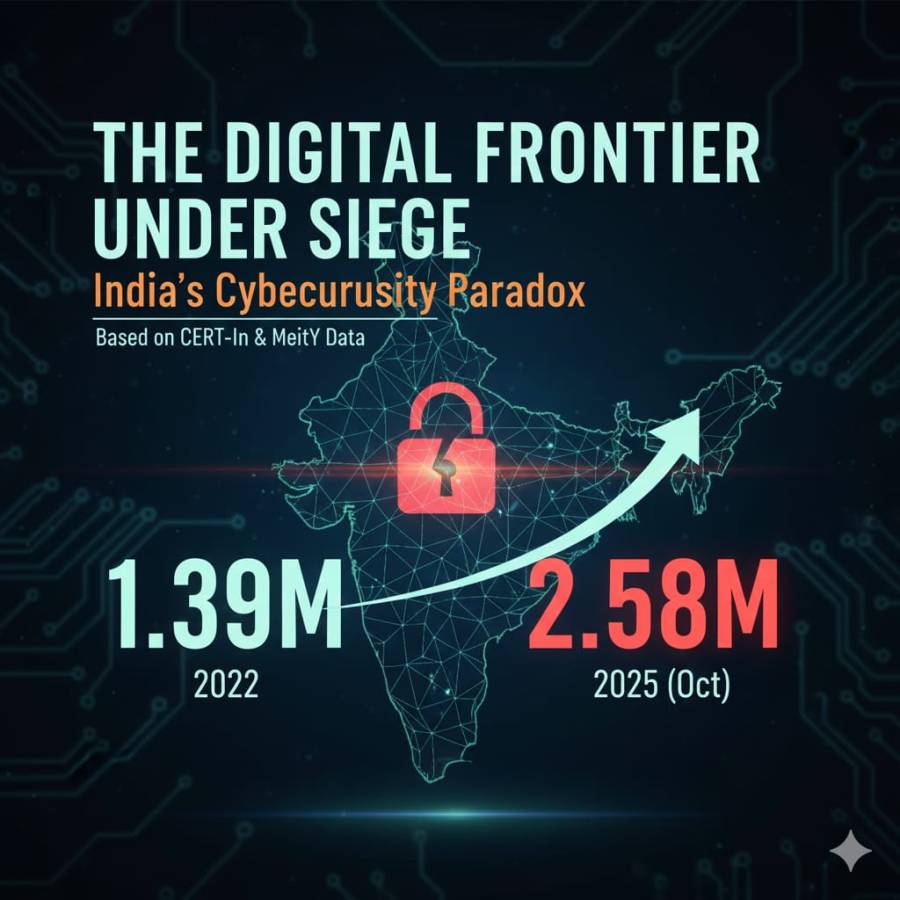
As India accelerates its journey toward becoming a trillion-dollar digital economy, the infrastructure supporting this transition is facing an unprecedented onslaught. Recent data shared by the Ministry of Electronics and Information Technology (MeitY) in the Rajya Sabha paints a sobering picture of our national digital health. In just three years, cybersecurity incidents reported to the Indian Computer Emergency Response Team (CERT-In) have nearly doubled, surging from 1.39 million in 2022 to a staggering 2.58 million by October 2025.
A Mathematical Surge in Threats
The trajectory of these figures reveals a persistent upward trend rather than a seasonal spike. Starting at 1,391,457 incidents in 2022, the numbers climbed to 1,592,917 in 2023, eventually crossing the two-million mark in 2024. The current 2025 figure of 2,580,655 (captured only until October) suggests that by year-end, the total could be nearly 100% higher than the 2022 baseline.
Interestingly, while national reporting is at an all-time high, the private sector has seen a curious fluctuation. After rising to 1.38 million in 2023, reported private sector incidents fell to 731,988 in 2024. This drop may not necessarily indicate a safer environment; rather, it often points to a "reporting gap" where organizations under-report breaches to avoid reputational damage or regulatory scrutiny—a challenge MeitY officials have explicitly noted as a benchmark for preparedness that India has yet to meet.
The Readiness Gap and Institutional Response
The government’s response to this "epidemic of bits" is twofold: institutional funding and human capital development. To bridge the preparedness gap, MeitY is currently implementing the Information Security Education and Awareness (ISEA) project. With a budget of ₹332.74 crore allocated for a five-year period (starting 2023), the project focuses on:
- Capacity Building: Training a new generation of cybersecurity professionals.
- Public Awareness: Educating "Digital Nagriks" (citizens) on basic cyber hygiene.
- Infrastructure: Strengthening the national response framework through CERT-In.
Despite these efforts, a critical bottleneck remains: investment. CERT-In has recommended that organizations earmark between 15% and 20% of their total IT and software spending specifically for cybersecurity. However, industry assessments suggest that many Indian entities—particularly small and medium enterprises—still treat security as a secondary "add-on" rather than a core operational necessity.
The Workforce Perspective: Why This Matters
For students and young professionals entering the workforce, these statistics are more than just numbers—they represent a shifting job market and a new set of ethical responsibilities. The "preparedness gap" mentioned by MeitY is essentially a skills gap. As the complexity of attacks evolves—utilizing AI for phishing and targeting critical cloud infrastructure—the demand for interdisciplinary experts who understand both the technical and legal nuances of the Digital Personal Data Protection (DPDP) Act is skyrocketing.
Moving Beyond Reactive Defense
The doubling of cyber incidents is a loud wake-up call. India’s digital transformation is outpacing its digital defense. To close this gap, the strategy must move from a reactive stance (responding to incidents after they happen) to a proactive culture of "Security by Design." Whether it is a government department or a private startup, the message is clear in the digital age— if you are not investing in defense, you are effectively subsidizing your own downfall.




























Leave a Comment