
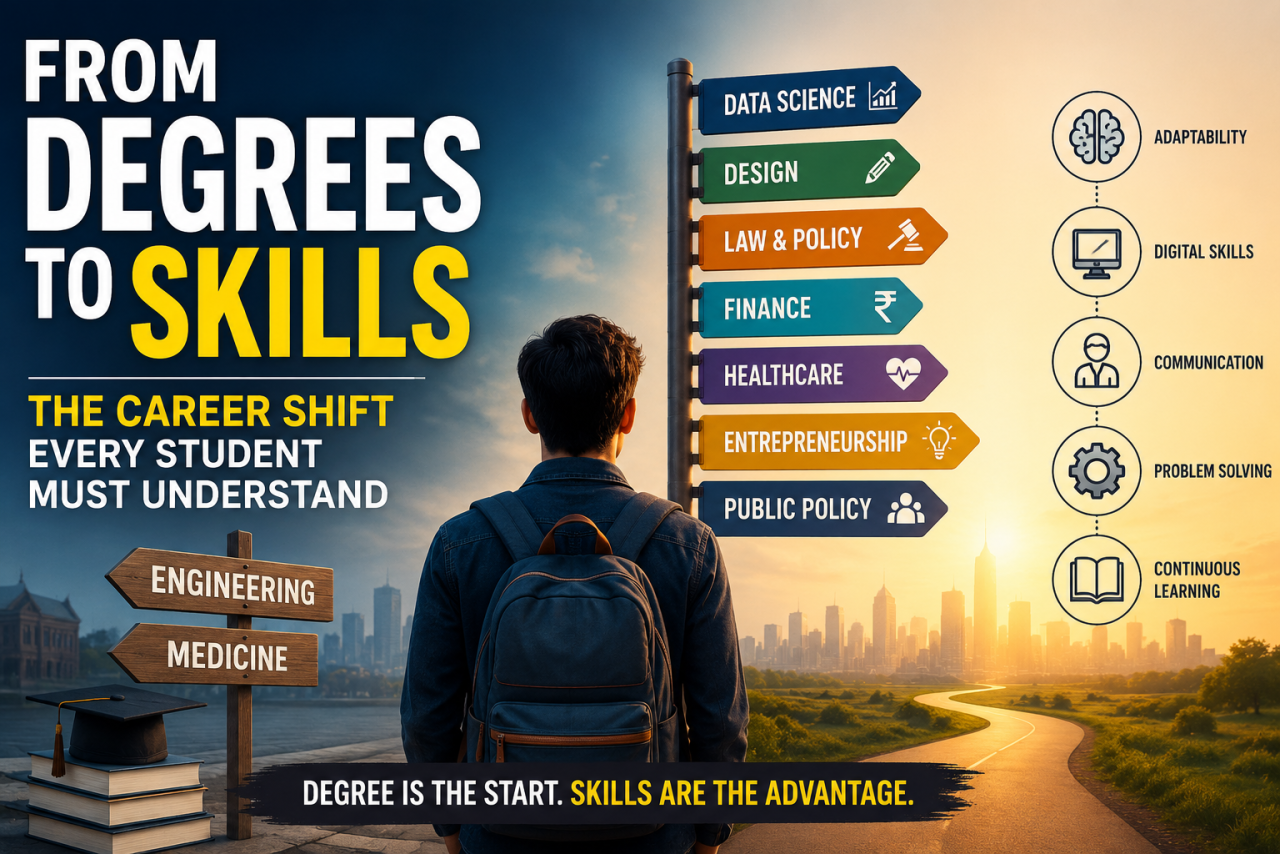
For decades, Indian students were told that success begins with choosing the right degree. Today's job market tells a different story: skills, adaptability, and interdisciplinary learning matter more than ever before.
Every June, the same ritual unfolds across millions of Indian homes. Board examination results arrive, family discussions intensify, and a familiar question takes centre stage:
"Engineering or medicine?"
For decades, this question has shaped the educational journeys of countless students. It was built on a simple assumption that professional success depended largely on choosing the right degree. But India's economy, workplaces, and opportunities have changed dramatically. The question that once defined a generation no longer captures the realities facing the next one.
The truth is that careers today are no longer determined by a single choice made at the age of seventeen.
A useful way to understand this shift is to imagine career planning as selecting a vehicle for a long journey. For years, Indian families were presented with two trusted options: a vehicle called Engineering and another called Medicine. Both were respected, reliable, and familiar. Most people never felt the need to look beyond them.
But today's garage looks very different.
There are now dozens of routes and vehicles designed for different destinations. Some are powered by technology, others by creativity, management, law, finance, healthcare, public policy, or design. Many of the most successful careers are no longer built within a single discipline but at the intersection of several.
India's economic transformation explains why.
As the country moves toward becoming one of the world's largest economies, growth is emerging from multiple sectors simultaneously. Finance, pharmaceuticals, renewable energy, digital services, legal consulting, artificial intelligence, logistics, biotechnology, media, and public policy are all creating new opportunities. These industries increasingly value professionals who can combine expertise from different domains.
A mechanical engineer who understands automation and data analytics. A commerce graduate who can work with artificial intelligence tools. A lawyer specialising in technology regulation and data privacy. A life sciences student with expertise in bioinformatics.
These combinations were rare a decade ago. Today, they are among the most sought-after professional profiles.
This points to a larger reality that every student should understand:
Skills have overtaken streams as the primary currency of employability.
A degree remains important, but it is no longer sufficient by itself. Employers increasingly evaluate candidates based on what they can do, not merely on what they studied. The degree opens the door; specialised skills determine how far one can go.
This is where higher education itself is changing.
Recent educational reforms have encouraged universities to offer greater flexibility through minors, interdisciplinary programmes, certifications, and skill-based learning. Students pursuing commerce can learn data analytics. Engineering students can study design thinking. Humanities graduates can develop expertise in digital tools, research methods, or policy analysis.
The boundaries between disciplines are becoming increasingly porous.
Think of a degree as the foundation of a house. It provides structure and stability. But a foundation alone does not make a home. The rooms, design, utilities, and finishing touches are what determine its functionality and value. Similarly, certifications, specialised training, internships, and practical skills transform a degree into a career.
Two students graduating with the same qualification can end up on completely different professional trajectories depending on the skills they acquire along the way.
This reality extends far beyond the technology sector.
Law is evolving rapidly as businesses navigate issues related to data protection, cybersecurity, intellectual property, and artificial intelligence governance. Management education is increasingly focused on leadership, innovation, and human-centred problem-solving—areas where technology supports rather than replaces human judgment.
The pharmaceutical and healthcare sectors are witnessing growing demand for professionals who can combine scientific knowledge with data interpretation and digital technologies. Creative industries such as media, design, architecture, animation, and content production have become structured professions with clear pathways for growth and specialisation.
Even traditional fields are being reshaped by technology and interdisciplinary thinking.
The opportunities exist. The information is available. Universities publish programme details. Industry reports highlight emerging trends. Career counsellors discuss changing employment patterns every year.
Yet many students continue to make decisions based primarily on familiarity rather than exploration.
The challenge today is not a lack of information. It is a lack of curiosity.
Too often, career decisions are guided by social expectations, family traditions, or perceived prestige rather than an honest assessment of strengths, interests, and future opportunities. As a result, students may overlook paths that align far better with their talents and aspirations.
Perhaps, then, students completing Class XII should ask a different question.
Not "Which stream should I choose?"
But rather:
"What combination of knowledge and skills am I willing to build over the next decade?"
That question reflects the world as it actually exists.
The future will not belong exclusively to engineers, doctors, lawyers, managers, or designers. It will belong to people who continuously learn, adapt, and combine expertise in ways that create value.
Degrees still matter. They provide direction and credibility. But they are no longer the final destination.
In the modern economy, a degree is the starting point. Skills are the differentiator. Continuous learning is the advantage.
Students who understand this shift early will not merely choose a career.
They will build one.
Every June, the same ritual unfolds across millions of Indian homes. Board examination results arrive, family discussions intensify, and a familiar question takes centre stage:
"Engineering or medicine?"
For decades, this question has shaped the educational journeys of countless students. It was built on a simple assumption that professional success depended largely on choosing the right degree. But India's economy, workplaces, and opportunities have changed dramatically. The question that once defined a generation no longer captures the realities facing the next one.
The truth is that careers today are no longer determined by a single choice made at the age of seventeen.
A useful way to understand this shift is to imagine career planning as selecting a vehicle for a long journey. For years, Indian families were presented with two trusted options: a vehicle called Engineering and another called Medicine. Both were respected, reliable, and familiar. Most people never felt the need to look beyond them.
But today's garage looks very different.
There are now dozens of routes and vehicles designed for different destinations. Some are powered by technology, others by creativity, management, law, finance, healthcare, public policy, or design. Many of the most successful careers are no longer built within a single discipline but at the intersection of several.
India's economic transformation explains why.
As the country moves toward becoming one of the world's largest economies, growth is emerging from multiple sectors simultaneously. Finance, pharmaceuticals, renewable energy, digital services, legal consulting, artificial intelligence, logistics, biotechnology, media, and public policy are all creating new opportunities. These industries increasingly value professionals who can combine expertise from different domains.
A mechanical engineer who understands automation and data analytics. A commerce graduate who can work with artificial intelligence tools. A lawyer specialising in technology regulation and data privacy. A life sciences student with expertise in bioinformatics.
These combinations were rare a decade ago. Today, they are among the most sought-after professional profiles.
This points to a larger reality that every student should understand:
Skills have overtaken streams as the primary currency of employability.
A degree remains important, but it is no longer sufficient by itself. Employers increasingly evaluate candidates based on what they can do, not merely on what they studied. The degree opens the door; specialised skills determine how far one can go.
This is where higher education itself is changing.
Recent educational reforms have encouraged universities to offer greater flexibility through minors, interdisciplinary programmes, certifications, and skill-based learning. Students pursuing commerce can learn data analytics. Engineering students can study design thinking. Humanities graduates can develop expertise in digital tools, research methods, or policy analysis.
The boundaries between disciplines are becoming increasingly porous.
Think of a degree as the foundation of a house. It provides structure and stability. But a foundation alone does not make a home. The rooms, design, utilities, and finishing touches are what determine its functionality and value. Similarly, certifications, specialised training, internships, and practical skills transform a degree into a career.
Two students graduating with the same qualification can end up on completely different professional trajectories depending on the skills they acquire along the way.
This reality extends far beyond the technology sector.
Law is evolving rapidly as businesses navigate issues related to data protection, cybersecurity, intellectual property, and artificial intelligence governance. Management education is increasingly focused on leadership, innovation, and human-centred problem-solving—areas where technology supports rather than replaces human judgment.
The pharmaceutical and healthcare sectors are witnessing growing demand for professionals who can combine scientific knowledge with data interpretation and digital technologies. Creative industries such as media, design, architecture, animation, and content production have become structured professions with clear pathways for growth and specialisation.
Even traditional fields are being reshaped by technology and interdisciplinary thinking.
The opportunities exist. The information is available. Universities publish programme details. Industry reports highlight emerging trends. Career counsellors discuss changing employment patterns every year.
Yet many students continue to make decisions based primarily on familiarity rather than exploration.
The challenge today is not a lack of information. It is a lack of curiosity.
Too often, career decisions are guided by social expectations, family traditions, or perceived prestige rather than an honest assessment of strengths, interests, and future opportunities. As a result, students may overlook paths that align far better with their talents and aspirations.
Perhaps, then, students completing Class XII should ask a different question.
Not "Which stream should I choose?"
But rather:
"What combination of knowledge and skills am I willing to build over the next decade?"
That question reflects the world as it actually exists.
The future will not belong exclusively to engineers, doctors, lawyers, managers, or designers. It will belong to people who continuously learn, adapt, and combine expertise in ways that create value.
Degrees still matter. They provide direction and credibility. But they are no longer the final destination.
In the modern economy, a degree is the starting point. Skills are the differentiator. Continuous learning is the advantage.
Students who understand this shift early will not merely choose a career.
They will build one.








Leave a Comment