
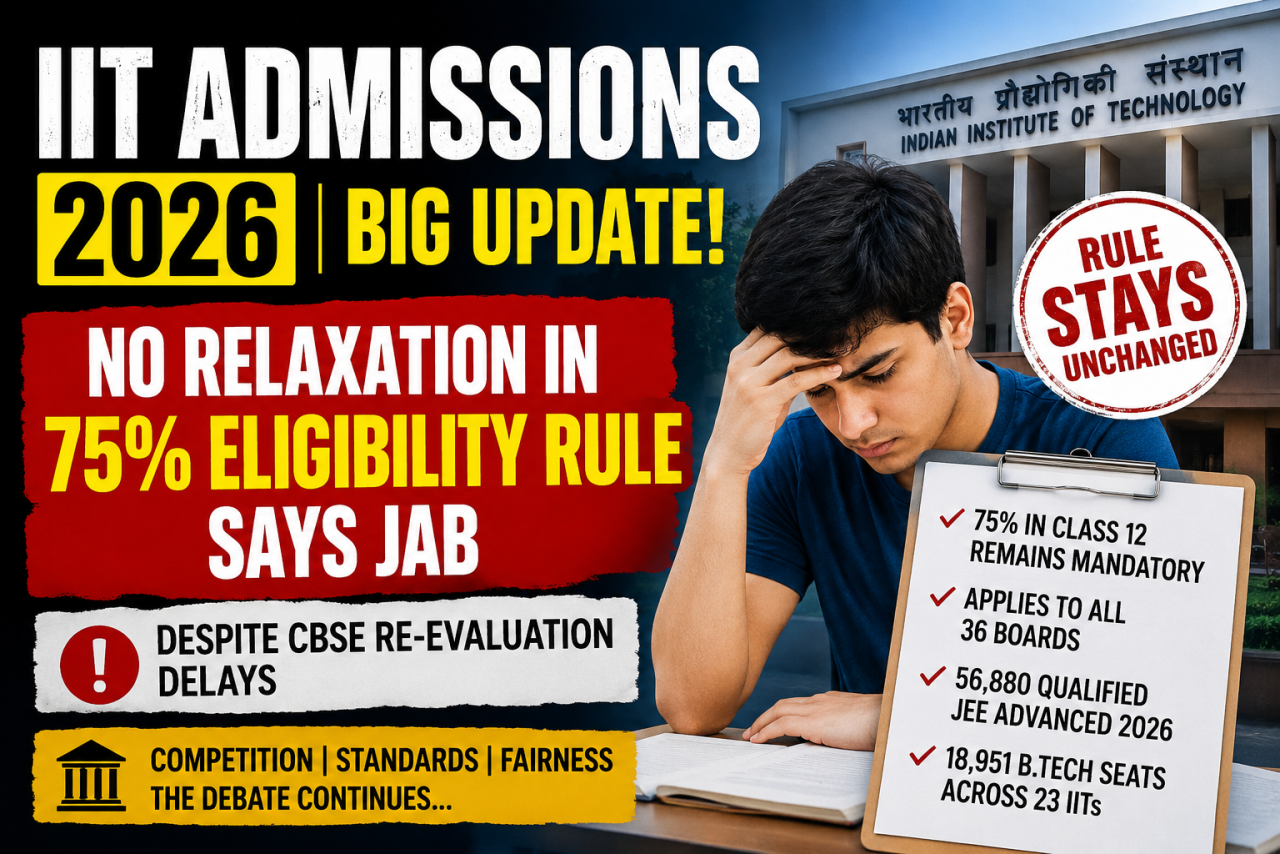
Thousands of JEE Advanced qualifiers hoping for relief from the IITs' 75% Class 12 eligibility requirement have received a clear answer from the Joint Admission Board: the rule stays.
The Joint Admission Board (JAB) has clarified that there will be no relaxation in the minimum 75% Class 12 marks criterion for admission to the Indian Institutes of Technology (IITs) through JEE (Advanced) 2026. The announcement comes at a time when many students and parents have been demanding a one-time exemption due to delays in the Central Board of Secondary Education (CBSE) re-evaluation process.
The decision has reignited a larger debate about fairness, eligibility standards, and the challenges faced by students navigating India's highly competitive engineering admission system.
What Is the Issue?
The controversy emerged after delays in CBSE's re-evaluation process following the introduction of the On-Screen Marking (OSM) system this year. Many students who applied for verification or re-evaluation of their Class 12 answer sheets have not yet received their revised results.
For some candidates, the stakes are enormous. A slight increase in marks after re-evaluation could push them above the 75% threshold required for IIT admissions. Fearing that delayed results may cost deserving students their seats, several student groups and parents appealed to authorities for a temporary relaxation of the eligibility requirement.
However, JAB has firmly ruled out any such concession.
Why Has JAB Refused to Relax the Rule?
According to the board, the primary reason is the need to maintain fairness across all educational boards.
Students appearing for IIT admissions come from 36 different school boards across India. JAB argues that lowering the eligibility benchmark for one group of students could create an imbalance and raise questions about equal treatment.
The board has also pointed out that the eligibility criteria were announced months in advance, giving candidates clarity regarding admission requirements. From the administrators' perspective, changing rules midway through the admission cycle could create confusion and legal complications.
In its statement, JAB emphasized that while it sympathizes with students affected by delays, the marks criterion itself cannot be altered.
The Larger Importance of the 75% Rule
The 75% criterion has long been one of the most debated aspects of IIT admissions.
Supporters argue that the rule ensures students maintain consistent academic performance in school rather than focusing solely on entrance examinations. It reflects a balance between board examination achievement and competitive test performance.
Critics, however, contend that board examination standards vary significantly across states and boards. They argue that a student who performs exceptionally well in JEE (Advanced) has already demonstrated the academic ability needed to succeed in an IIT, making the board marks requirement less relevant.
This debate has surfaced repeatedly over the years, but authorities continue to view the criterion as an important measure of academic preparedness.
A Highly Competitive Race
The significance of the eligibility issue becomes even clearer when viewed against the scale of IIT admissions.
This year, 56,880 candidates qualified JEE (Advanced) 2026, representing an increase of about 4.6% compared to the previous year. These candidates will compete for approximately 18,951 B.Tech seats across 23 IITs through the Joint Seat Allocation Authority (JoSAA) counseling process.
The numbers reveal the intensity of the competition. Roughly one out of every three qualified candidates will eventually secure an IIT seat. For students on the margin of the 75% requirement, even a small delay in re-evaluation can have life-changing consequences.
Relief May Still Be Possible
While rejecting any relaxation in eligibility norms, JAB has indicated that it is working closely with CBSE to address the concerns of affected students.
The board has stated that candidates whose admissions may be impacted by pending re-evaluation results will be treated as a priority matter. This suggests that authorities are exploring administrative solutions rather than altering admission rules.
If revised marks are released in time, eligible students may still be able to participate fully in the counseling and admission process.
Final Take
The eligibility standards for IIT admissions will remain unchanged, even under exceptional circumstances. At the same time, it highlights the growing need for faster and more efficient examination and re-evaluation systems.
For students, the episode serves as a reminder that success in the IIT admission process depends not only on JEE performance but also on meeting all academic eligibility requirements. For policymakers, it underscores the importance of ensuring that administrative delays do not become barriers to educational opportunities.
As counseling approaches, thousands of aspirants will now be hoping that pending re-evaluation cases are resolved swiftly so that deserving candidates do not lose their chance to study at India's most prestigious engineering institutions.
The Joint Admission Board (JAB) has clarified that there will be no relaxation in the minimum 75% Class 12 marks criterion for admission to the Indian Institutes of Technology (IITs) through JEE (Advanced) 2026. The announcement comes at a time when many students and parents have been demanding a one-time exemption due to delays in the Central Board of Secondary Education (CBSE) re-evaluation process.
The decision has reignited a larger debate about fairness, eligibility standards, and the challenges faced by students navigating India's highly competitive engineering admission system.
What Is the Issue?
The controversy emerged after delays in CBSE's re-evaluation process following the introduction of the On-Screen Marking (OSM) system this year. Many students who applied for verification or re-evaluation of their Class 12 answer sheets have not yet received their revised results.
For some candidates, the stakes are enormous. A slight increase in marks after re-evaluation could push them above the 75% threshold required for IIT admissions. Fearing that delayed results may cost deserving students their seats, several student groups and parents appealed to authorities for a temporary relaxation of the eligibility requirement.
However, JAB has firmly ruled out any such concession.
Why Has JAB Refused to Relax the Rule?
According to the board, the primary reason is the need to maintain fairness across all educational boards.
Students appearing for IIT admissions come from 36 different school boards across India. JAB argues that lowering the eligibility benchmark for one group of students could create an imbalance and raise questions about equal treatment.
The board has also pointed out that the eligibility criteria were announced months in advance, giving candidates clarity regarding admission requirements. From the administrators' perspective, changing rules midway through the admission cycle could create confusion and legal complications.
In its statement, JAB emphasized that while it sympathizes with students affected by delays, the marks criterion itself cannot be altered.
The Larger Importance of the 75% Rule
The 75% criterion has long been one of the most debated aspects of IIT admissions.
Supporters argue that the rule ensures students maintain consistent academic performance in school rather than focusing solely on entrance examinations. It reflects a balance between board examination achievement and competitive test performance.
Critics, however, contend that board examination standards vary significantly across states and boards. They argue that a student who performs exceptionally well in JEE (Advanced) has already demonstrated the academic ability needed to succeed in an IIT, making the board marks requirement less relevant.
This debate has surfaced repeatedly over the years, but authorities continue to view the criterion as an important measure of academic preparedness.
A Highly Competitive Race
The significance of the eligibility issue becomes even clearer when viewed against the scale of IIT admissions.
This year, 56,880 candidates qualified JEE (Advanced) 2026, representing an increase of about 4.6% compared to the previous year. These candidates will compete for approximately 18,951 B.Tech seats across 23 IITs through the Joint Seat Allocation Authority (JoSAA) counseling process.
The numbers reveal the intensity of the competition. Roughly one out of every three qualified candidates will eventually secure an IIT seat. For students on the margin of the 75% requirement, even a small delay in re-evaluation can have life-changing consequences.
Relief May Still Be Possible
While rejecting any relaxation in eligibility norms, JAB has indicated that it is working closely with CBSE to address the concerns of affected students.
The board has stated that candidates whose admissions may be impacted by pending re-evaluation results will be treated as a priority matter. This suggests that authorities are exploring administrative solutions rather than altering admission rules.
If revised marks are released in time, eligible students may still be able to participate fully in the counseling and admission process.
Final Take
The eligibility standards for IIT admissions will remain unchanged, even under exceptional circumstances. At the same time, it highlights the growing need for faster and more efficient examination and re-evaluation systems.
For students, the episode serves as a reminder that success in the IIT admission process depends not only on JEE performance but also on meeting all academic eligibility requirements. For policymakers, it underscores the importance of ensuring that administrative delays do not become barriers to educational opportunities.
As counseling approaches, thousands of aspirants will now be hoping that pending re-evaluation cases are resolved swiftly so that deserving candidates do not lose their chance to study at India's most prestigious engineering institutions.






















Leave a Comment