
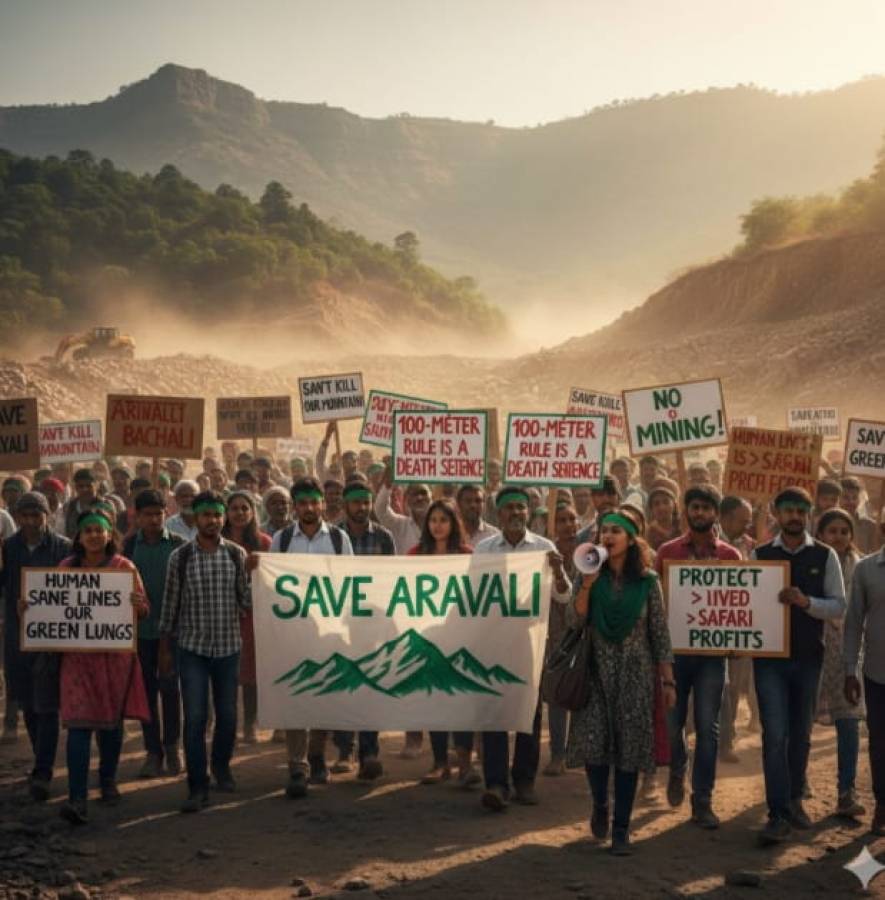
In the heart of the National Capital Region, where industrial haze and construction dust have become part of daily life, a quieter but far more consequential battle is unfolding. Over the past month, the ancient Aravalli Range—among the oldest geological formations on Earth—has emerged as the centre of an intensifying citizen-led movement. From the rocky ridges of Gurugram’s Chakkarpur–Wazirabad belt to political circles in Jaipur, the call to “Save Aravalli” has grown louder, driven by a controversial legal redefinition that activists warn could irreversibly weaken the hills’ protection.
A Technical Definition That Sparked a Revolt
The immediate trigger for the protests lies in a new interpretation accepted by the Supreme Court, based on a definition proposed by a panel under the Union Ministry of Environment. Under this framework, only hills rising 100 metres or more above the surrounding terrain are recognised as part of the Aravalli range.
Environmental groups and citizen collectives such as Aravalli Bachao and People for Aravallis argue that this approach fundamentally misunderstands the nature of the range. The Aravallis, they say, are not a series of towering peaks but a continuous ecological system of low ridges, rocky outcrops, and weathered hillocks spread across nearly 700 kilometres.
“By applying a height-based filter, nearly 90 per cent of the Aravallis lose their protected status,” said Samyra Shah, a volunteer at a recent protest in Gurugram. “This opens vast tracts of land to mining and real estate activity, undoing years of judicial intervention meant to safeguard the region.”
A Multi-Front Environmental Assault
Activists stress that the legal redefinition is only one part of a broader pattern of environmental pressure on the Aravallis.
Mining pressure continues despite a Supreme Court pause on fresh leases until a Management Plan for Sustainable Mining is finalised. In Rajasthan’s Sikar district, residents report that stone-crushing units are coating crops in fine dust and rapidly depleting groundwater levels.
At the same time, a draft notification issued in October 2025 proposes exempting waste-to-energy plants and landfills from mandatory environmental clearance. Campaigners fear this could legitimise the use of Aravalli land as a dumping ground for NCR waste. The Bandhwari landfill, already infamous for pollution and fires, has become a symbol of what activists describe as regulatory neglect.
Another flashpoint is Haryana’s proposed 10,000-acre zoo safari project. Retired Indian Forest Service officers, conservationists, and local communities have warned that large-scale construction, cable cars, and entertainment facilities will fracture wildlife corridors critical for species such as leopards, hyenas, and numerous migratory birds.
Political Signals and Grassroots Resistance
The movement has begun to draw political attention. Former Rajasthan Chief Minister Ashok Gehlot recently adopted the “Save Aravalli” emblem on his social media profiles, urging the Centre to rethink the height-based definition. The Aravallis, he said, cannot be assessed “with tape measures alone,” describing them as a vital green barrier against the westward advance of the Thar Desert.
On the ground, the resistance has taken on an almost grassroots revivalist character. In neighbourhood meetings and weekend gatherings, children, students, and senior citizens paint placards, collect signatures, and organise awareness drives. Digital petitions demanding stronger protection have attracted thousands of supporters.
The demands remain firm: withdrawal of the 100-metre rule, declaration of the entire Aravalli range as a permanent biosphere reserve, and cancellation of the safari project in favour of low-impact conservation models.
An Ecological Tipping Point
The consequences of inaction could be severe. Scientists identify the Aravallis as a critical groundwater recharge zone, replenishing aquifers in an already water-stressed region. Estimates suggest recharge rates of nearly two million litres per hectare annually. The degradation of these hills also widens “dust corridors,” allowing desertification from the Thar to creep closer to the capital.
As Delhi-NCR grapples with persistently poor air quality, the Aravallis remain one of the last natural buffers protecting the region from ecological collapse. For those protesting on the ground, the warning is stark: economic growth cannot be sustained by dismantling a billion-year-old natural shield.























Leave a Comment