
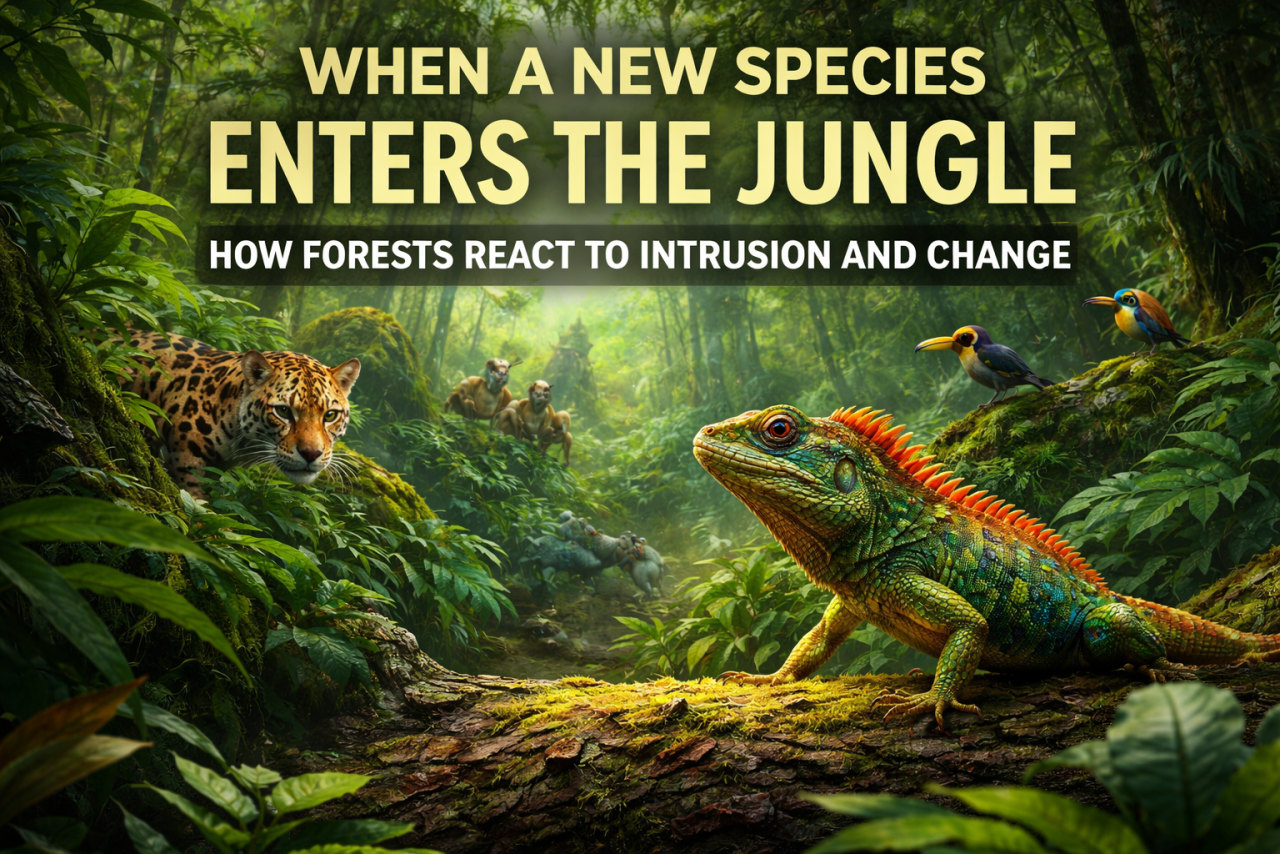
When a new species enters a jungle, the forest does not react with drama—but it does respond with consequences. A jungle is not merely a gathering of trees and animals; it is a finely tuned living system shaped by millions of years of adaptation, competition, cooperation, and survival. Any intruder, whether arriving through drifting seeds, wandering animals, or human intervention, becomes a test of this delicate balance.
The First Encounter: Curiosity and Caution
In the initial phase, the jungle responds with what ecologists call ecological neutrality. Native species do not instantly identify the newcomer as a threat. Birds may sample unfamiliar fruits. Predators observe without hunting. Plants grow unaware that a new competitor has rooted itself nearby. This stage is marked by quiet experimentation, where the intruding species is tested by climate, soil conditions, predators, parasites, and the forest’s natural rhythm.
Most intrusions end here. Research indicates that nearly 90 percent of introduced species fail to establish themselves. They struggle to survive humidity, fall prey to local insects, or fail to reproduce efficiently. In this sense, the jungle behaves like a biological immune system—filtering out what does not belong.
Competition Begins: The Silent Struggle
When a species survives the initial test, the jungle’s response shifts subtly. Competition begins—not with noise or visible conflict, but through slow, relentless pressure. Plants compete for sunlight, nutrients, and space. Animals compete for food and territory.
Invasive plants such as lantana or fast-growing vines demonstrate this struggle clearly. Studies in tropical forests across India and Southeast Asia show that invasive vegetation can reduce native plant diversity by nearly 30 percent within a few decades. As these intruders block sunlight and alter soil chemistry, the forest responds by slowing regeneration and reshaping its structure.
Animals adapt unevenly. Native herbivores may avoid unfamiliar plants, while predators fail to recognize new prey. This imbalance allows some populations to grow unchecked, disrupting food chains and sending ripple effects throughout the ecosystem.
Adaptation or Collapse: The Turning Point
At this stage, the jungle reaches a critical threshold. Some ecosystems adapt. Predators adjust hunting patterns. Insects evolve to feed on new plant species. Over time, balance may return, though the forest is permanently altered. Research from parts of the Amazon shows that certain invasive fish species have been slowly integrated into existing food webs.
However, adaptation requires time—often decades or centuries. Fragile ecosystems may not survive long enough to adjust. Studies from island jungles in Madagascar and Hawaii reveal a harsher outcome: native species disappear rapidly, pollination networks collapse, and forest regeneration weakens. The destruction is quiet but irreversible.
Dominance and Transformation
When an intruding species becomes dominant, the jungle’s behavior changes entirely. Biodiversity declines. Complexity fades. Scientists describe this process as biotic homogenization—where ecosystems lose uniqueness and resilience. The jungle remains, but its identity shifts, much like a language losing its vocabulary.
This dominance is often accelerated by human activity. Climate change, deforestation, and habitat fragmentation weaken natural defenses, allowing invasive species to thrive. Research consistently shows that disturbed forests are far more vulnerable to ecological takeover.
A Living Lesson from the Forest
The jungle does not react emotionally—it responds ecologically. It tests newcomers, resists pressure, adapts when possible, and collapses when overwhelmed. Every intrusion leaves a mark, not as memory but as transformation.
In this silent negotiation between survival and balance, jungles offer a powerful lesson: resilience is built on relationships. When one new thread is added or pulled too tightly, the entire fabric of life shifts—and the forest is never the same again.























Leave a Comment