
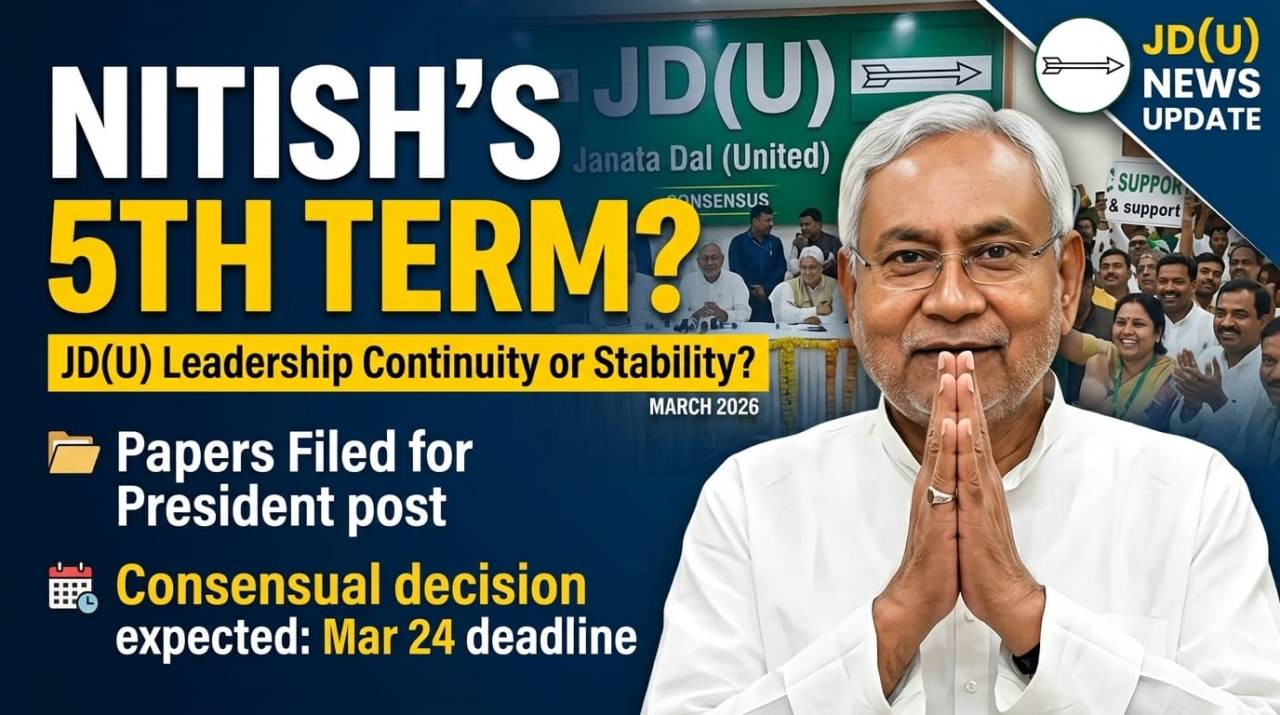
In a state known for shifting alliances and political surprises, one constant continues to hold firm—Nitish Kumar tightens his grip on the Janata Dal (United), setting the stage for a fifth consecutive term that signals continuity over change in Bihar politics.
The political landscape of Bihar is often characterized by its fluidity, yet within the Janata Dal (United), the message remains remarkably consistent: stability is the order of the day. In a move that reaffirms his absolute grip on the party machinery, Bihar Chief Minister Nitish Kumar has officially filed his nomination papers for the post of JD(U) national president. This marks the beginning of what is almost certainly going to be his fifth term at the helm of the party.
The Road to Re-election
The formal process was initiated on Thursday in New Delhi when Sanjay Kumar Jha, the JD(U) national working president, submitted the nomination papers on behalf of the Chief Minister. The papers were handed over to Aneel Hegde, a senior party leader serving as the returning officer for the internal election.
While the "election" is technically a democratic procedure within the party, the atmosphere surrounding the filing suggests it is more of a coronation. Insiders and senior leaders have hinted that a broad consensus exists among the rank and file, making any last-minute challenge to Kumar’s leadership highly unlikely.
Key Dates in the Election Calendar
According to the official press release issued by the party, the timeline for the internal polls is as follows:
- Nomination Deadline: Candidates have until March 22 to file their papers.
- Scrutiny of Papers: The returning officer will review the submissions on March 23.
- Withdrawal Deadline: Candidates wishing to retract their names must do so by March 24.
Given the current political climate and Kumar's standing, it is expected that he will be declared elected unopposed shortly after the withdrawal deadline passes.
Why Now? The Strategy of Continuity
The decision to stick with Nitish Kumar for a fifth term is not merely a matter of habit; it is a calculated political strategy. A senior JD(U) leader, speaking on the condition of anonymity, noted that the party is currently "not in favor of any leadership changes."
The rationale behind this is two-fold: experience and stability.
"Given the prevailing political climate, the party wants to continue relying on experience and stability," the leader remarked.
In a period where coalition politics in India are increasingly complex, the JD(U) views Kumar as the only figure capable of navigating the shifting alliances and maintaining the party's relevance on the national stage. By re-electing him, the party signals to both allies and rivals that there is no internal vacuum or power struggle, at least not for the foreseeable future.
The Significance of a Fifth Term
Nitish Kumar’s fifth term as president comes at a time when the JD(U) is looking to consolidate its base ahead of future electoral challenges. Kumar has long been the face of the party, and his dual role as Chief Minister and National President allows for a seamless integration of government policy and party ideology.
While critics often point to the lack of a "Plan B" or a clear succession line within the JD(U), the party faithful see Kumar as the "anchor" in a stormy sea. His ability to maintain a disciplined cadre and a unified front remains his greatest asset.
Final Take
As the scrutiny of papers nears on March 23, political circles in Patna and New Delhi are watching closely. While the outcome appears largely certain, the re-election of Nitish Kumar is set to define the Janata Dal (United)’s strategic direction in the years ahead.



















Leave a Comment