
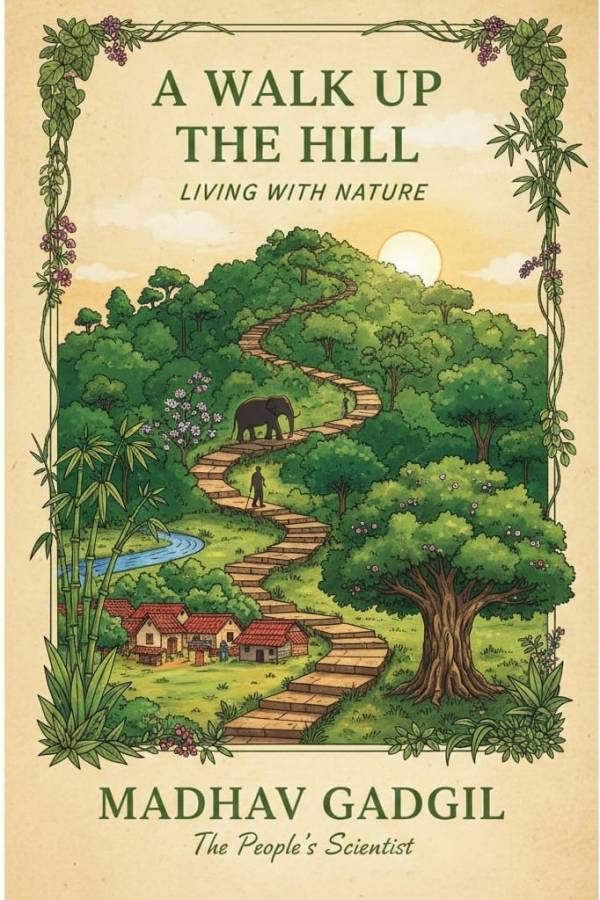
In the world of Indian science, few names command as much respect and occasional controversy as Madhav Gadgil. Often referred to as "The People’s Scientist," Gadgil has spent over five decades championing a version of conservation that doesn’t just protect trees and tigers, but also protects the rights of the people who live alongside them.
His memoir, A Walk Up the Hill: Living with Nature, is more than just an autobiography; it is a heartfelt, intellectually sharp, and deeply honest account of a life dedicated to the soil of India.
A Life Rooted in Curiosity
The book takes us back to Gadgil’s childhood in Pune, where his love for nature began not in a high-tech lab, but in the hills and forests surrounding his home. Unlike many academic memoirs that can feel dry or overly technical, Gadgil writes in a simple, conversational style that makes you feel like you are sitting across from him over a cup of tea.
He shares his journey from a young birdwatcher to a Harvard-educated scholar. However, the most fascinating part of his story isn't his time in America; it’s his decision to return to India. Gadgil chose to apply his world-class training to the local landscape, proving that true science is most powerful when it addresses the problems of its own backyard.
Why he is "The People’s Scientist"
The central theme of the book and Gadgil’s career is the idea that nature and humans are not enemies. In many parts of the world, conservationists believe that to save a forest, you must kick out the local tribes and villagers. Gadgil argues the exact opposite.
He shares stories of "Sacred Groves"—patches of forest protected by local communities for generations due to religious and cultural beliefs. Through these examples, he demonstrates that:
- Local communities are the best guardians of biodiversity.
- Traditional knowledge is often as valuable as academic research.
- Development should not happen at the cost of the environment or the poor.
The Western Ghats Controversy
One cannot discuss Madhav Gadgil without mentioning the Western Ghats Ecology Expert Panel (WGEEP), often called the Gadgil Commission. The book provides a behind-the-scenes look at this pivotal moment in Indian environmental history.
Gadgil explains his recommendations to protect one of the world's most "biodiversity hotspots" and the fierce political pushback he faced. He writes with a sense of urgency but without bitterness. For a common reader, this section is an eye-opener. It shows how science often clashes with corporate interests and why it is so important for ordinary citizens to understand the ecology of their own regions.
Key Takeaways for the Common Reader
- Democratizing Science: Gadgil believes science shouldn't be locked in ivory towers. He advocates for "citizen science," where regular people help collect data and monitor their environment.
- Sustainability: The book offers a blueprint for how India can grow economically without destroying its natural heritage.
- Integrity: Throughout the pages, Gadgil’s personal integrity shines. He isn't afraid to speak truth to power, a trait that earned him the title of a "rebel" scientist.
Final Thoughts
A Walk Up the Hill is a refreshing read because it is grounded in reality. It doesn't use heavy jargon or complex formulas. Instead, it uses stories of bamboo, elephants, grassroots activists, and the changing seasons.
It is a call to action for every Indian. Gadgil reminds us that we are all stakeholders in the health of our planet. Whether you are a student, a teacher, a farmer, or an office worker, this book will change the way you look at a forest, a river, or even a small hill in your town.
Madhav Gadgil has indeed walked a long, steep hill in his life. Through this book, he invites us to walk alongside him, teaching us that while the climb is difficult, the view from the top—a sustainable and fair world—is worth every step.
"Nature is not something to be conquered; it is a community to which we belong." — This sentiment echoes through every chapter of Gadgil’s remarkable life story.



























Leave a Comment