
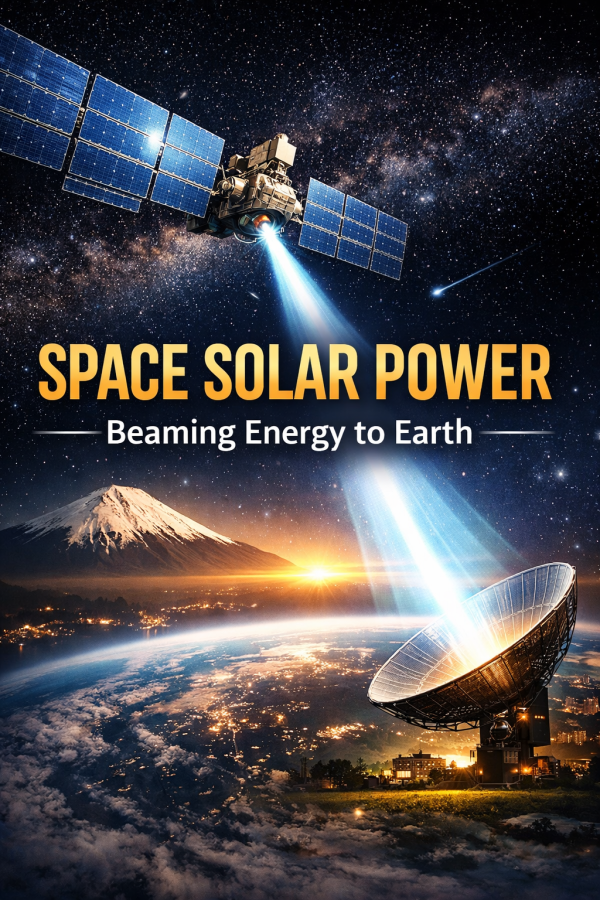
For years, the idea of generating electricity in space and sending it back to Earth belonged firmly in the realm of science fiction. Recently, a claim circulating on LinkedIn suggested that Japan had already pulled it off. The truth is a little more measured — and arguably more interesting. Japan hasn’t completed a full space-to-Earth power delivery yet, but it is closer than ever to proving that the concept actually works.
Japan’s interest in space-based solar power is not new. Scientists have long known that solar panels placed in orbit could collect far more energy than those on the ground. In space, sunlight is constant. There are no clouds, no monsoon disruptions, and no nights. That uninterrupted exposure makes space an ideal place to harvest solar energy — if it can be delivered back to Earth efficiently.
The biggest challenge has never been capturing the sunlight. It has been transmission. The solution being developed involves converting solar energy into microwave signals and beaming them down to a receiving station on the ground. These microwaves are then converted back into usable electricity. Over the years, Japanese researchers have tested this technology through ground experiments and airborne trials, successfully sending power across long distances without physical cables.
The next milestone is a small but critical one. Japan is preparing a satellite mission known as the OHISAMA project. The satellite will attempt to collect solar energy in low Earth orbit and transmit a limited amount of power — roughly one kilowatt — to a ground station. While that amount is small, the objective is proof, not scale. If energy can be generated in space, transmitted accurately, and converted back on Earth, the door to much larger systems opens.
This is where online claims often get ahead of verified facts. There is currently no public confirmation that Japan has already completed an end-to-end space solar power transmission using orbiting panels. What does exist is something just as important: successful component tests, validated physics, and a realistic roadmap toward a full demonstration.
If scaled in the future, space-based solar power could change how the world thinks about clean energy. Unlike traditional solar farms, these systems would not depend on weather, geography, or daylight hours. Power could be delivered to remote regions, disaster-hit areas, or dense cities without fuel transport or carbon emissions. For countries under pressure to decarbonise, the appeal is obvious.
Challenges remain. Launching and assembling large structures in orbit is expensive, and long-term safety and regulation of microwave transmission must be carefully managed. Yet with falling launch costs and rapid advances in space engineering, many experts believe these obstacles are no longer insurmountable.
Japan’s progress shows that space-based solar power is no longer a distant fantasy. It is an emerging reality, moving step by step from laboratory experiments to orbital trials. The breakthrough moment may still lie ahead, but when it arrives, it could redefine not just renewable energy, but humanity’s relationship with space itself.




























Leave a Comment