
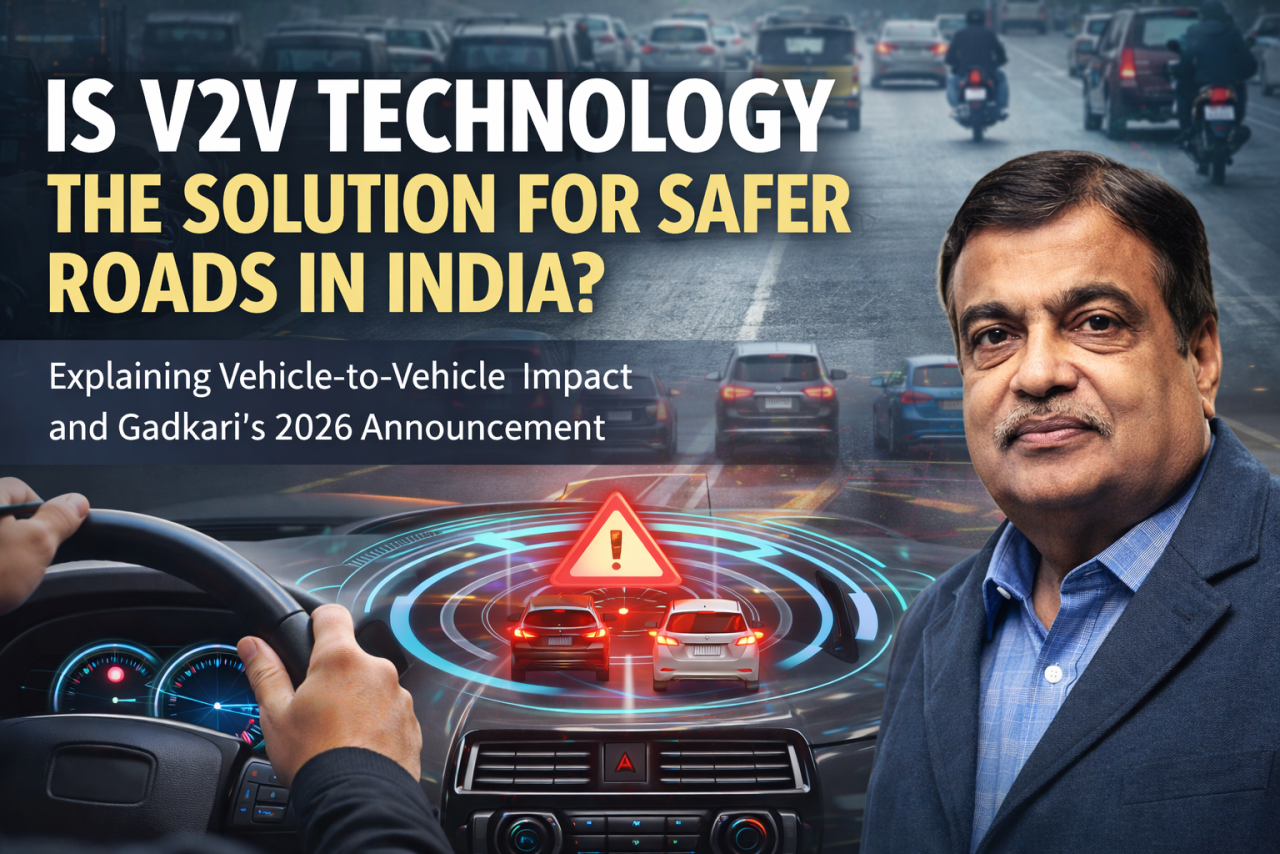
India’s roads are among the most dangerous in the world. According to official government data, the country records over 4.8 lakh road accidents every year, leading to more than 1.7 lakh deaths. Most of these accidents are caused by human error—overspeeding, delayed reaction, poor visibility, and lack of coordination between road users. While stricter laws, better highways, and awareness campaigns have helped, they have not been enough. This is where Vehicle-to-Vehicle (V2V) communication technology is being seen as a possible game-changer.
What Is V2V Technology?
V2V, or Vehicle-to-Vehicle communication, allows vehicles to exchange information with each other in real time using short-range wireless signals. These vehicles continuously share critical data such as speed, position, direction, and sudden braking. The system works independently of mobile networks, making it fast and reliable.
For example, if a car suddenly applies brakes on a highway, nearby vehicles instantly receive a warning—even before the driver can see the danger. This early alert gives drivers precious extra seconds to react, which can prevent serious crashes.
Why V2V Matters for Indian Roads
Indian roads are uniquely challenging. Cars share space with bikes, buses, trucks, auto-rickshaws, pedestrians, cyclists, and even animals. Visibility is often poor due to fog, dust, sharp turns, or overcrowding. Traditional safety tools like mirrors, cameras, or human judgment often fail in such conditions.
Research shows that V2V technology can help reduce:
- Rear-end collisions
- Intersection crashes
- Chain accidents caused by sudden braking
- Accidents in fog, rain, or blind curves
Studies conducted in traffic simulations suggest that even if only 5–10% of vehicles are V2V-enabled, there can be a noticeable reduction in secondary crashes under heavy traffic conditions.
Government Push: Gadkari’s Announcement
A major boost to V2V adoption in India came on 9 January 2026, when Union Minister for Road Transport and Highways, Nitin Gadkari, officially announced the rollout of V2V-enabled road systems for India. He stated that connected vehicle technologies like V2V will play a key role in reducing road accidents and fatalities, especially on national highways.
Gadkari emphasized that India must move beyond reactive safety measures and adopt predictive and preventive technologies, where vehicles warn each other before accidents happen. This announcement signals the government’s serious intent to integrate smart transport solutions into India’s road ecosystem.
The plan includes enabling vehicles with onboard communication units and allocating dedicated radio frequencies so that safety messages are not interrupted by network congestion. V2V is expected to work alongside other technologies such as Advanced Driver Assistance Systems (ADAS).
How V2V Can Save Lives
1. Early Warnings
V2V alerts drivers about hazards they cannot see—like a stopped vehicle beyond a curve or an accident ahead in fog.
2. Faster Reaction Time
Machines communicate faster than humans. Even a one-second early warning can significantly reduce crash severity.
3. Better Coordination
Vehicles move more predictably when they are aware of each other’s actions, reducing confusion and sudden maneuvers.
4. Support for Future Automation
V2V forms the foundation for semi-autonomous and autonomous driving systems, which depend on constant data exchange.
Limitations and Challenges
Despite its promise, V2V is not a complete solution on its own.
- Adoption Rate: Its effectiveness increases as more vehicles adopt it. Older vehicles may take years to be upgraded.
- Mixed Traffic: Two-wheelers, pedestrians, and animals cannot communicate digitally, limiting full coverage.
- Driver Behavior: Warnings are useful only if drivers respond responsibly.
- Cost and Standardisation: Uniform standards across manufacturers are essential for nationwide success.
Is V2V the Final Answer?
V2V technology is not a magic solution, but it is a powerful tool. Experts agree that when combined with:
- better road design
- strict law enforcement
- driver education
- safer vehicles
V2V can dramatically reduce accidents and fatalities.
For a country like India, where human error dominates crash statistics, V2V offers a shift from reactive safety to preventive safety. With government backing, including Gadkari’s January 2026 announcement, India is taking a serious step toward smarter and safer roads.
The road ahead will require patience, investment, and public trust—but V2V may well become one of the most important safety innovations in India’s transport history.
















Leave a Comment