
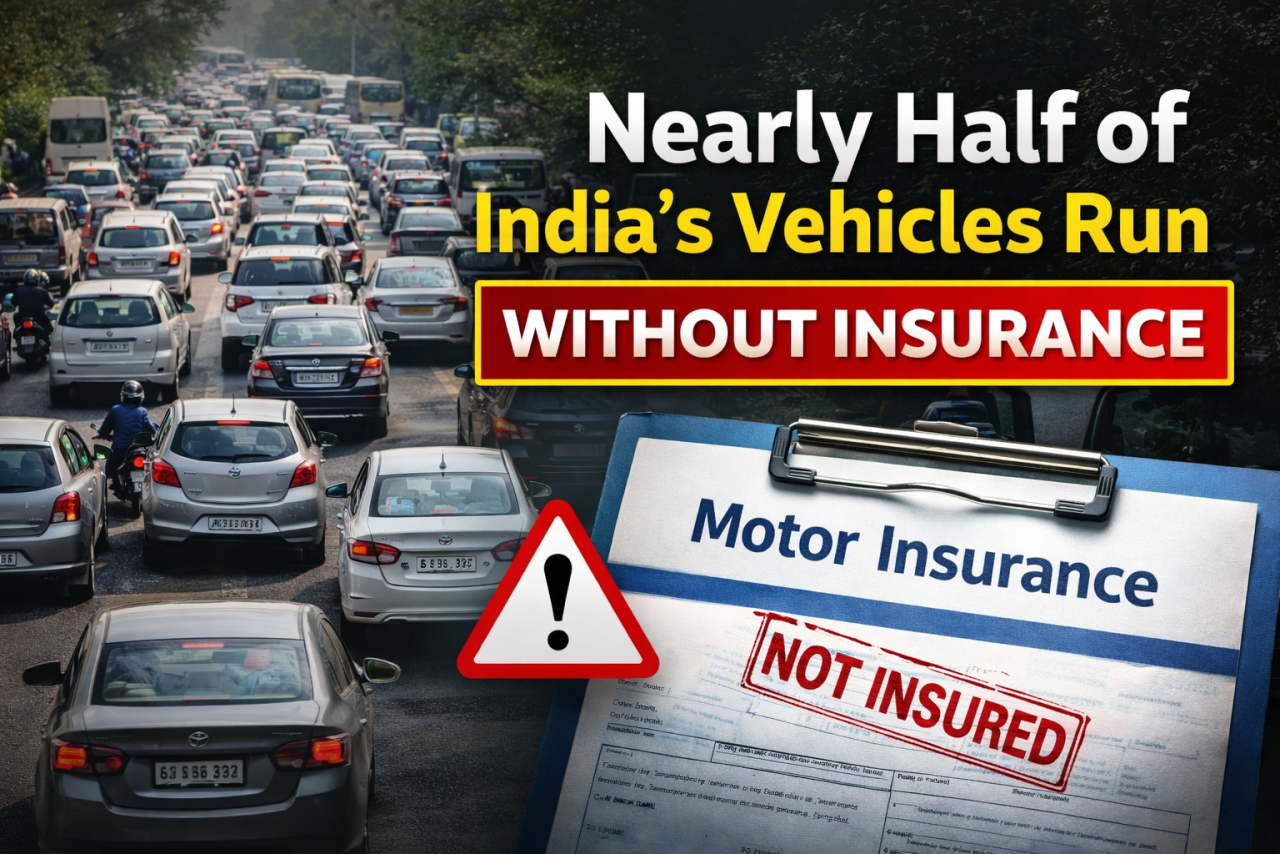
Nearly half the vehicles on India’s roads have no insurance, government data reveals—leaving accident victims at serious financial risk.
India’s roads are among the busiest in the world, carrying millions of commuters every day. Yet a startling revelation from the government has exposed a serious safety and financial risk hidden in plain sight: nearly half of the vehicles on Indian roads are operating without valid insurance.
The information was shared in the Rajya Sabha, where Union Minister for Road Transport and Highways Nitin Gadkari informed members that about 44 percent of vehicles in India do not have insurance coverage.
Data Based on National Vehicle Records
The figure comes from the VAHAN database, which maintains records of registered vehicles across the country. According to the data available as of March 6, 2026, a significant share of vehicles listed in the system are currently running without active insurance policies.
This indicates a large compliance gap in the country’s transport system, especially considering that insurance coverage is legally mandatory for every vehicle operating on public roads.
Insurance Is a Legal Requirement
Under the Motor Vehicles Act 1988, all vehicle owners must have at least third-party insurance. This type of insurance protects victims in case a vehicle causes injury, death, or damage to property during an accident.
The rule exists to ensure that victims of road accidents are not left without financial support. However, the government’s latest disclosure suggests that many vehicle owners either fail to renew their policies or deliberately avoid purchasing insurance.
What Happens When an Uninsured Vehicle Causes an Accident?
In most road accidents, compensation for victims is paid by the insurance company that issued the vehicle’s third-party policy. But when a vehicle involved in an accident has no insurance, the situation becomes far more complicated.
To address such cases, the government has created the Motor Vehicle Accident Fund, which helps provide financial assistance to victims when the responsible vehicle is uninsured or cannot be identified.
This fund operates through two separate accounts.
The first account is mainly used to cover medical treatment expenses for accident victims, especially in cases involving uninsured vehicles or hit-and-run incidents.
The second account focuses on compensation in hit-and-run cases, where the vehicle responsible for the accident cannot be traced. Victims or their families receive fixed financial assistance under this provision.
Emergency Medical Support for Victims
To further support road accident victims, the government has introduced the PM RAHAT Scheme.
Under this initiative, victims of road accidents can receive cashless medical treatment of up to ₹1.5 lakh during the first seven days after an accident. The treatment is available at designated hospitals, allowing patients to receive urgent care without worrying about immediate financial arrangements.
A Growing Concern for Road Safety
India already records a large number of road accidents each year, making insurance coverage a critical safeguard for both drivers and victims. When vehicles operate without insurance, accident victims may face delays in compensation and additional legal complications.
Experts say that many vehicle owners overlook insurance renewals after the first year or consider it an avoidable expense. However, driving without insurance not only violates the law but also exposes the vehicle owner to heavy financial liability if an accident occurs.
A Reminder for Vehicle Owners
The government’s disclosure serves as a reminder that insurance is not merely a formality. It is an essential protection mechanism designed to support accident victims and maintain accountability on the road.
As millions of Indians rely on road transport every day, improving compliance with insurance rules could significantly strengthen road safety and financial protection for everyone sharing the country’s highways and streets.














Leave a Comment