
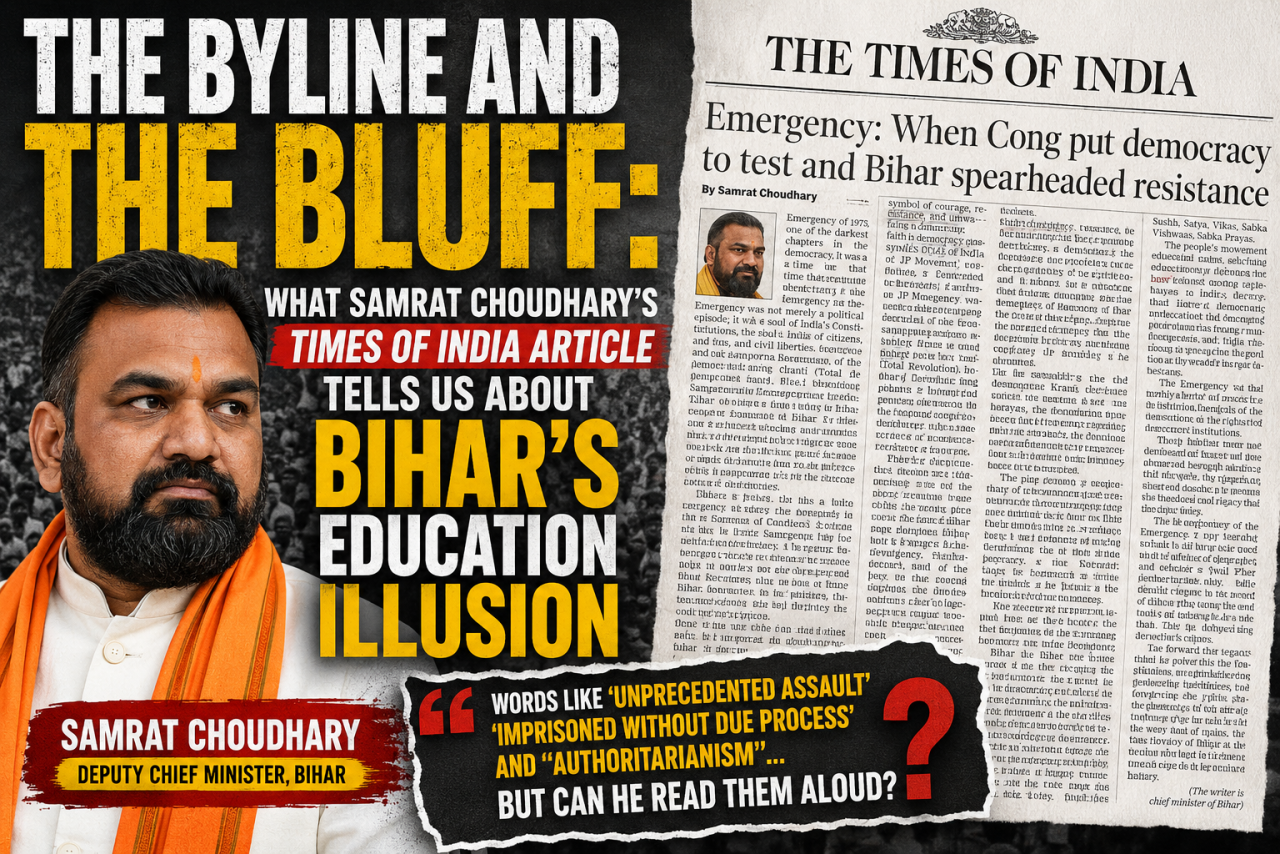
An English-language article published under Bihar Chief Minister Samrat Choudhary's name has sparked a larger debate about authorship, transparency, media credibility, and the state of political leadership in Bihar.
A photograph has been circulating widely on social media: a clipping from The Times of India carrying an English-language opinion article on the Emergency of 1975, Bihar's role in resisting authoritarianism, and the legacy of Loknayak Jayaprakash Narayan. The byline reads: Samrat Choudhary, Chief Minister of Bihar.
Ordinarily, there would be nothing unusual about that. Politicians frequently publish opinion pieces in newspapers. What has made this particular article noteworthy is a question that many in Bihar have quietly asked for years: did the man whose name appears beneath the article actually write it?
The article is written in polished, sophisticated English. It employs phrases such as "unprecedented assault on democracy," "imprisoned without due process," and "authoritarianism." Yet Samrat Choudhary's public appearances over the years have often raised questions about his command of the language. Critics point to instances where he appeared uncomfortable with even basic English terminology.
This is not a debate about whether a politician should speak English. India has produced many effective leaders who governed successfully without doing so. The issue is whether the public is being given an accurate account of who authored a piece of writing presented under a politician's name.
A Byline Without an Author?
Ghostwriting is hardly unusual. Across the world, ministers, chief executives, and public figures rely on researchers, aides, and communications teams to convert ideas into publishable articles. Readers generally understand that public figures often receive assistance.
The issue arises when the gap between the named author and the published text becomes so large that the byline itself begins to mislead.
The article attributed to Choudhary presents a nuanced interpretation of the Emergency and the JP Movement. It argues that the movement represented not merely opposition to a government but a broader struggle for democratic renewal and systemic reform. These are thoughtful observations requiring either substantial personal engagement with the subject or the work of a skilled writer operating behind the scenes.
If the latter is true, then transparency becomes important.
The Question for The Times of India
The larger question may not be about Samrat Choudhary at all. It may be about The Times of India.
Major newspapers have editorial procedures governing opinion articles. While ghostwriting is common, publications have historically used descriptions such as "as told to" or "based on conversations with" when an article has been substantially drafted by someone other than the named author.
No such qualification accompanied this article.
That raises a straightforward question: what degree of authorship or contribution is required before a newspaper places a person's name on a published opinion piece?
The issue is not whether Choudhary received editorial assistance. The issue is whether readers were given a clear understanding of how the article came into being.
For a publication that regularly advocates transparency and accountability, that question deserves an answer.
Bihar's Deeper Problem: The Performance of Education
Yet focusing solely on one politician risks missing the larger story.
Samrat Choudhary may be less an exception than a symptom of a political culture that has existed in Bihar for decades. Electoral success has often depended more on social coalitions, caste arithmetic, organizational strength, and political mobilisation than on demonstrated intellectual or administrative competence.
As a result, educational credentials frequently function as symbols rather than evidence of capability. The appearance of expertise is often valued more than expertise itself.
This disconnect carries consequences. Bihar continues to struggle on many measures of educational attainment, institutional quality, and human development. Public debate rarely examines whether those responsible for shaping policy possess the skills required to understand, evaluate, and formulate complex governance decisions.
Instead, educational shortcomings are often reframed as proof of authenticity—a "son of the soil" image that substitutes relatability for competence.
What a Byline Is Supposed to Mean
A byline is more than a name beneath an article. It is a declaration of authorship.
It tells readers that the person identified is responsible for the ideas, arguments, and words contained in the piece. It conveys intellectual ownership and accountability.
When that connection becomes uncertain, something important is lost. Public discourse begins to resemble theatre rather than communication. Citizens are encouraged to judge appearances rather than substance.
The result is a culture in which the projection of competence becomes more important than competence itself.
A Simple Challenge
The controversy surrounding this article has generated a simple challenge.
If the Chief Minister is indeed the author of the piece, he could settle the matter easily. He could sit before a camera, hold the article in his hands, and read it aloud from beginning to end.
No speeches. No teleprompters. No aides. Just the article and the man whose name appears beneath it.
It would take only a few minutes.
Whether such a challenge is fair or necessary is open to debate. But the fact that people are asking the question reveals a deeper crisis of trust.
The Irony of an Emergency Essay
There is one final irony.
The article itself reflects on the Emergency—a period remembered for censorship, institutional compromise, and the suppression of truth. It warns of what happens when institutions lose their independence and bend under political pressure.
Those are important lessons.
Yet critics argue that by publishing a highly sophisticated English-language article under the name of a politician whose authorship is widely questioned, the newspaper has created an uncomfortable contradiction between message and practice.
The article calls for institutional integrity.
The debate surrounding its publication asks whether that standard was upheld.
Bihar deserves more than symbolic leadership and performative expertise. It deserves an honest conversation about competence, accountability, and transparency in public life.
The controversy over one newspaper article may seem minor. But small controversies often illuminate larger truths.
And sometimes, a byline tells a story far bigger than the article beneath it.
A photograph has been circulating widely on social media: a clipping from The Times of India carrying an English-language opinion article on the Emergency of 1975, Bihar's role in resisting authoritarianism, and the legacy of Loknayak Jayaprakash Narayan. The byline reads: Samrat Choudhary, Chief Minister of Bihar.
Ordinarily, there would be nothing unusual about that. Politicians frequently publish opinion pieces in newspapers. What has made this particular article noteworthy is a question that many in Bihar have quietly asked for years: did the man whose name appears beneath the article actually write it?
The article is written in polished, sophisticated English. It employs phrases such as "unprecedented assault on democracy," "imprisoned without due process," and "authoritarianism." Yet Samrat Choudhary's public appearances over the years have often raised questions about his command of the language. Critics point to instances where he appeared uncomfortable with even basic English terminology.
This is not a debate about whether a politician should speak English. India has produced many effective leaders who governed successfully without doing so. The issue is whether the public is being given an accurate account of who authored a piece of writing presented under a politician's name.
A Byline Without an Author?
Ghostwriting is hardly unusual. Across the world, ministers, chief executives, and public figures rely on researchers, aides, and communications teams to convert ideas into publishable articles. Readers generally understand that public figures often receive assistance.
The issue arises when the gap between the named author and the published text becomes so large that the byline itself begins to mislead.
The article attributed to Choudhary presents a nuanced interpretation of the Emergency and the JP Movement. It argues that the movement represented not merely opposition to a government but a broader struggle for democratic renewal and systemic reform. These are thoughtful observations requiring either substantial personal engagement with the subject or the work of a skilled writer operating behind the scenes.
If the latter is true, then transparency becomes important.
The Question for The Times of India
The larger question may not be about Samrat Choudhary at all. It may be about The Times of India.
Major newspapers have editorial procedures governing opinion articles. While ghostwriting is common, publications have historically used descriptions such as "as told to" or "based on conversations with" when an article has been substantially drafted by someone other than the named author.
No such qualification accompanied this article.
That raises a straightforward question: what degree of authorship or contribution is required before a newspaper places a person's name on a published opinion piece?
The issue is not whether Choudhary received editorial assistance. The issue is whether readers were given a clear understanding of how the article came into being.
For a publication that regularly advocates transparency and accountability, that question deserves an answer.
Bihar's Deeper Problem: The Performance of Education
Yet focusing solely on one politician risks missing the larger story.
Samrat Choudhary may be less an exception than a symptom of a political culture that has existed in Bihar for decades. Electoral success has often depended more on social coalitions, caste arithmetic, organizational strength, and political mobilisation than on demonstrated intellectual or administrative competence.
As a result, educational credentials frequently function as symbols rather than evidence of capability. The appearance of expertise is often valued more than expertise itself.
This disconnect carries consequences. Bihar continues to struggle on many measures of educational attainment, institutional quality, and human development. Public debate rarely examines whether those responsible for shaping policy possess the skills required to understand, evaluate, and formulate complex governance decisions.
Instead, educational shortcomings are often reframed as proof of authenticity—a "son of the soil" image that substitutes relatability for competence.
What a Byline Is Supposed to Mean
A byline is more than a name beneath an article. It is a declaration of authorship.
It tells readers that the person identified is responsible for the ideas, arguments, and words contained in the piece. It conveys intellectual ownership and accountability.
When that connection becomes uncertain, something important is lost. Public discourse begins to resemble theatre rather than communication. Citizens are encouraged to judge appearances rather than substance.
The result is a culture in which the projection of competence becomes more important than competence itself.
A Simple Challenge
The controversy surrounding this article has generated a simple challenge.
If the Chief Minister is indeed the author of the piece, he could settle the matter easily. He could sit before a camera, hold the article in his hands, and read it aloud from beginning to end.
No speeches. No teleprompters. No aides. Just the article and the man whose name appears beneath it.
It would take only a few minutes.
Whether such a challenge is fair or necessary is open to debate. But the fact that people are asking the question reveals a deeper crisis of trust.
The Irony of an Emergency Essay
There is one final irony.
The article itself reflects on the Emergency—a period remembered for censorship, institutional compromise, and the suppression of truth. It warns of what happens when institutions lose their independence and bend under political pressure.
Those are important lessons.
Yet critics argue that by publishing a highly sophisticated English-language article under the name of a politician whose authorship is widely questioned, the newspaper has created an uncomfortable contradiction between message and practice.
The article calls for institutional integrity.
The debate surrounding its publication asks whether that standard was upheld.
Bihar deserves more than symbolic leadership and performative expertise. It deserves an honest conversation about competence, accountability, and transparency in public life.
The controversy over one newspaper article may seem minor. But small controversies often illuminate larger truths.
And sometimes, a byline tells a story far bigger than the article beneath it.























Leave a Comment