
Every June 21, India celebrates yoga. But when an ancient discipline becomes a stage-managed political spectacle, the real exercise may not be flexibility—it may be image management.
Every June 21, something remarkable happens across India. Politicians who spend the remaining 364 days bent over files, feuds, and press conferences suddenly discover their inner yogi. Mats are unrolled on manicured lawns. White kurtas give way to white tracksuits. Cameras appear on cue. And the nation is reminded—with the full force of state machinery behind it—that yoga is ancient, yoga is Indian, and yoga is, above all, an excellent backdrop for a photograph.
This year was no exception.
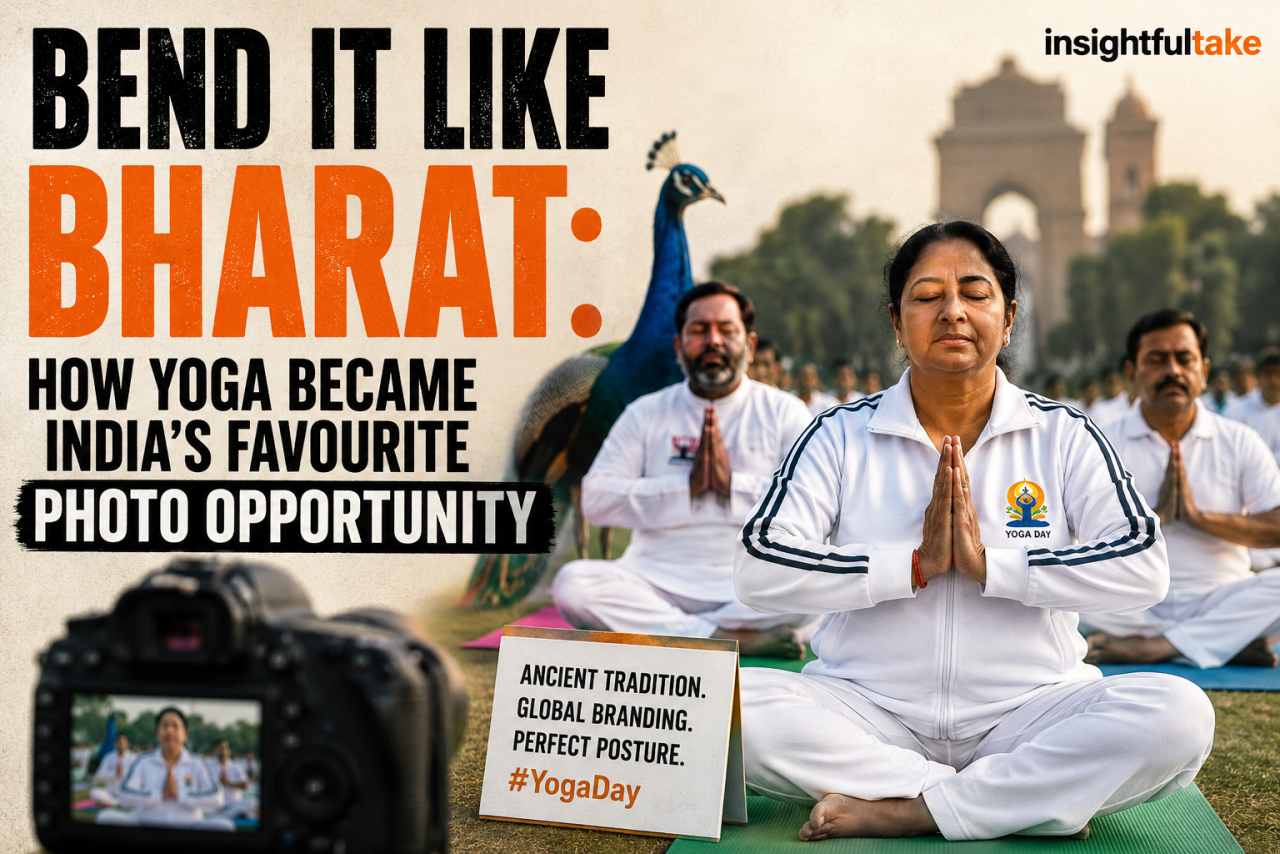
Delhi Chief Minister Rekha Gupta led the capital's International Day of Yoga celebrations at Neeli Jheel in the Asola Bhatti Wildlife Sanctuary. Ministers stretched. MLAs meditated. A peacock reportedly wandered into the frame, blissfully unaware that it had become part of a carefully curated wellness narrative.
On X, Gupta described yoga as “an important medium in the direction of making Delhi healthy, active and stress-free.” One can only hope the city's potholed roads, toxic air, and recurring waterlogging crises were also doing some gentle stretching exercises in her absence.
To be fair, yoga is genuinely ancient, genuinely Indian, and genuinely transformative for those who practise it with sincerity. The Yoga Sutras of Patanjali predate social media by nearly two thousand years. Yet somewhere between those ancient teachings and contemporary political enthusiasm, something changed. Yoga stopped being merely a practice and became a press release.
Since the BJP consolidated power at the Centre, yoga has enjoyed a remarkable second career as both a cultural symbol and a geopolitical instrument. India's successful campaign to secure United Nations recognition for the International Day of Yoga in 2015 was undoubtedly a significant diplomatic achievement. Since then, however, the annual celebration has evolved into something less concerned with yoga's philosophical foundations and more focused on the visual language of political branding.
The symbolism is hardly subtle.
Within the ruling party's cultural imagination, yoga often functions as shorthand for a particular vision of India—ancient, civilisational, Hindu, and proudly non-Western. Every Surya Namaskar performed by a minister becomes not merely an exercise but an assertion of identity. Every government-sponsored mass yoga event becomes a tableau designed to communicate a larger message: rooted in tradition, aligned with heritage, photographed from the perfect angle.
This has produced an intriguing contradiction.
Classical yoga asks practitioners to detach from ego, abandon performance, and turn inward. Government yoga spectacles demand precisely the opposite. They reward visibility, branding, and carefully managed appearances. The philosophy encourages withdrawal from external validation; the event management strategy depends upon it.
The Bhagavad Gita's ideal of nishkama karma—action without attachment to results—appears to have been quietly updated for the digital age. The action remains, but the attachment now includes engagement statistics, trending hashtags, and media coverage.
One does not wish to be entirely cynical.
Perhaps Minister Manjinder Singh Sirsa genuinely found it “an extremely positive and energetic experience” to sit cross-legged beside a peacock in a wildlife sanctuary at seven in the morning. Perhaps MLA Kartar Singh Tanwar closed his eyes in authentic contemplation rather than anticipation of the photographer's shutter. Perhaps the experience was sincere.
It is entirely possible.
Yet yoga, in its classical understanding, is fundamentally about consistency. It is a daily discipline rather than an annual performance. Pranayama practised once a year is merely controlled breathing. Meditation performed only when cameras are present is difficult to distinguish from choreography.
More importantly, yoga extends beyond physical postures. The tradition begins with ethical principles. Ahimsa, or non-violence, stands as the first of yoga's foundational disciplines. Satya, or truthfulness, follows close behind. These principles do not pause for election campaigns, partisan rhetoric, or political convenience before returning for ceremonial observance on June 21.
The Yamas and Niyamas—the ethical framework at yoga's core—are considerably less photogenic than a mass gathering in matching tracksuits. They are also considerably more demanding.
What India's yoga politics has mastered, therefore, is the aesthetic of wellness without necessarily embracing its substance.
The mats are laid out. The poses are struck. The ministers smile. The hashtags trend.
By afternoon, the celebrations conclude and governance returns to normal. The pollution that makes pranayama an act of endurance remains. The inequalities that make wellness inaccessible for millions persist. The stress that no government press release has ever meaningfully reduced continues to accumulate.
Yoga, at its deepest level, teaches that body and mind must be brought into alignment before truth can be clearly perceived.
One cannot help but wonder what a genuinely sustained national commitment to that principle might reveal to those currently directing the performance.
Until then, the ritual will continue.
Same time next year.
Bring your own mat.
The cameras will already be there.
Every June 21, something remarkable happens across India. Politicians who spend the remaining 364 days bent over files, feuds, and press conferences suddenly discover their inner yogi. Mats are unrolled on manicured lawns. White kurtas give way to white tracksuits. Cameras appear on cue. And the nation is reminded—with the full force of state machinery behind it—that yoga is ancient, yoga is Indian, and yoga is, above all, an excellent backdrop for a photograph.
This year was no exception.
Delhi Chief Minister Rekha Gupta led the capital's International Day of Yoga celebrations at Neeli Jheel in the Asola Bhatti Wildlife Sanctuary. Ministers stretched. MLAs meditated. A peacock reportedly wandered into the frame, blissfully unaware that it had become part of a carefully curated wellness narrative.
On X, Gupta described yoga as “an important medium in the direction of making Delhi healthy, active and stress-free.” One can only hope the city's potholed roads, toxic air, and recurring waterlogging crises were also doing some gentle stretching exercises in her absence.
To be fair, yoga is genuinely ancient, genuinely Indian, and genuinely transformative for those who practise it with sincerity. The Yoga Sutras of Patanjali predate social media by nearly two thousand years. Yet somewhere between those ancient teachings and contemporary political enthusiasm, something changed. Yoga stopped being merely a practice and became a press release.
Since the BJP consolidated power at the Centre, yoga has enjoyed a remarkable second career as both a cultural symbol and a geopolitical instrument. India's successful campaign to secure United Nations recognition for the International Day of Yoga in 2015 was undoubtedly a significant diplomatic achievement. Since then, however, the annual celebration has evolved into something less concerned with yoga's philosophical foundations and more focused on the visual language of political branding.
The symbolism is hardly subtle.
Within the ruling party's cultural imagination, yoga often functions as shorthand for a particular vision of India—ancient, civilisational, Hindu, and proudly non-Western. Every Surya Namaskar performed by a minister becomes not merely an exercise but an assertion of identity. Every government-sponsored mass yoga event becomes a tableau designed to communicate a larger message: rooted in tradition, aligned with heritage, photographed from the perfect angle.
This has produced an intriguing contradiction.
Classical yoga asks practitioners to detach from ego, abandon performance, and turn inward. Government yoga spectacles demand precisely the opposite. They reward visibility, branding, and carefully managed appearances. The philosophy encourages withdrawal from external validation; the event management strategy depends upon it.
The Bhagavad Gita's ideal of nishkama karma—action without attachment to results—appears to have been quietly updated for the digital age. The action remains, but the attachment now includes engagement statistics, trending hashtags, and media coverage.
One does not wish to be entirely cynical.
Perhaps Minister Manjinder Singh Sirsa genuinely found it “an extremely positive and energetic experience” to sit cross-legged beside a peacock in a wildlife sanctuary at seven in the morning. Perhaps MLA Kartar Singh Tanwar closed his eyes in authentic contemplation rather than anticipation of the photographer's shutter. Perhaps the experience was sincere.
It is entirely possible.
Yet yoga, in its classical understanding, is fundamentally about consistency. It is a daily discipline rather than an annual performance. Pranayama practised once a year is merely controlled breathing. Meditation performed only when cameras are present is difficult to distinguish from choreography.
More importantly, yoga extends beyond physical postures. The tradition begins with ethical principles. Ahimsa, or non-violence, stands as the first of yoga's foundational disciplines. Satya, or truthfulness, follows close behind. These principles do not pause for election campaigns, partisan rhetoric, or political convenience before returning for ceremonial observance on June 21.
The Yamas and Niyamas—the ethical framework at yoga's core—are considerably less photogenic than a mass gathering in matching tracksuits. They are also considerably more demanding.
What India's yoga politics has mastered, therefore, is the aesthetic of wellness without necessarily embracing its substance.
The mats are laid out. The poses are struck. The ministers smile. The hashtags trend.
By afternoon, the celebrations conclude and governance returns to normal. The pollution that makes pranayama an act of endurance remains. The inequalities that make wellness inaccessible for millions persist. The stress that no government press release has ever meaningfully reduced continues to accumulate.
Yoga, at its deepest level, teaches that body and mind must be brought into alignment before truth can be clearly perceived.
One cannot help but wonder what a genuinely sustained national commitment to that principle might reveal to those currently directing the performance.
Until then, the ritual will continue.
Same time next year.
Bring your own mat.
The cameras will already be there.


















Leave a Comment