
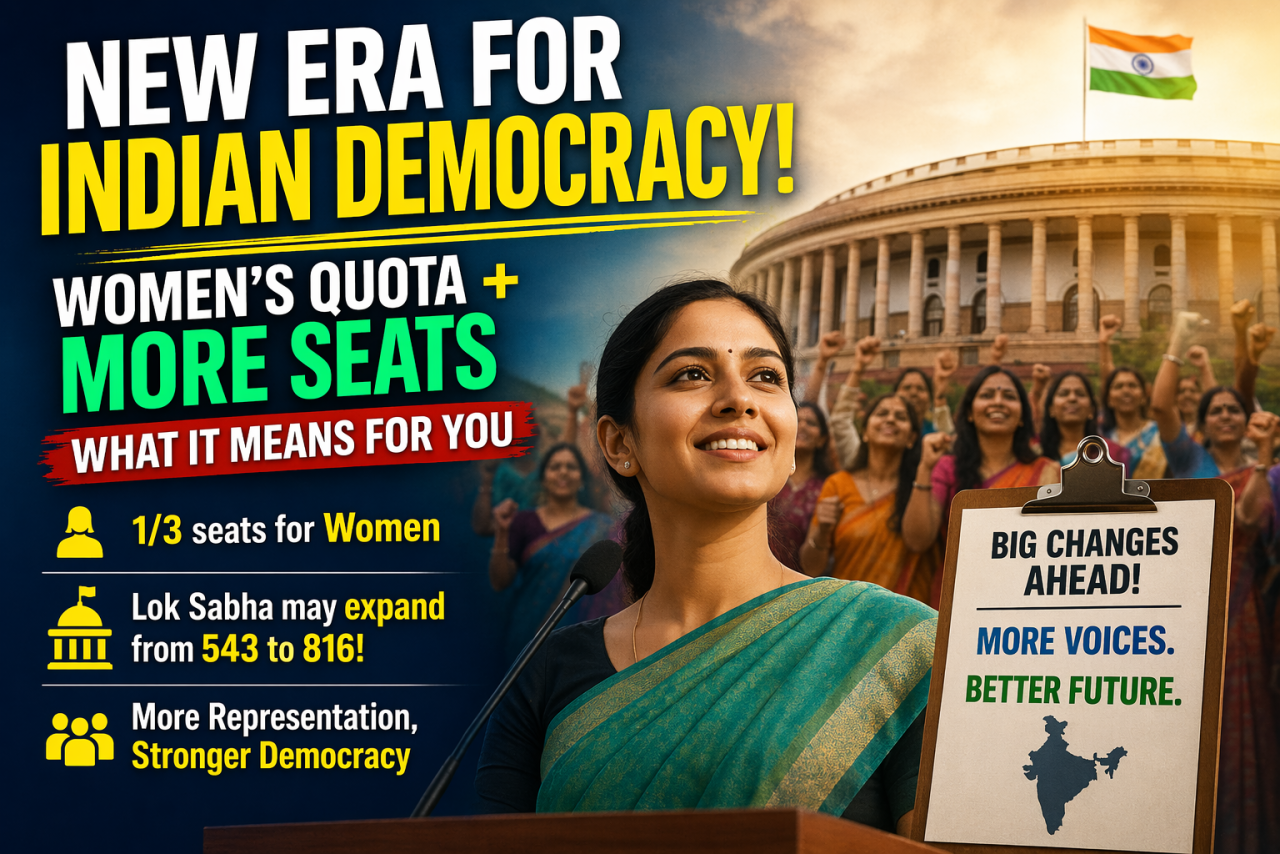
India is preparing for a structural shift in democracy. More seats, more women, and a new power map could redefine representation.
India is once again standing at a moment where its democratic structure is being redesigned—not through elections, but through laws that decide who gets to be represented and how. The recent developments around the Women’s Reservation law and the proposed delimitation of Lok Sabha seats are not just routine policy updates. Together, they signal a deeper shift in how Indian democracy will function in the coming decades.
At the center of this change are two key ideas: expanding the number of seats in Parliament and ensuring that one-third of them are reserved for women. But the real story goes beyond numbers. It is about power, fairness, representation, and the evolving meaning of democracy in India.
From Symbolic Inclusion to Structural Change
India passed the Women’s Reservation law in 2023, promising 33% reservation for women in the Lok Sabha and state assemblies. This was not a small step. It ended a debate that had lasted for nearly three decades.
However, the law came with a condition: it would only be implemented after a fresh census and delimitation exercise. This created uncertainty because both processes have been delayed.
Now, the government is exploring ways to move forward faster. One proposal suggests increasing the total number of Lok Sabha seats from 543 to around 816, with about 273 seats reserved for women. This is not just about adding seats—it is about expanding the democratic space itself.
This marks a shift from symbolic inclusion (talking about representation) to structural change (rebuilding the system to ensure it).
The Delimitation Debate: Numbers vs Fairness
Delimitation means redrawing constituency boundaries based on population. On paper, it sounds simple: more population should mean more representation.
But in India, it is politically sensitive.
States that controlled population growth—especially in the South—fear they might lose political influence if seats are redistributed purely on population numbers.Meanwhile, northern states with higher population growth could gain more seats.
The government has tried to address these concerns by indicating that all states may see an increase in seats, possibly by around 50%, rather than reducing anyone’s share.
This is a crucial shift. Instead of redistribution being a zero-sum game (one state gains, another loses), the idea is to expand the total pie.
This reflects a new approach to democracy: growth instead of redistribution.
Women’s Reservation Changes the Nature of Politics
Reserving one-third of seats for women is not just about gender justice. It has the potential to change how politics works at a deeper level.
Currently, women’s representation in the Lok Sabha has been around 14–15%, far below global averages. The new system could more than double that overnight.
But the real impact will be qualitative:
- More focus on health, education, and welfare issues
- Greater representation of grassroots concerns
- A shift in political culture, possibly reducing aggressive and personality-driven politics
Prime Minister Narendra Modi has described the move as one of the most important moments in parliamentary history, emphasizing its role in inclusive development.
At the same time, critics argue that without proper implementation mechanisms, the law could remain symbolic or be manipulated through seat rotation and candidate selection.
The Hidden Question: Who Controls Representation?
Beyond the public debate, there is a deeper issue that often goes unnoticed: who controls the design of representation?
If the number of seats increases and boundaries are redrawn, political power will shift—not just between states, but also between communities and parties.
Opposition leaders have raised concerns that the delimitation process could alter the balance of power in ways that disadvantage certain regions or social groups.
Civil society groups have also demanded greater transparency, arguing that such major changes should involve wider consultation.
This raises a fundamental democratic question:
Is democracy only about voting, or also about how the system of representation is designed?
A New Democratic Model: Expansion Instead of Limitation
One of the most interesting aspects of the current proposals is the idea of expanding the Lok Sabha significantly.
India’s population has grown massively since the last major delimitation. Yet, the number of MPs has remained almost frozen since the 1970s due to constitutional limits.
Increasing the number of seats could:
- Improve MP-to-citizen ratio
- Make constituencies smaller and more manageable
- Allow more diverse voices to enter Parliament
This could be seen as the next stage of Indian democracy—moving from a limited representation model to an expanded representation model.
Possible New Features of Indian Democracy
If these changes are implemented, Indian democracy could gain several new features:
1. Gender-balanced governance
With one-third women MPs, decision-making will become more inclusive.
2. Larger and more representative Parliament
An expanded Lok Sabha could better reflect India’s diversity.
3. Dynamic constituency structure
Frequent delimitation could keep representation aligned with population changes.
4. Shift from identity politics to structural politics
Debates may move from “who gets what” to “how the system is designed.”
Challenges Ahead
Despite the promise, several challenges remain:
- Implementation delay: The law is still linked to census and delimitation unless amended
- Political resistance: Regional and opposition concerns are strong
- Operational complexity: Increasing seats and redrawing boundaries is a massive administrative task
- Risk of tokenism: Reservation alone does not guarantee real empowerment
There is also discussion about alternative methods, such as using a lottery system to reserve seats temporarily, to implement the quota earlier.
Democracy in Transition
India’s democracy has always evolved through phases—from universal adult franchise to coalition politics to digital governance.
What we are witnessing now is another transition: from a stable but frozen system to a flexible and expanding one.
The Women’s Reservation law and delimitation proposals together are not just reforms. They are an attempt to redefine representation in the world’s largest democracy.
If implemented carefully, they could make Indian democracy more inclusive, more balanced, and more responsive.
But if handled poorly, they could deepen regional tensions and political mistrust.
The real test, therefore, is not just passing these laws—but ensuring that they strengthen trust in the democratic system.
Because in the end, democracy is not only about how many people are represented.
It is about whether people feel truly represented.
India is once again standing at a moment where its democratic structure is being redesigned—not through elections, but through laws that decide who gets to be represented and how. The recent developments around the Women’s Reservation law and the proposed delimitation of Lok Sabha seats are not just routine policy updates. Together, they signal a deeper shift in how Indian democracy will function in the coming decades.
At the center of this change are two key ideas: expanding the number of seats in Parliament and ensuring that one-third of them are reserved for women. But the real story goes beyond numbers. It is about power, fairness, representation, and the evolving meaning of democracy in India.
From Symbolic Inclusion to Structural Change
India passed the Women’s Reservation law in 2023, promising 33% reservation for women in the Lok Sabha and state assemblies. This was not a small step. It ended a debate that had lasted for nearly three decades.
However, the law came with a condition: it would only be implemented after a fresh census and delimitation exercise. This created uncertainty because both processes have been delayed.
Now, the government is exploring ways to move forward faster. One proposal suggests increasing the total number of Lok Sabha seats from 543 to around 816, with about 273 seats reserved for women. This is not just about adding seats—it is about expanding the democratic space itself.
This marks a shift from symbolic inclusion (talking about representation) to structural change (rebuilding the system to ensure it).
The Delimitation Debate: Numbers vs Fairness
Delimitation means redrawing constituency boundaries based on population. On paper, it sounds simple: more population should mean more representation.
But in India, it is politically sensitive.
States that controlled population growth—especially in the South—fear they might lose political influence if seats are redistributed purely on population numbers.Meanwhile, northern states with higher population growth could gain more seats.
The government has tried to address these concerns by indicating that all states may see an increase in seats, possibly by around 50%, rather than reducing anyone’s share.
This is a crucial shift. Instead of redistribution being a zero-sum game (one state gains, another loses), the idea is to expand the total pie.
This reflects a new approach to democracy: growth instead of redistribution.
Women’s Reservation Changes the Nature of Politics
Reserving one-third of seats for women is not just about gender justice. It has the potential to change how politics works at a deeper level.
Currently, women’s representation in the Lok Sabha has been around 14–15%, far below global averages. The new system could more than double that overnight.
But the real impact will be qualitative:
- More focus on health, education, and welfare issues
- Greater representation of grassroots concerns
- A shift in political culture, possibly reducing aggressive and personality-driven politics
Prime Minister Narendra Modi has described the move as one of the most important moments in parliamentary history, emphasizing its role in inclusive development.
At the same time, critics argue that without proper implementation mechanisms, the law could remain symbolic or be manipulated through seat rotation and candidate selection.
The Hidden Question: Who Controls Representation?
Beyond the public debate, there is a deeper issue that often goes unnoticed: who controls the design of representation?
If the number of seats increases and boundaries are redrawn, political power will shift—not just between states, but also between communities and parties.
Opposition leaders have raised concerns that the delimitation process could alter the balance of power in ways that disadvantage certain regions or social groups.
Civil society groups have also demanded greater transparency, arguing that such major changes should involve wider consultation.
This raises a fundamental democratic question:
Is democracy only about voting, or also about how the system of representation is designed?
A New Democratic Model: Expansion Instead of Limitation
One of the most interesting aspects of the current proposals is the idea of expanding the Lok Sabha significantly.
India’s population has grown massively since the last major delimitation. Yet, the number of MPs has remained almost frozen since the 1970s due to constitutional limits.
Increasing the number of seats could:
- Improve MP-to-citizen ratio
- Make constituencies smaller and more manageable
- Allow more diverse voices to enter Parliament
This could be seen as the next stage of Indian democracy—moving from a limited representation model to an expanded representation model.
Possible New Features of Indian Democracy
If these changes are implemented, Indian democracy could gain several new features:
1. Gender-balanced governance
With one-third women MPs, decision-making will become more inclusive.
2. Larger and more representative Parliament
An expanded Lok Sabha could better reflect India’s diversity.
3. Dynamic constituency structure
Frequent delimitation could keep representation aligned with population changes.
4. Shift from identity politics to structural politics
Debates may move from “who gets what” to “how the system is designed.”
Challenges Ahead
Despite the promise, several challenges remain:
- Implementation delay: The law is still linked to census and delimitation unless amended
- Political resistance: Regional and opposition concerns are strong
- Operational complexity: Increasing seats and redrawing boundaries is a massive administrative task
- Risk of tokenism: Reservation alone does not guarantee real empowerment
There is also discussion about alternative methods, such as using a lottery system to reserve seats temporarily, to implement the quota earlier.
Democracy in Transition
India’s democracy has always evolved through phases—from universal adult franchise to coalition politics to digital governance.
What we are witnessing now is another transition: from a stable but frozen system to a flexible and expanding one.
The Women’s Reservation law and delimitation proposals together are not just reforms. They are an attempt to redefine representation in the world’s largest democracy.
If implemented carefully, they could make Indian democracy more inclusive, more balanced, and more responsive.
But if handled poorly, they could deepen regional tensions and political mistrust.
The real test, therefore, is not just passing these laws—but ensuring that they strengthen trust in the democratic system.
Because in the end, democracy is not only about how many people are represented.
It is about whether people feel truly represented.















Leave a Comment