
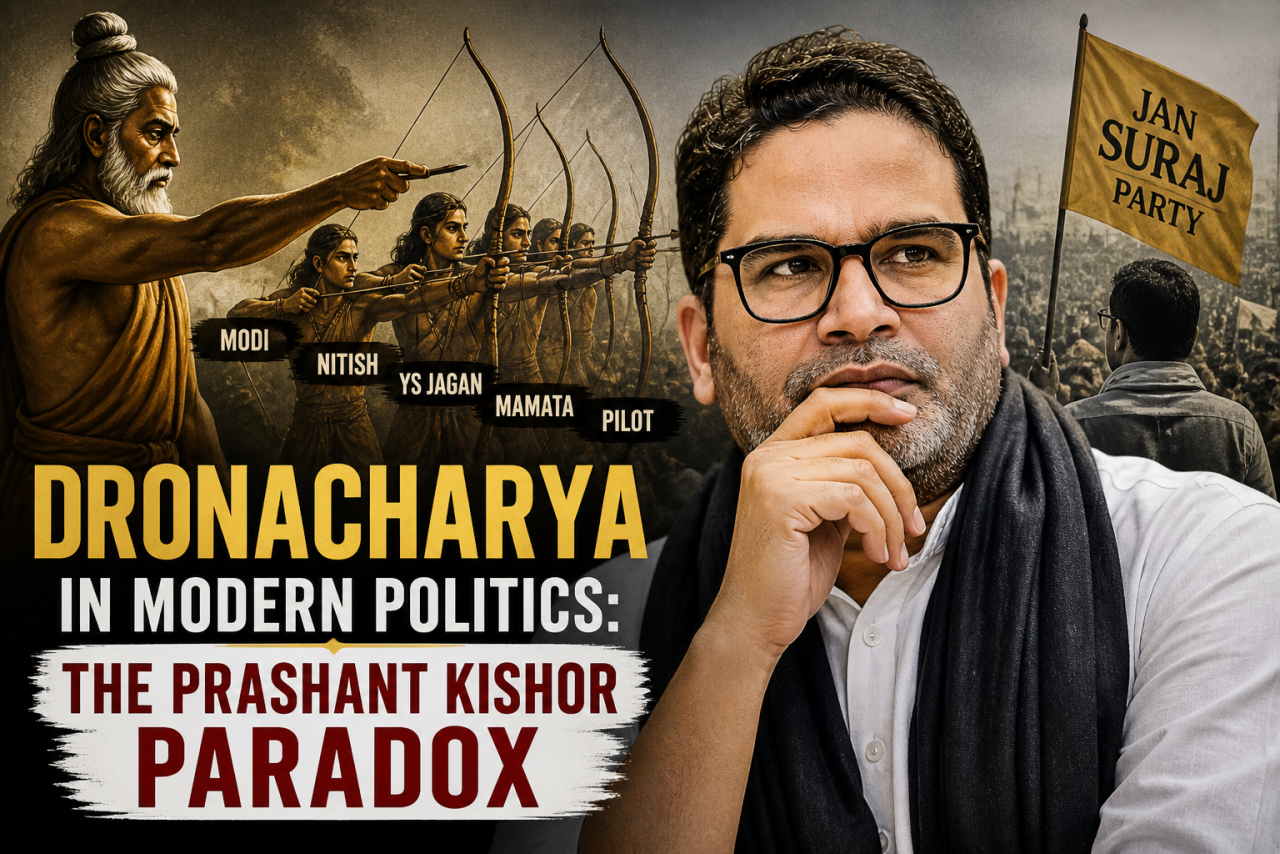
He can script victories, shape leaders, and decode voters—but when the battlefield is his own, the outcome changes. Is Prashant Kishor India’s modern Dronacharya, or does politics demand more than strategy alone?
Indian politics has long relied on mythology to interpret its shifting power equations. Strategists are likened to Chanakya, mass leaders to Krishna, and elections to epic battles. In that symbolic vocabulary, Prashant Kishor is increasingly being cast in a role that is both powerful and paradoxical—that of Dronacharya: a master strategist capable of shaping winners, yet struggling to translate that mastery into his own electoral success.
The 2026 political cycle has sharpened this perception. On one hand, Kishor is widely seen as a mind behind successful electoral strategies, credited in public discourse with understanding voter psychology, campaign structuring, and narrative control. On the other, his own political experiment through the Jan Suraaj Party in Bihar has not yet delivered comparable results at the ballot box. The contrast is stark—and it is precisely this contrast that fuels the metaphor.
The Strategist Who Builds Arjunas
In the Mahabharata, Dronacharya is remembered not as a king, but as a teacher. His legacy rests in the warriors he trained, most notably Arjuna. His strength lay in instruction, discipline, and the ability to identify and refine talent. Yet, despite his unmatched skill as a mentor, he was never the central victor of the war he helped shape.
In a similar symbolic reading, Prashant Kishor’s public image has been built around his role as an architect of campaigns rather than a direct wielder of political power. He has operated in the background—designing narratives, crafting outreach strategies, and identifying electoral vulnerabilities. This has earned him a reputation as someone who can convert uncertainty into structured political advantage.
For many observers, this is his defining strength: the ability to build “Arjunas” for the political battlefield.
When the Strategist Enters the Arena
However, electoral politics is not a space where strategy alone determines outcomes. The transition from strategist to candidate is not merely a change in role—it is a shift in the very nature of political engagement.
A strategist operates with distance. He studies, calculates, and adjusts. A candidate, in contrast, must embody the politics he represents. He must inspire trust, carry identity, and withstand direct scrutiny from voters. The rules change because the expectations change.
This is where the Prashant Kishor paradox becomes most visible. Through the Jan Suraaj Party, he has attempted to move from being an observer and designer of political systems to becoming an active participant within them. But Bihar’s political landscape is deeply entrenched—defined by caste alignments, historical loyalties, and organisational networks that have evolved over decades.
In such an environment, strategy can guide—but it cannot substitute for rooted presence.
The Weight of Perception
Part of what intensifies this paradox is the burden of expectation. When a strategist is elevated to near-mythical status as a “mastermind,” the public begins to expect consistent, almost inevitable success. Any setback is then interpreted not as a routine electoral outcome, but as a contradiction of identity.
This creates a narrative trap. Success is seen as proof of genius, while failure is seen as exposure of limitation. In reality, electoral politics is far more complex. It is shaped not only by planning, but by timing, alliances, social coalitions, and unpredictable voter behaviour.
Kishor’s journey reflects this complexity. It reveals that political intelligence does not automatically translate into electoral dominance when the strategist himself becomes the face of the campaign.
The Limits of Political Engineering
Modern campaigns often place immense faith in data, messaging, and strategic design. These tools have undoubtedly transformed how elections are fought. But they operate within a larger ecosystem that remains resistant to complete control.
In India, that ecosystem includes deeply embedded social identities, local leadership structures, and emotional connections between voters and political actors. These factors cannot be engineered overnight.
This is the structural boundary that defines the Prashant Kishor paradox. His expertise lies in optimising campaigns within existing political frameworks. But building a framework from scratch—creating a political base that is both loyal and expansive—is an entirely different challenge.
Beyond the Metaphor
The Dronacharya comparison is compelling because it captures a visible tension. But it should not be mistaken for a final judgment. Kishor’s political journey is still unfolding, and the outcomes of such experiments are rarely immediate.
What his trajectory does highlight, however, is a deeper truth about democratic politics: understanding power is not the same as possessing it. Strategy can illuminate pathways, but it cannot walk them alone.
Strategy Meets Its Limits
The story of Prashant Kishor is not simply one of success or failure. It is the story of a transition—from strategist to political actor—and the friction that comes with it.
In that sense, the Dronacharya metaphor holds not because it defines him, but because it raises a question that extends beyond one individual: can the science of winning elections replace the slow, organic process of building political legitimacy?
For now, the answer appears uncertain. What is clear, however, is that in the arena of democracy, designing victory and embodying it are two very different battles.
Indian politics has long relied on mythology to interpret its shifting power equations. Strategists are likened to Chanakya, mass leaders to Krishna, and elections to epic battles. In that symbolic vocabulary, Prashant Kishor is increasingly being cast in a role that is both powerful and paradoxical—that of Dronacharya: a master strategist capable of shaping winners, yet struggling to translate that mastery into his own electoral success.
The 2026 political cycle has sharpened this perception. On one hand, Kishor is widely seen as a mind behind successful electoral strategies, credited in public discourse with understanding voter psychology, campaign structuring, and narrative control. On the other, his own political experiment through the Jan Suraaj Party in Bihar has not yet delivered comparable results at the ballot box. The contrast is stark—and it is precisely this contrast that fuels the metaphor.
The Strategist Who Builds Arjunas
In the Mahabharata, Dronacharya is remembered not as a king, but as a teacher. His legacy rests in the warriors he trained, most notably Arjuna. His strength lay in instruction, discipline, and the ability to identify and refine talent. Yet, despite his unmatched skill as a mentor, he was never the central victor of the war he helped shape.
In a similar symbolic reading, Prashant Kishor’s public image has been built around his role as an architect of campaigns rather than a direct wielder of political power. He has operated in the background—designing narratives, crafting outreach strategies, and identifying electoral vulnerabilities. This has earned him a reputation as someone who can convert uncertainty into structured political advantage.
For many observers, this is his defining strength: the ability to build “Arjunas” for the political battlefield.
When the Strategist Enters the Arena
However, electoral politics is not a space where strategy alone determines outcomes. The transition from strategist to candidate is not merely a change in role—it is a shift in the very nature of political engagement.
A strategist operates with distance. He studies, calculates, and adjusts. A candidate, in contrast, must embody the politics he represents. He must inspire trust, carry identity, and withstand direct scrutiny from voters. The rules change because the expectations change.
This is where the Prashant Kishor paradox becomes most visible. Through the Jan Suraaj Party, he has attempted to move from being an observer and designer of political systems to becoming an active participant within them. But Bihar’s political landscape is deeply entrenched—defined by caste alignments, historical loyalties, and organisational networks that have evolved over decades.
In such an environment, strategy can guide—but it cannot substitute for rooted presence.
The Weight of Perception
Part of what intensifies this paradox is the burden of expectation. When a strategist is elevated to near-mythical status as a “mastermind,” the public begins to expect consistent, almost inevitable success. Any setback is then interpreted not as a routine electoral outcome, but as a contradiction of identity.
This creates a narrative trap. Success is seen as proof of genius, while failure is seen as exposure of limitation. In reality, electoral politics is far more complex. It is shaped not only by planning, but by timing, alliances, social coalitions, and unpredictable voter behaviour.
Kishor’s journey reflects this complexity. It reveals that political intelligence does not automatically translate into electoral dominance when the strategist himself becomes the face of the campaign.
The Limits of Political Engineering
Modern campaigns often place immense faith in data, messaging, and strategic design. These tools have undoubtedly transformed how elections are fought. But they operate within a larger ecosystem that remains resistant to complete control.
In India, that ecosystem includes deeply embedded social identities, local leadership structures, and emotional connections between voters and political actors. These factors cannot be engineered overnight.
This is the structural boundary that defines the Prashant Kishor paradox. His expertise lies in optimising campaigns within existing political frameworks. But building a framework from scratch—creating a political base that is both loyal and expansive—is an entirely different challenge.
Beyond the Metaphor
The Dronacharya comparison is compelling because it captures a visible tension. But it should not be mistaken for a final judgment. Kishor’s political journey is still unfolding, and the outcomes of such experiments are rarely immediate.
What his trajectory does highlight, however, is a deeper truth about democratic politics: understanding power is not the same as possessing it. Strategy can illuminate pathways, but it cannot walk them alone.
Strategy Meets Its Limits
The story of Prashant Kishor is not simply one of success or failure. It is the story of a transition—from strategist to political actor—and the friction that comes with it.
In that sense, the Dronacharya metaphor holds not because it defines him, but because it raises a question that extends beyond one individual: can the science of winning elections replace the slow, organic process of building political legitimacy?
For now, the answer appears uncertain. What is clear, however, is that in the arena of democracy, designing victory and embodying it are two very different battles.















Leave a Comment