
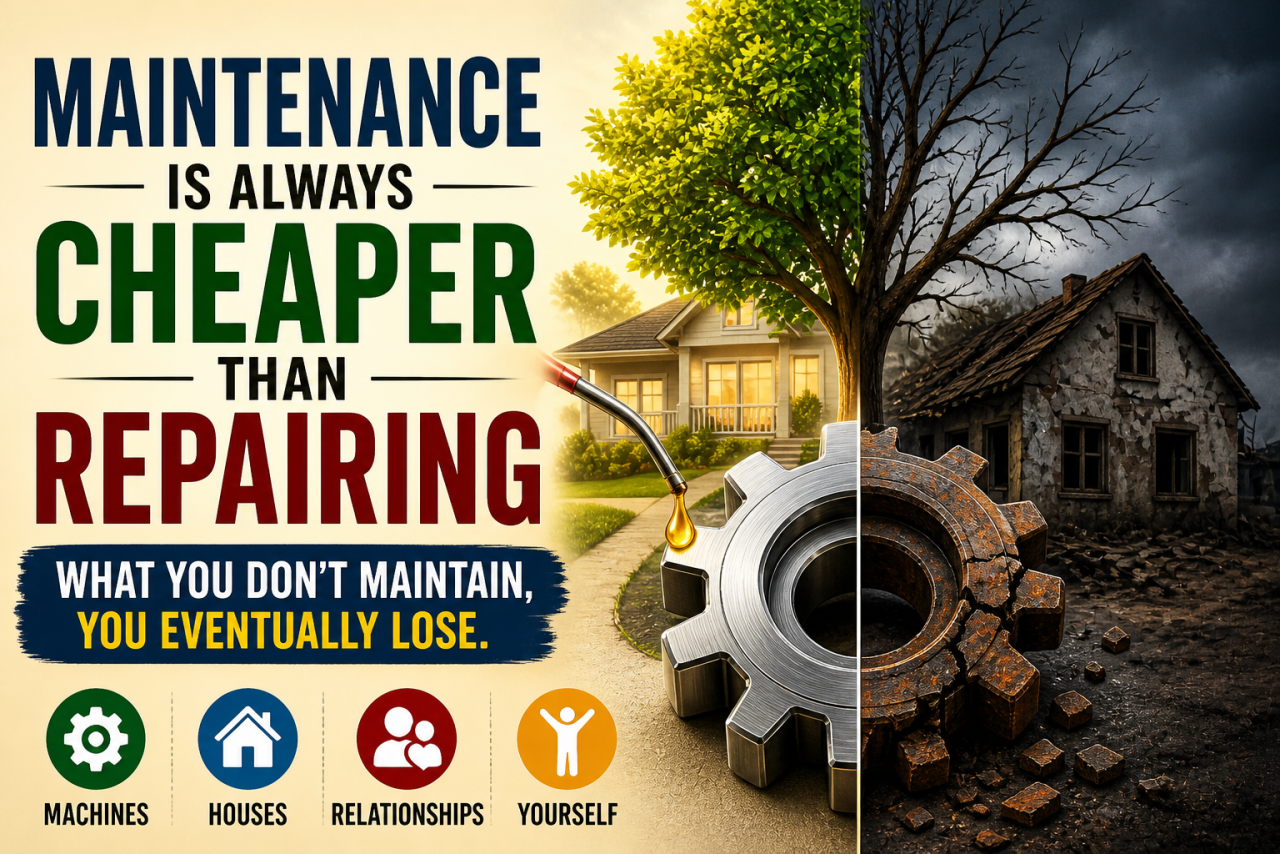
We don’t lose things all at once. We lose them little by little—when we stop caring for them.
There is a simple truth we often ignore in our daily lives:
What we don’t maintain, we eventually lose.
This idea applies to everything—machines, homes, health, and most importantly, relationships. Yet, many of us only realise its value when something breaks down. By then, repair becomes costly, painful, or sometimes even impossible.
Why Maintenance Feels Optional
Maintenance does not feel urgent. It is quiet, repetitive, and often invisible. Cleaning a room, checking in on a friend, taking care of your health, or investing time in your skills—none of these things give immediate results. They don’t feel dramatic or exciting.
Repair, on the other hand, forces attention. A broken machine stops working. A damaged relationship hurts. A neglected body shows signs of illness. Suddenly, what was once optional becomes urgent.
The irony is simple: maintenance always feels like effort, but repair always costs more.
The Machine We Ignore
Think about a machine. If you oil it regularly, clean it, and handle it with care, it runs smoothly for years. But if you ignore it, push it beyond limits, and never check on it, one day it stops working.
Life works the same way.
Your mind is a machine. Your body is a machine. Your habits are the system that keeps everything running. If you ignore them, burnout, stress, and fatigue are not surprises—they are outcomes.
Daily care may seem small, but it prevents major breakdowns.
The House That Slowly Falls Apart
A house doesn’t collapse in a day. It weakens slowly.
A small crack in the wall. A leaking pipe. A loose wire.
None of these feel urgent at first. But when ignored, they grow. And one day, the cost of fixing them becomes much higher than the cost of maintaining them.
Now think of your life structure—your routines, your discipline, your goals. If you stop maintaining them, they don’t disappear instantly. They fade slowly. And rebuilding them later takes far more effort than sustaining them daily.
Relationships Need the Most Maintenance
Perhaps the most important area where this quote applies is relationships.
People often believe that strong relationships don’t need effort. That if something is real, it will survive on its own. But the truth is the opposite.
Relationships don’t break suddenly. They weaken over time—through silence, neglect, lack of communication, and unspoken expectations.
A simple message, a small gesture, a few minutes of genuine conversation—these are acts of maintenance. They may feel small, but they hold relationships together.
When these are missing, distance grows. And once that distance becomes emotional, repairing it is far more difficult than maintaining connection in the first place.
The Cost of Waiting Too Long
One of the biggest mistakes people make is waiting for the “right time” to fix things.
“I’ll focus on my health later.”
“I’ll call them when I’m free.”
“I’ll get back on track next month.”
But life doesn’t pause. Neglect continues quietly. And by the time we decide to act, the situation has already worsened.
Maintenance works only when it is consistent. It is not about doing something big once. It is about doing something small, regularly.
The Discipline of Care
Maintenance is not about perfection. It is about discipline.
You don’t need to do everything right. You just need to show up consistently.
- Take care of your health before it forces you to.
- Invest in your relationships before they drift away.
- Work on your skills before they become outdated.
- Organise your life before it becomes overwhelming.
These are not big actions. They are small habits repeated over time.
And those small habits decide whether you build a stable life or constantly struggle to repair it.
A Simple Shift in Thinking
Instead of asking, “What needs to be fixed?”, start asking,
“What needs to be maintained?”
This shift changes everything.
You stop reacting to problems and start preventing them. You move from crisis management to conscious living. And slowly, life becomes less about damage control and more about steady growth.
Protect What Matters
In the end, life is not lost in one big moment. It is lost in small acts of neglect.
And it is built in small acts of care.
Whether it’s your health, your work, or your relationships—the principle remains the same:
Maintenance may feel boring, but it protects everything that matters.
Because what you care for, stays.
And what you ignore, slowly slips away.
There is a simple truth we often ignore in our daily lives:
What we don’t maintain, we eventually lose.
This idea applies to everything—machines, homes, health, and most importantly, relationships. Yet, many of us only realise its value when something breaks down. By then, repair becomes costly, painful, or sometimes even impossible.
Why Maintenance Feels Optional
Maintenance does not feel urgent. It is quiet, repetitive, and often invisible. Cleaning a room, checking in on a friend, taking care of your health, or investing time in your skills—none of these things give immediate results. They don’t feel dramatic or exciting.
Repair, on the other hand, forces attention. A broken machine stops working. A damaged relationship hurts. A neglected body shows signs of illness. Suddenly, what was once optional becomes urgent.
The irony is simple: maintenance always feels like effort, but repair always costs more.
The Machine We Ignore
Think about a machine. If you oil it regularly, clean it, and handle it with care, it runs smoothly for years. But if you ignore it, push it beyond limits, and never check on it, one day it stops working.
Life works the same way.
Your mind is a machine. Your body is a machine. Your habits are the system that keeps everything running. If you ignore them, burnout, stress, and fatigue are not surprises—they are outcomes.
Daily care may seem small, but it prevents major breakdowns.
The House That Slowly Falls Apart
A house doesn’t collapse in a day. It weakens slowly.
A small crack in the wall. A leaking pipe. A loose wire.
None of these feel urgent at first. But when ignored, they grow. And one day, the cost of fixing them becomes much higher than the cost of maintaining them.
Now think of your life structure—your routines, your discipline, your goals. If you stop maintaining them, they don’t disappear instantly. They fade slowly. And rebuilding them later takes far more effort than sustaining them daily.
Relationships Need the Most Maintenance
Perhaps the most important area where this quote applies is relationships.
People often believe that strong relationships don’t need effort. That if something is real, it will survive on its own. But the truth is the opposite.
Relationships don’t break suddenly. They weaken over time—through silence, neglect, lack of communication, and unspoken expectations.
A simple message, a small gesture, a few minutes of genuine conversation—these are acts of maintenance. They may feel small, but they hold relationships together.
When these are missing, distance grows. And once that distance becomes emotional, repairing it is far more difficult than maintaining connection in the first place.
The Cost of Waiting Too Long
One of the biggest mistakes people make is waiting for the “right time” to fix things.
“I’ll focus on my health later.”
“I’ll call them when I’m free.”
“I’ll get back on track next month.”
But life doesn’t pause. Neglect continues quietly. And by the time we decide to act, the situation has already worsened.
Maintenance works only when it is consistent. It is not about doing something big once. It is about doing something small, regularly.
The Discipline of Care
Maintenance is not about perfection. It is about discipline.
You don’t need to do everything right. You just need to show up consistently.
- Take care of your health before it forces you to.
- Invest in your relationships before they drift away.
- Work on your skills before they become outdated.
- Organise your life before it becomes overwhelming.
These are not big actions. They are small habits repeated over time.
And those small habits decide whether you build a stable life or constantly struggle to repair it.
A Simple Shift in Thinking
Instead of asking, “What needs to be fixed?”, start asking,
“What needs to be maintained?”
This shift changes everything.
You stop reacting to problems and start preventing them. You move from crisis management to conscious living. And slowly, life becomes less about damage control and more about steady growth.
Protect What Matters
In the end, life is not lost in one big moment. It is lost in small acts of neglect.
And it is built in small acts of care.
Whether it’s your health, your work, or your relationships—the principle remains the same:
Maintenance may feel boring, but it protects everything that matters.
Because what you care for, stays.
And what you ignore, slowly slips away.























Leave a Comment