
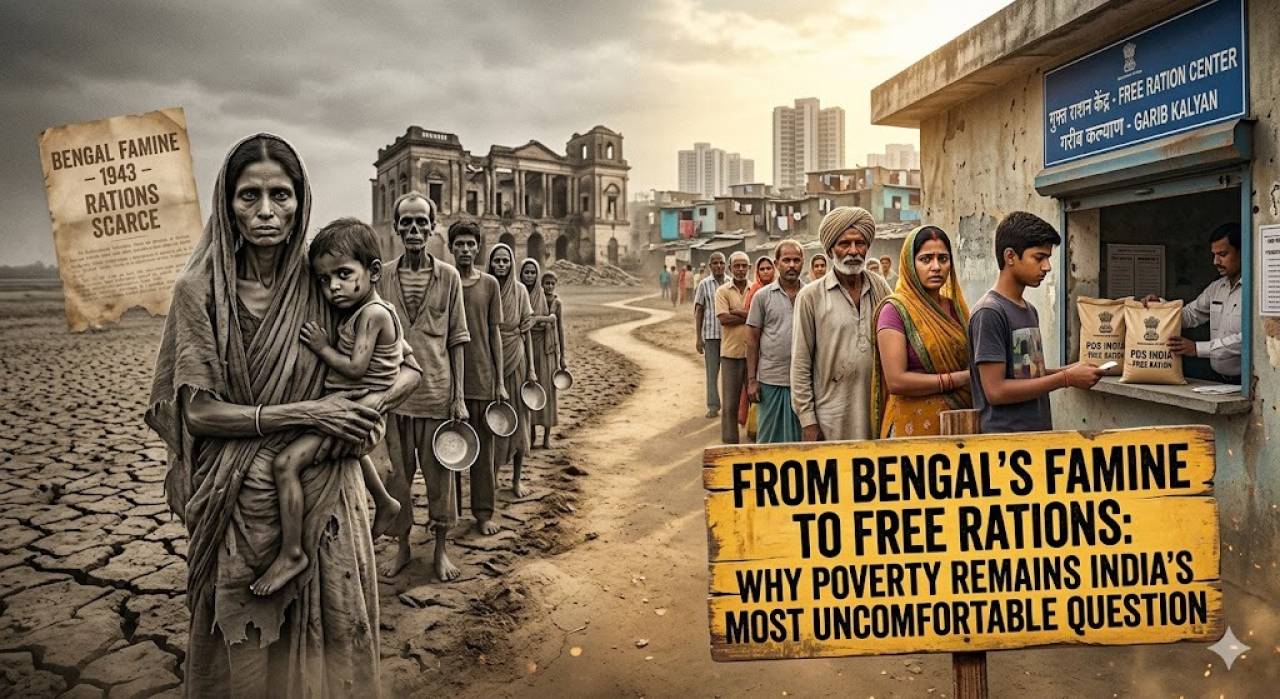
India is among the world's largest economies, yet over 80 crore people rely on food security schemes. Has the shadow of colonial poverty truly disappeared?
The haunting images of the Bengal Famine of 1943 are often presented as evidence of British colonial cruelty. Emaciated bodies, starving children, and millions of preventable deaths remain among the darkest memories of India's colonial past. The famine has become a symbol of how imperial policies, wartime priorities, and administrative indifference could turn food scarcity into a humanitarian catastrophe.
What is discussed far less, however, is a difficult question that extends beyond history: if colonial rule laid the foundations of mass poverty in India, why does poverty continue to shape the lives of millions nearly eight decades after Independence?
India became a free nation in 1947, but freedom did not erase the economic scars left behind by two centuries of colonial rule. The British departed, but the burden of poverty remained. Independent India inherited a country with low industrialization, poor literacy rates, weak healthcare infrastructure, low agricultural productivity, and widespread deprivation. The challenge before the new republic was not simply political self-governance but the reconstruction of an economy that had been shaped for imperial extraction rather than national development.
The scale of colonial economic decline remains a subject of extensive historical research. Economic historians estimate that India accounted for nearly 24 percent of the world's economic output in the early eighteenth century. By the time British rule ended, India's share had fallen dramatically. While global economic transformations played a role, colonial policies prioritized British industrial growth over Indian economic development. Revenue extraction, deindustrialization in several sectors, and repeated famines left lasting consequences.
The Bengal Famine of 1943 became the most visible expression of that reality. Between two and three million people are estimated to have died from starvation and famine-related diseases. The tragedy occurred not because food completely disappeared, but because millions lost the ability to access it. Wartime inflation, administrative failures, disruption of food distribution networks, and British policy decisions combined to create one of the deadliest famines of the twentieth century.
The role of Winston Churchill remains controversial. Historians continue to debate the extent of his responsibility, but there is little disagreement that the British government failed to respond adequately to the crisis. Churchill's dismissive attitude toward Indian concerns and his government's prioritization of wartime logistics over civilian relief have become central to discussions about colonial accountability.
Yet history alone cannot explain present realities.
India today is no longer a colonized nation. It is the world's most populous country, a nuclear power, a major technology hub, and according to recent international rankings, one of the four largest economies in the world by GDP. Modern India has achieved remarkable successes in agriculture, space technology, pharmaceuticals, digital payments, and infrastructure development.
At the same time, another reality exists alongside these achievements.
According to government figures, more than 80 crore Indians continue to receive subsidized or free food grains under the National Food Security Act and related welfare schemes. Following the COVID-19 pandemic, the Pradhan Mantri Garib Kalyan Anna Yojana expanded food support, and the government later integrated free grain distribution into the national food security framework. The continuation of these schemes reflects a significant achievement in welfare delivery, but it also highlights the scale of economic vulnerability that still exists.
The contradiction is difficult to ignore. India celebrates its rise as a global economic power while simultaneously supporting hundreds of millions of citizens through food assistance programs. Both facts are true. Neither can be ignored.
Supporters of government welfare policies argue that free ration schemes demonstrate the state's commitment to ensuring food security. They point out that no large-scale famine has occurred in independent India despite population growth and multiple economic crises. In this sense, India has succeeded where colonial administrations often failed.
Critics, however, ask a different question. If India has become one of the world's largest economies, why do such a large number of people still depend on government-supported food distribution for basic nutritional security? Economic growth, they argue, should ultimately reduce dependence on welfare rather than normalize it.
The answer lies partly in the distinction between economic growth and economic distribution. GDP measures the size of an economy, but it does not automatically reflect how prosperity is shared. A country can experience rapid growth while significant sections of its population continue to struggle with low incomes, underemployment, and limited access to quality education and healthcare.
This is where the legacy of colonial poverty intersects with contemporary policy challenges. Colonial rule may have created many of the structural conditions of deprivation, but independent India has had nearly eight decades to address them. Progress has undoubtedly occurred, yet the persistence of large-scale economic vulnerability suggests that the task remains unfinished.
The Bengal Famine should therefore be remembered not only as a chapter of colonial injustice but also as a reminder of a larger responsibility. Historical memory is important. The victims of famine deserve to be remembered, and colonial policies deserve scrutiny. But history cannot become a substitute for examining present realities.
A nation that carries the memory of millions who died from hunger must also confront the question of why so many citizens still require state support for food security. The debate is not about choosing between remembering the past and addressing the present. It is about recognizing that the two are connected.
The shadow of colonial poverty may explain where the journey began. Whether that journey finally ends depends on what India does with the freedom it gained in 1947.
The haunting images of the Bengal Famine of 1943 are often presented as evidence of British colonial cruelty. Emaciated bodies, starving children, and millions of preventable deaths remain among the darkest memories of India's colonial past. The famine has become a symbol of how imperial policies, wartime priorities, and administrative indifference could turn food scarcity into a humanitarian catastrophe.
What is discussed far less, however, is a difficult question that extends beyond history: if colonial rule laid the foundations of mass poverty in India, why does poverty continue to shape the lives of millions nearly eight decades after Independence?
India became a free nation in 1947, but freedom did not erase the economic scars left behind by two centuries of colonial rule. The British departed, but the burden of poverty remained. Independent India inherited a country with low industrialization, poor literacy rates, weak healthcare infrastructure, low agricultural productivity, and widespread deprivation. The challenge before the new republic was not simply political self-governance but the reconstruction of an economy that had been shaped for imperial extraction rather than national development.
The scale of colonial economic decline remains a subject of extensive historical research. Economic historians estimate that India accounted for nearly 24 percent of the world's economic output in the early eighteenth century. By the time British rule ended, India's share had fallen dramatically. While global economic transformations played a role, colonial policies prioritized British industrial growth over Indian economic development. Revenue extraction, deindustrialization in several sectors, and repeated famines left lasting consequences.
The Bengal Famine of 1943 became the most visible expression of that reality. Between two and three million people are estimated to have died from starvation and famine-related diseases. The tragedy occurred not because food completely disappeared, but because millions lost the ability to access it. Wartime inflation, administrative failures, disruption of food distribution networks, and British policy decisions combined to create one of the deadliest famines of the twentieth century.
The role of Winston Churchill remains controversial. Historians continue to debate the extent of his responsibility, but there is little disagreement that the British government failed to respond adequately to the crisis. Churchill's dismissive attitude toward Indian concerns and his government's prioritization of wartime logistics over civilian relief have become central to discussions about colonial accountability.
Yet history alone cannot explain present realities.
India today is no longer a colonized nation. It is the world's most populous country, a nuclear power, a major technology hub, and according to recent international rankings, one of the four largest economies in the world by GDP. Modern India has achieved remarkable successes in agriculture, space technology, pharmaceuticals, digital payments, and infrastructure development.
At the same time, another reality exists alongside these achievements.
According to government figures, more than 80 crore Indians continue to receive subsidized or free food grains under the National Food Security Act and related welfare schemes. Following the COVID-19 pandemic, the Pradhan Mantri Garib Kalyan Anna Yojana expanded food support, and the government later integrated free grain distribution into the national food security framework. The continuation of these schemes reflects a significant achievement in welfare delivery, but it also highlights the scale of economic vulnerability that still exists.
The contradiction is difficult to ignore. India celebrates its rise as a global economic power while simultaneously supporting hundreds of millions of citizens through food assistance programs. Both facts are true. Neither can be ignored.
Supporters of government welfare policies argue that free ration schemes demonstrate the state's commitment to ensuring food security. They point out that no large-scale famine has occurred in independent India despite population growth and multiple economic crises. In this sense, India has succeeded where colonial administrations often failed.
Critics, however, ask a different question. If India has become one of the world's largest economies, why do such a large number of people still depend on government-supported food distribution for basic nutritional security? Economic growth, they argue, should ultimately reduce dependence on welfare rather than normalize it.
The answer lies partly in the distinction between economic growth and economic distribution. GDP measures the size of an economy, but it does not automatically reflect how prosperity is shared. A country can experience rapid growth while significant sections of its population continue to struggle with low incomes, underemployment, and limited access to quality education and healthcare.
This is where the legacy of colonial poverty intersects with contemporary policy challenges. Colonial rule may have created many of the structural conditions of deprivation, but independent India has had nearly eight decades to address them. Progress has undoubtedly occurred, yet the persistence of large-scale economic vulnerability suggests that the task remains unfinished.
The Bengal Famine should therefore be remembered not only as a chapter of colonial injustice but also as a reminder of a larger responsibility. Historical memory is important. The victims of famine deserve to be remembered, and colonial policies deserve scrutiny. But history cannot become a substitute for examining present realities.
A nation that carries the memory of millions who died from hunger must also confront the question of why so many citizens still require state support for food security. The debate is not about choosing between remembering the past and addressing the present. It is about recognizing that the two are connected.
The shadow of colonial poverty may explain where the journey began. Whether that journey finally ends depends on what India does with the freedom it gained in 1947.

























Leave a Comment