
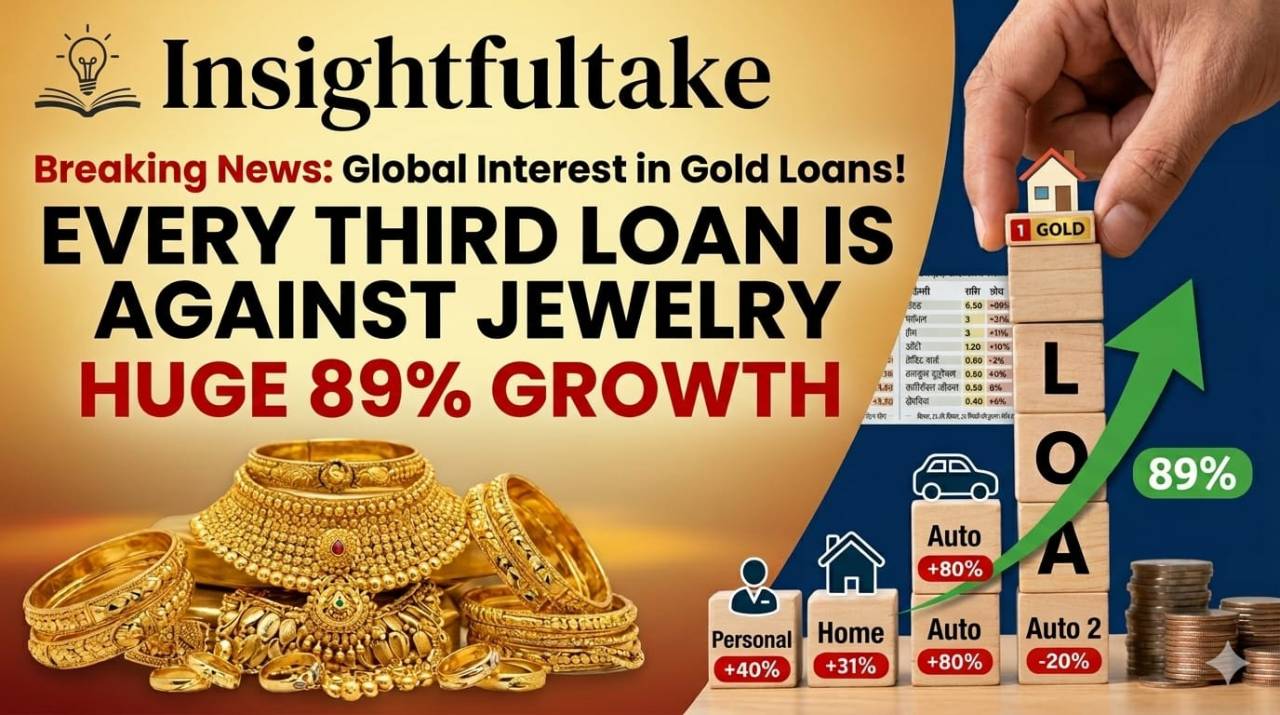
India’s borrowing story is changing fast—not with new credit, but with old gold, as millions turn their jewellery into the country’s most trusted source of loans.
India’s relationship with gold has always been emotional. In 2025–26, it became financial in a much deeper way. During the festive quarter from October to December, nearly one in every three loans issued in the country was backed by gold, marking one of the sharpest behavioural shifts in the history of India’s retail credit market.
The data comes from reports by credit bureaus and rating agencies that tracked lending during the peak festive season. The numbers show not just a seasonal spike but a structural change in how Indian households and small businesses are choosing to borrow.
A Surge That Goes Beyond Festive Spending
In Q3 FY26, gold loan sourcing jumped by 89% year on year, reaching about ₹6.5 trillion. The total loans issued across categories during the quarter stood at around ₹20 trillion, placing gold at roughly 32–33% of all new lending.
This growth was not an isolated data point. Another industry report showed gold loan disbursements nearly doubling to ₹8.16 trillion in the same period, confirming that the shift was broad-based across lenders and regions.
For context, this is one of the fastest growth rates recorded in any retail credit segment in India in recent years.
Gold Is No Longer a Last Resort
Traditionally, gold loans were associated with emergency borrowing. Families pledged jewellery only in distress. That perception is now fading.
Credit data shows that the number of gold loan accounts is growing steadily, but the bigger story is in the increase in ticket size. Borrowers are not just pledging gold more often. They are borrowing larger amounts against it. Rising gold prices have also increased the collateral value, allowing borrowers to raise more funds without pledging additional jewellery.
This trend indicates a shift from distress borrowing to planned borrowing.
Why Borrowers Are Moving Away from Credit Cards
Several factors have converged to push borrowers toward gold-backed credit.
First, interest rates on unsecured loans such as credit cards remain among the highest in the retail credit market. Second, regulators have tightened norms around unsecured lending, forcing banks to become more cautious in issuing such loans. This reduced easy credit availability.
Gold loans, by contrast, offer lower interest rates and faster processing. They require minimal documentation. The approval process often takes less than an hour. For many borrowers, especially in semi-urban and rural markets, this is the most practical form of formal credit.
The result is visible in portfolio data. Gold loans now account for close to 10% of India’s total retail loan portfolio, up from just over 8% a year earlier.
Banks and NBFCs Are Competing Aggressively
The growth in gold loans is not just demand-driven. Supply has also expanded. Public sector banks, private banks, and non-banking finance companies are all increasing their exposure to the segment.
Public sector banks still hold the largest share of outstanding gold loans. However, NBFCs have gained ground in new loan sourcing due to their faster processing and deeper reach in Tier-2 and Tier-3 markets.
This competition is improving access and lowering borrowing costs for customers.
Rising Gold Prices Are Fueling the Credit Cycle
The surge in gold loans cannot be separated from the rally in gold prices over the past two years. As the value of pledged jewellery rises, lenders can safely extend higher loan amounts while staying within regulatory loan-to-value limits.
This creates a feedback loop. Higher gold prices increase borrowing capacity. Increased borrowing boosts loan growth even if the number of borrowers rises only modestly.
It also explains why the gold loan portfolio in India expanded to over ₹15.6 lakh crore by late 2025, making it one of the fastest-growing segments in retail lending.
A Stabilising Force for the Banking System
From a banking perspective, the shift toward gold loans is positive. These loans have historically shown lower default rates because they are fully secured. In case of non-repayment, lenders can auction the pledged gold to recover dues.
This is one reason banks have been rebalancing their loan books toward secured lending after a period of rapid growth in unsecured products. The change improves asset quality and reduces systemic risk in the credit market.
It also helps explain why lenders are actively promoting gold loans through digital channels and doorstep appraisal services.
Small Businesses Are the Silent Drivers
While festive consumption is often highlighted, a large portion of gold loan demand is coming from small traders and self-employed individuals. They use gold loans to manage working capital, purchase inventory, or handle seasonal cash-flow gaps.
Unlike formal business loans, gold loans do not require detailed financial statements or collateral beyond jewellery. This makes them one of the few accessible credit options for informal sector entrepreneurs.
This segment is vast in India and remains underserved by traditional banking. Gold loans are effectively acting as a bridge between informal income streams and formal credit systems.
What This Means for India’s Credit Culture
The rise of gold loans reflects a deeper change in how Indians perceive debt. The earlier model was driven by easy availability of unsecured credit and rising consumption. The current model is more cautious and asset-backed.
This shift may have long-term consequences. A credit market dominated by secured lending is less vulnerable to sudden spikes in defaults. It also aligns more closely with the financial habits of Indian households, which historically preferred saving in physical assets rather than relying on debt.
In that sense, the gold loan boom is not an anomaly. It is a reversion to a culturally familiar form of finance, now integrated into modern banking systems.
The Road Ahead
Industry estimates suggest that the organised gold loan market could cross ₹15 trillion by March 2026, reaching this milestone earlier than previously projected due to sustained demand and high gold prices.
If current trends continue, gold loans may soon rival traditional personal loans in size and importance within India’s retail credit ecosystem.
For lenders, this segment offers stable returns and lower risk. For borrowers, it provides quick and relatively affordable liquidity. For the broader economy, it reflects a gradual shift toward more disciplined borrowing patterns.
Final Take
The headline number—every third loan backed by gold—captures attention. The deeper story is about structural change.
India is not reducing its reliance on credit. It is redefining it. Households and small businesses are increasingly leveraging assets they already own rather than accumulating expensive unsecured debt.
In a country that holds one of the largest private stocks of gold in the world, this shift was perhaps inevitable. The difference now is that formal lenders have built the systems to convert that idle wealth into a mainstream credit engine.
That engine is now running at full speed.


























Leave a Comment